Golf buggy hire guides
Practical, honest guides to hiring a golf buggy in the UK. What it costs, how delivery works, how to choose, and how to plan buggy transport for weddings, events and venues.
Start here
 10 minute read
How much does golf buggy hire cost in the UK
Golf buggy hire in the UK is priced from four things: how long you need the buggies, how many and which sizes, how far they travel to your venue, and any extras, with VAT on top. Delivery distance is the part that varies most, which is why an accurate price needs your venue address rather than a headline figure.
Read the guide 10 minute read
How golf buggy hire delivery works
We deliver the buggies to your venue, position them where you want, check they are charged and working, and show your nominated person how to drive and charge them. We collect at the agreed time afterwards. Delivery is priced by road distance from the nearest depot to your venue.
Read the guide 7 minute read
Electric versus petrol golf buggies for hire
We hire electric buggies rather than petrol, and for the events we serve electric is the better fit on the points that matter. It is quiet enough to run near a ceremony or bedrooms, it produces no fumes for enclosed spaces, its running costs and maintenance are lower, and it suits venues with noise or environmental conditions. The one thing electric asks for is charging, which is simple to plan. Petrol's only real advantage, refuelling in seconds, rarely matters once a hire is planned properly.
Read the guide 9 minute read
Golf buggy troubleshooting, a complete guide
Most electric golf buggy faults trace back to one of four areas: the batteries and their connections, the charger, the controller and solenoid, or the motor and drivetrain. Start with the simplest and cheapest checks, the battery connections and charge state, before assuming the worst, because a loose terminal mimics a dead controller.
Read the guide 6 minute read
Are golf buggies road legal in the UK
Most golf buggies are not road legal in the UK and cannot be driven on public roads. They are designed for private land: golf courses, estates, event sites and private grounds. Making a buggy road legal requires it to meet vehicle construction, lighting and registration standards that a standard buggy does not, which is why hire buggies are delivered by trailer and used off the highway.
Read the guide 7 minute read
How to choose the right golf buggy for hire
Choosing the right golf buggy means matching four things to your event: how many people or how much load it must carry, whether the job is passengers or equipment, the ground it has to cross, and whether any guest needs step-free access. Get those right and the size almost picks itself. We will work it through with you rather than leave you guessing.
Read the guide 5 minute read
How to drive a golf buggy
Driving a golf buggy is straightforward, and doing it safely comes down to common sense: keep the speed low, especially near people, do not overload it, take corners and slopes gently, and never let anyone ride who is not seated properly. A buggy is simple to drive, but it carries people and often operates among guests, so a calm, unhurried driver is the whole of it.
Read the guide- 7 minute read
Hiring versus buying golf buggies, which makes sense
Whether to hire or buy golf buggies comes down to how often you need them. Concentrated or occasional demand, a wedding season, an event, a summer, favours hiring, because you avoid the cost of a vehicle sitting idle most of the year along with its maintenance and storage. Steady year-round use starts to favour owning. Most venues sit closer to the hire side than they expect.
Read the guide - 4 minute read
Custom branded golf buggy hire for events
A hired golf buggy can carry your branding for an event, applied before delivery and removed afterwards. It works well for corporate events, product launches and brand activations, where a branded buggy is a moving presence that guests notice. It needs artwork and lead time agreed at booking, because branding is not something arranged at the last minute.
Read the guide - 6 minute read
What is a golf buggy
A golf buggy is a small, low-speed electric or petrol vehicle built to carry people and light loads over short distances on private ground. In the UK the ride-on vehicle is called a golf buggy; a golf cart usually means the small trolley that carries a bag of clubs, and a golf trolley the same. Most modern buggies are electric, seat two to eight, and are used well beyond golf: at weddings, events, estates, hotels and large sites where the walk between points is long.
Read the guide  8 minute read
How to buy a golf buggy: a complete guide
Buying a golf buggy comes down to a few decisions: new or used, electric or petrol, how many seats, and whether it is for a private estate, a business site or leisure. Electric suits most buyers for quiet running and low maintenance, and used suits a tighter budget as long as you check the battery and the history. Match the buggy to how and where you will use it first, then decide new or used within that.
Read the guide 9 minute read
A buyer's guide to hiring buggies for your organisation
Hiring golf buggies for an organisation comes down to specifying the job clearly, expecting the right paperwork, and comparing suppliers on substance rather than price alone. Decide passengers or payload, describe the site and ground honestly, confirm insurance and safety documents, and match the hire length to the actual need.
Read the guide 8 minute read
Who hires golf buggies and why
Golf buggies are hired by anyone who has to move people or equipment across a site too large to walk comfortably: weddings and events, estates and farms, hotels and golf clubs, hospitals and campuses, warehouses and factories, film sets and attractions. The common thread is distance, and a need that comes and goes rather than justifying a bought vehicle.
Read the guide 11 minute read
Planning golf buggy hire for your wedding day
A wedding buggy carries the couple and guests between the ceremony, photographs and reception, protecting the timeline at venues where those points are far apart. How many you need is set by the distance between them and how many people move at once, not by the guest count.
Read the guide 10 minute read
Golf buggy hire for events, the operator's guide
Golf buggy hire for events is about moving crew, kit, artists and medical teams across a site too large to walk, usually over several days. Size the fleet to the movements not the audience, plan ground and charging early, and put vehicles in your event safety plan.
Read the guide 7 minute read
Golf buggy safety, the complete guide
Golf buggy safety reduces to a short list applied consistently: competent adult drivers, passengers seated within the seat count with limbs inboard, walking pace near people, routes matched to the ground, care on slopes and in weather, and keys removed whenever the vehicle is parked. Buggies are forgiving vehicles, and almost every incident traces to one of those habits being skipped rather than to anything exotic.
Read the guide- 7 minute read
Golf buggy medical exemption at a golf club
Where a club restricts buggy use, it usually operates an exemption for golfers who cannot walk the course, granted on evidence of a medical condition. There is no national certificate and no standard form: each club sets its own policy, and the usual evidence is a letter from a GP or consultant confirming that walking the course is not possible. Ask your club's secretary for their policy first, because it is the club's decision to make.
Read the guide  10 minute read
Golf buggy makes explained: who builds what
Three marques dominate golf fleets in Britain: Club Car, E-Z-GO and Yamaha. Alongside them sit work-vehicle names such as Cushman, Bradshaw and Columbia, a scattering of low-volume specialists, and a newer group building buggies intended for road registration. From an owner's point of view the differences that matter are parts supply, who can service the machine locally, and how the drive is arranged. On a used purchase, condition and support decide far more than the badge does.
Read the guide 11 minute read
Golf buggies at a golf club: the complete guide
A club has six things to settle and they interlock. Whether to own the fleet or hire it. How many machines the demand actually justifies. Where they live and charge. Who may drive them and under what written rules. Where they may go, and in what weather. And what the safety file can produce if anyone ever asks. Access duties under equality law sit across all of it, and so does the insurer's view of how you store and charge.
Read the guide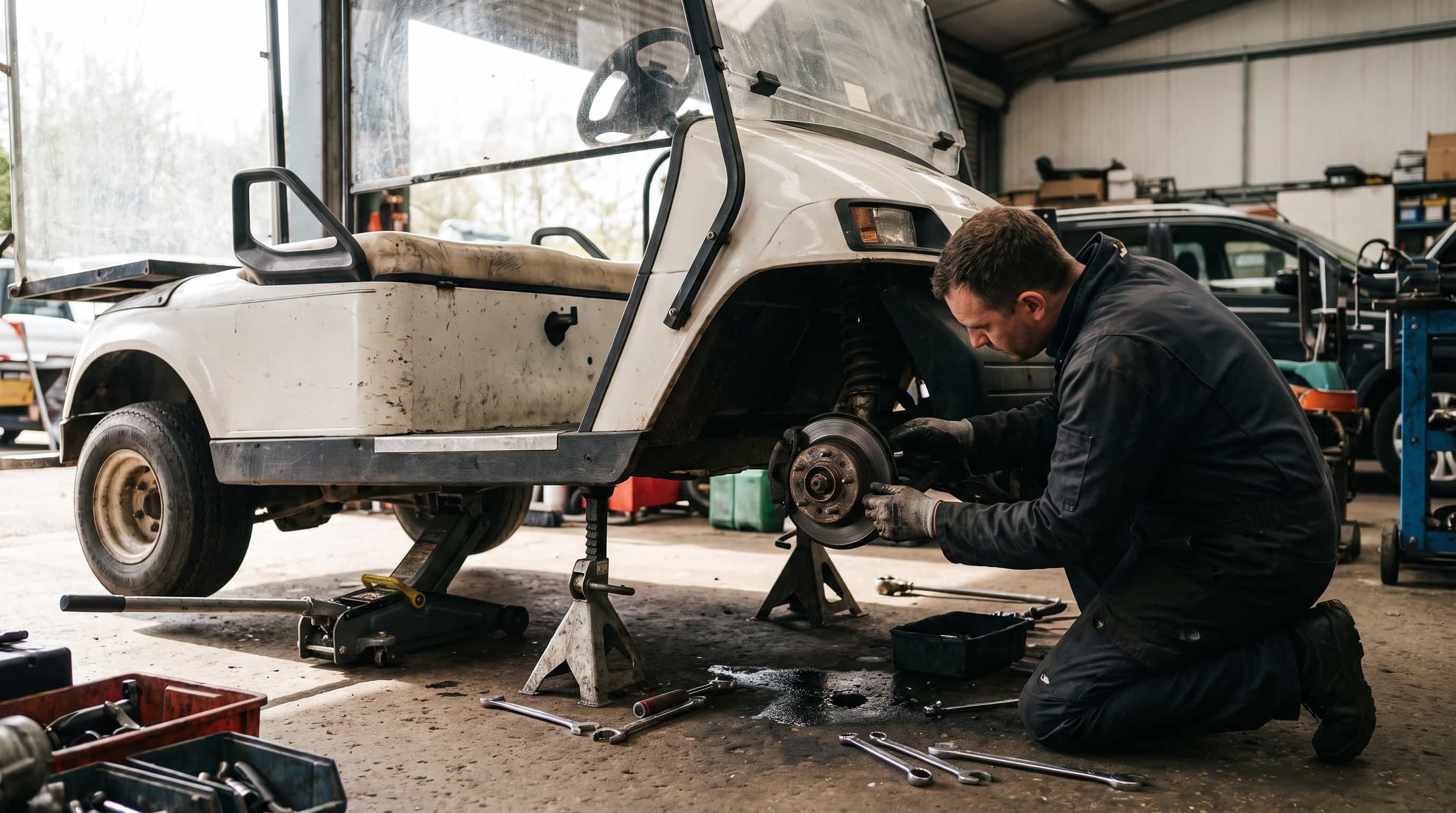 10 minute read
Golf buggy accessories: what is worth fitting
Start from what actually stops you using the machine, which is usually rain, darkness or a shortage of seats. Weather protection and lighting buy usable days, so they earn their place before anything cosmetic. Changes to seating or load change how the buggy stops and how it sits on a slope, so treat those as specification decisions rather than accessories. Comfort and on-board power are cheap and easy to add later. Settle fitting and warranty first, because a retro-fit often costs more than the part.
Read the guide- 9 minute read
Electric utility vehicles in the UK, a buyer's guide
An electric utility vehicle is a low-speed work vehicle built around a load bed rather than around passengers. It shares its motor, batteries and chassis thinking with a passenger buggy but is specified by payload, bed size and gradient rather than by seats. In the UK they are bought mostly by grounds teams, farms, estates, warehouses, councils and holiday parks, and they are chosen against a diesel gator or a compact tractor rather than against another electric machine.
Read the guide
Browse by topic
About golf buggies
What a golf buggy is, how it works, how fast it goes, what it weighs and what it costs.
Costs and pricing
What golf buggy hire costs and what drives the price.
Licensing, law and insurance
Licences, road rules, insurance and liability.
Weddings
Planning buggy transport for a wedding day.
Events and festivals
Moving guests, crew and VIPs at events.
Electric and sustainability
Why electric, range, charging and running.
Choosing the right buggy
Matching the buggy to your event and ground.
Delivery, logistics and on the day
How delivery, set-up and collection work.
Safety and operation
Driving safely and running buggies at an event.
Sector guides
Who hires buggies and why, by sector.
Hire versus buy
When hiring makes more sense than buying.
Buying a golf buggy
Choosing, checking, financing and owning a buggy of your own.
Accessibility and inclusion
Making events reachable for every guest.
Branding, experience and planning
Branded buggies and guest experience.
Business and fleet decisions
Hiring buggies for an organisation: procurement, insurance, safety files and budgeting.
Venues and settings
Choosing buggy transport for your venue type, from marquees and barns to castles, vineyards and the coast.
Seasonal and planning
Planning buggy transport through the year, from peak summer weddings to winter, wet weather and festival season.
Repairs and maintenance
Diagnosing faults, keeping a buggy running, and when to call an engineer.
Makes and models
Who builds golf buggies, what each model line is for, and how to tell which machine you are looking at.
Golf clubs and courses
Running buggies at a golf club: policy, access, fleet, ground conditions and the decisions a committee has to make.
Electric utility vehicles
Load beds, payloads and running costs for the electric work vehicles that are not golf buggies.
- Electric utility vehicles in the UK, a buyer's guide
- How much can an electric utility vehicle carry
- Two seater utility vehicles, and when two seats is the right answer
- Small electric utility vehicles for tight sites
- Tipping beds, and whether yours needs one
- Bed lengths, and what actually fits on one
- See all 26 guides
Accessories and upgrades
What is worth fitting to a buggy, what it changes, and what it costs you in weight, range or safety.
Titles in grey are being written and will be published as they are ready. We would rather publish a guide worth reading than fill the list with thin pages.
Ready to plan your event
Tell us the venue and dates and we will send an itemised quote within one working hour.