Golf buggies at a golf club: the complete guide
By James Brown · Updated 29 August 2026 · 11 minute read

A club has six things to settle and they interlock. Whether to own the fleet or hire it. How many machines the demand actually justifies. Where they live and charge. Who may drive them and under what written rules. Where they may go, and in what weather. And what the safety file can produce if anyone ever asks. Access duties under equality law sit across all of it, and so does the insurer's view of how you store and charge.
Key takeaways
- Storage and charging capacity usually constrain a club fleet more tightly than the number of machines does.
- Size the fleet from recorded requests and refusals across a season, not from estimates round a table.
- On private land the club sets the driver rules, which is exactly why they have to be written down and applied evenly.
- Staff driving buggies at work brings the employer's ordinary duties around training, maintenance and records.
- A blanket wet-weather ban needs to account for golfers with a medical need, under the duty to make reasonable adjustments.
- Publishing a scale of restriction, and naming who decides, makes the wet-weather call look like agronomy rather than mood.
- The safety file is a morning's work before an incident and close to impossible to assemble afterwards.
The decisions a club has to make
Buggies look like a small operational matter until the first complaint, the first wet Saturday or the first incident, at which point they turn out to touch the course, the members, the staff, the insurance and the accounts all at once. Treating them as one connected decision rather than six separate ones saves committee time, and it stops the club settling a question in March that it reopens in July.
The order matters, because answers upstream constrain the ones below them. There is no point agreeing a fleet size the store cannot charge overnight, and no point writing a driver policy nobody intends to enforce on a busy visitor day. Work down the list, write each answer down, and accept that two of them will be settled by the electrician and the insurer rather than by the committee.
- Own the fleet, hire it, or own a core and hire the peak.
- Fleet size, set by the demand you turn away rather than by ambition.
- Storage and charging, usually the binding constraint on everything else.
- Driver eligibility, briefing, and the written policy behind both.
- Routes, ground conditions, and the process for closing to buggies.
- The file: risk assessment, policy, checks, servicing, insurance, incidents.
Owning the fleet or hiring it
Ownership buys control and carries everything with it: capital, depreciation, battery replacement at end of life, servicing, storage, insurance, disposal and the staff time all of that quietly consumes. It suits clubs with steady year-round demand, somewhere proper to keep the machines, and a named person who will genuinely own the maintenance rather than merely intending to when the season allows. The last of those three is the one clubs consistently overestimate about themselves.
Hiring moves the maintenance, the replacement cycle and the residual risk to the supplier, and it matches spend to the season instead of to the balance sheet. Seasonal hire is the common arrangement for clubs whose demand concentrates in the warmer months. Contract hire over longer terms sits between the two and keeps a fleet current without a capital purchase or a disposal problem waiting at the end of it.
The hybrid is more common than either in practice. A club owns a small core fleet covering baseline demand and medical need all year, then hires machines for the season, the open week and society days. It costs more per machine at the peak and less across the year, and it avoids turning members away in July because the fleet was sized for February.
Working out how many
Size the fleet from demand you can evidence. Keep a simple record of buggy requests, refusals and the days when everything was out, for a full season, before anyone argues about numbers. That data settles more disagreements than any amount of estimating, and it shows which weeks the shortfall actually falls in, which is usually narrower than people remember at the committee table.
Some of the demand is not optional. Golfers who play with a buggy for medical reasons need one to be available, and treating that as first call on the fleet rather than as overflow is both the decent position and the safer one. Competition days, open events and society bookings create predictable spikes a base fleet cannot absorb, and those spikes are exactly what seasonal hire exists to cover.
Where they live, and the charging that decides it
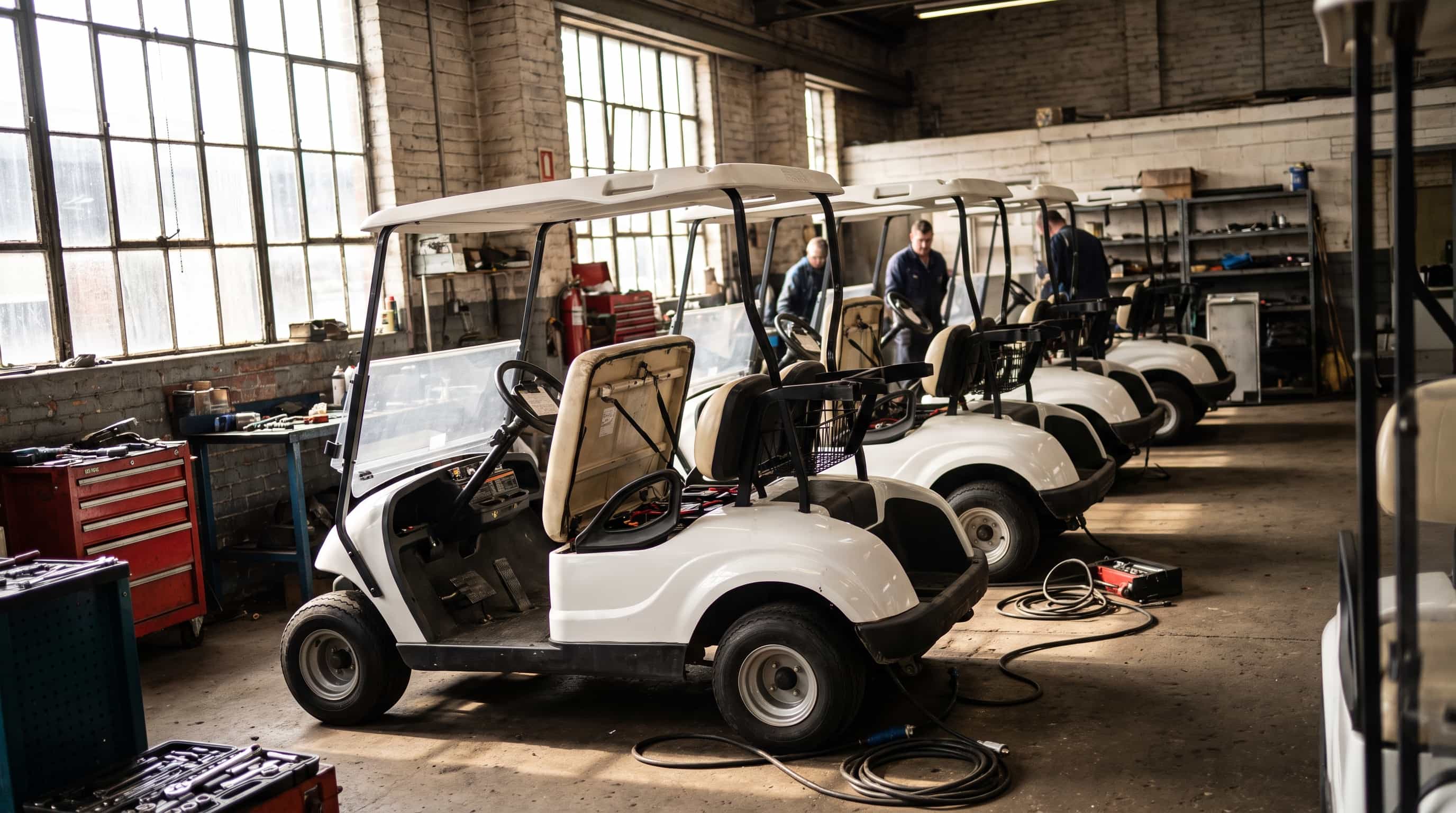
Storage is where most club buggy plans meet reality. The store needs mains power sized for the number of chargers, ventilation, a dry floor with sensible drainage, security, lighting, and enough room to walk round a machine and work on it. Retro-fitting all of that to a shed behind the greenkeeping compound is often the largest single cost in the fleet decision, and it is the one left out of the first paper.
The electrical installation is a job for a qualified electrician rather than for enthusiasm. Chargers running overnight in numbers put a sustained load on the supply, cable routing has to avoid trip hazards and damage, and the installation needs inspecting and recording. Battery chemistry changes the requirements: flooded lead-acid sets vent gas while charging and need ventilation and a watering routine, while lithium sets bring storage, charging and fire considerations your insurer will want addressed specifically.
The constraint people forget is charge turnaround rather than machine count. A buggy that comes back mid-afternoon needs its charge before it goes out again, and if the store cannot charge every machine overnight then the effective fleet is smaller than the one on the asset register. Count the charging points before counting the buggies, and tell the insurer what is stored and how it is charged.
- One charging point per machine, or a working fleet smaller than the fleet.
- A qualified electrician's installation, inspected and recorded.
- Ventilation and a watering routine wherever flooded lead-acid sets are used.
- Storage and charging agreed with the insurer and the fire risk assessment.
- Room to work on a machine indoors, because engineers visit in February too.
Who may drive one
On private land the club sets the rules, and that freedom is precisely why they have to be written down. The points to settle are a minimum age, whether a driving licence is required, whether members, visitors, guests and caddies are treated differently, whether a passenger may take over, and what briefing everyone receives before their first outing of the season rather than their first outing ever.
Staff are a different matter entirely. When greenkeepers, professionals or bar staff drive a buggy at work it is work equipment, and the employer's ordinary duties apply: suitable equipment, proper maintenance, training, competence and records showing all four. Contractors driving club machines need the same treatment. That paperwork is what an inspector or an insurer asks for after an incident, and it cannot be assembled retrospectively with any credibility.
Working out what this costs for your own event? Tell us the venue and dates and you will have an itemised written quote within one working hour.
Access, exemptions and reasonable adjustments
For many golfers the buggy is the difference between playing and stopping, which puts the subject squarely inside the Equality Act 2010 and its requirement that service providers make reasonable adjustments so disabled people are not put at a substantial disadvantage. A club is a service provider for these purposes, and a blanket buggy ban affects disabled golfers differently from how it affects everybody else.
There is no single national exemption document that every club recognises, so each club sets its own evidence policy, and the sensible ones keep it proportionate and private. Check your national governing body's current guidance rather than copying a neighbouring club, and take your own advice on the wording. The practical questions are what evidence you ask for, who sees it, and how long it stands.
That last question causes the most trouble. A wet-weather closure making no provision for golfers who cannot walk the course is worth thinking through calmly in advance, with the greenkeeping reasoning written down and an alternative at least considered, rather than being settled early on a Saturday under pressure at the counter. Our guides on medical exemptions and on wet-weather bans take both sides of it further.
The course itself
Buggies and turf are a managed relationship, and the course manager should own it. Wear concentrates where machines turn, stop and queue, so damage shows at tees, near greens, at path exits and on the same corners every year. The controls are familiar: defined routes, distance rules keeping machines away from greens, tees and bunkers, roping and signage that moves as the wear moves, and a willingness to change a route before the ground gives up.
Ground conditions decide the rest. Winter play, saturated ground and frost each change what a machine does to turf, and most clubs handle that with a scale of restriction rather than a single switch. Publishing the scale, and naming who makes the call, makes the decision look like agronomy rather than mood. Record each one with the date, the conditions and what members were told, because that answers the complaint arriving a fortnight later.
- Defined buggy routes, reviewed each season rather than set once.
- Distance rules around greens, tees and bunkers, signed and enforced evenly.
- A published scale of restriction, from full access through paths only to closed.
- A named person who makes the call, and a record of each decision.
- Wear hotspots watched, with routes changed before the turf gives up.
Members, money and the friction
Buggies generate income and complaints in roughly equal measure. The income side is straightforward: hire charges, society and visitor packages, and the ability to keep members playing who would otherwise have resigned. The complaint side is about noise near the tee, pace of play, damage to turf, machines standing where they should not be, and the perception that the rules are applied to some people and not to others.
Most of that is answered by publishing the rules and applying them to everyone, including committee members and the professional. Say plainly who may hire, on what terms, what happens to the deposit or the account if a machine is damaged, and what the club does about a driver who ignores route restrictions. A club that has never written down the consequence does not, in practice, have one.
The safety file
The file is the club's answer to the question that follows an incident, an insurance renewal or an inspection: show us how you manage this. It is not elaborate, and assembling it is a morning's work if it is done before it is needed rather than during the week it is needed most. Keep it where the secretary and the course manager can both reach it, and review it once a year alongside the risk assessment.
It should hold the risk assessment for buggy use on the course and in the store, the written buggy policy covering driver eligibility and route restrictions, the hire agreement wording checked by the club's own adviser, evidence that drivers were briefed, the daily and weekly check records, servicing and battery records for each machine, the electrical inspection record for the charging installation, the insurance schedule, and an incident log.
Two of those deserve emphasis. Insurance is a question for the club's broker and nobody else: describe the use honestly, including visitors and staff driving and any machines hired in, and get the answer in writing. And the incident log matters most when it is boring, because a record of near misses is what lets a club change a route or a rule before something serious happens on it.
Common questions
- Should a golf club buy or hire its buggies?
- It depends on how concentrated the demand is and whether the club has somewhere proper to keep and charge machines. Steady year-round demand and a decent store favour ownership. A short busy season favours hire. Many clubs land on a small owned core covering baseline and medical demand, with hired machines carrying the season and the event days.
- How many buggies does a golf club need?
- Enough to cover the days you currently turn people away, plus the medical demand, plus the events that spike. The real limit is often charging rather than machines: if the store cannot charge every buggy overnight, the working fleet is smaller than the one on the register. Record requests and refusals for a season and size it from that.
- Can a golf club stop a member using a buggy?
- It can set and enforce course conditions, including closing the course to buggies when the ground demands it. What it should not do is apply a blanket rule without considering golfers who play with a buggy for medical reasons, since the duty to make reasonable adjustments applies. Take advice on your own policy wording and check your governing body's current guidance.
- Do golf club staff need training to drive a buggy?
- Yes, in substance. When staff drive at work the buggy is work equipment, and the employer's duties around suitable equipment, maintenance, training and competence apply to it. That does not mean a formal qualification, but it does mean a documented briefing, a competent person signing it off, and records you can produce later. Contractors on club machines need the same.
- Who pays when a member damages a club buggy?
- Whatever the hire agreement says, which is why the wording matters and why it should be checked by the club's own adviser rather than copied from another club's website. Set out how damage is assessed, what the member is liable for, and what happens where a driver breached the route rules. Members accept a clear rule far more readily than an improvised one.
- How long does a club buggy fleet last?
- Longer than most clubs expect on the vehicle and shorter on the battery sets, which are the consumable that sets the replacement rhythm. Rounds driven, terrain, charging discipline and storage all move it, so no general figure would be honest. Track each machine's battery age and servicing, and let that rather than the calendar drive replacement planning.
Ready to get a price
Tell us about your event and we will send an itemised written quote within one working hour.
Related pages
Related guides
 Writing a buggy policy for your golf club11 minute read
- England Golf and buggy access: what a club policy should cover11 minute read
- Buying golf buggies for a golf club6 minute read
 Seasonal golf buggy hire for golf clubs5 minute read
 Golf buggy medical exemption at a golf club7 minute read
 Buggy bans in wet weather: how clubs decide11 minute read