Golf buggy medical exemption at a golf club
By James Brown · Updated 2 September 2026 · 7 minute read

Where a club restricts buggy use, it usually operates an exemption for golfers who cannot walk the course, granted on evidence of a medical condition. There is no national certificate and no standard form: each club sets its own policy, and the usual evidence is a letter from a GP or consultant confirming that walking the course is not possible. Ask your club's secretary for their policy first, because it is the club's decision to make.
Key takeaways
- There is no national buggy exemption certificate in the UK. Each club sets its own policy.
- Ask the club secretary for their written policy before arranging any medical evidence.
- Evidence is usually a letter confirming you cannot walk the course, not a diagnosis.
- A club restricting buggies still has duties towards disabled golfers under equality law.
- Exemptions and course-condition closures are separate: a wet course can close to all buggies.
What an exemption actually is
Some clubs allow buggies freely. Others restrict them, whether by limiting them to certain competitions, certain times of year, or certain golfers. Where a restriction exists, most clubs run an exemption alongside it: a golfer who cannot walk the course may use a buggy even when others may not.
It is worth being precise about what that means, because the language causes trouble. The exemption is from the club's own rule. It is not a licence, not a legal document, and not something issued by any national body. A golfer who has one at one club has no automatic standing at another, and a visitor should expect to raise it again when playing away.
There is no standard certificate
People search for a "golf buggy medical certificate" expecting a form, and there is not one. England Golf, Scottish Golf, Wales Golf and Golf Ireland do not issue a national buggy card, and the R&A's rules of golf govern how a competition is played rather than who may use transport to play it.
What exists instead is each club's own policy, and they vary widely. Some ask for a letter and keep it on file. Some ask the medical committee or the secretary to review it. Some grant an exemption for a season and ask for it to be renewed. Some ask for nothing more than a conversation. Because of that variation, the first and most useful step is always the same: ask your club for their policy in writing before you arrange anything else.
What a supporting letter is usually asked to say
Where a club does ask for medical evidence, what it generally needs to establish is a functional point rather than a clinical one: that walking the course, or walking it repeatedly, is not something you can do. It rarely needs a diagnosis, and you are not obliged to volunteer one.
That distinction is worth holding on to when you speak to your GP. A letter saying that a named patient is unable to walk a golf course and would be able to play with the use of a buggy answers the club's question completely, and does so without putting your medical history into a club file. Practices often charge for a letter of this kind, because it falls outside NHS work, and it is reasonable to ask what the fee will be first.
- Ask the club what they require, and in what form, before booking anything with a practice.
- A letter confirming you cannot walk the course is usually enough; a diagnosis usually is not needed.
- Ask about the fee, as this is normally private rather than NHS work.
- Keep a copy. You will need it again if you move clubs or play as a visitor.
- Ask how long the club treats it as valid, and whether renewal is required.
Where equality law sits alongside the club's policy
A club's freedom to set a buggy policy is not unlimited. Golf clubs providing services to the public, and members' clubs in their treatment of members and guests, have duties towards disabled people under the Equality Act 2010, and one of those duties is to make reasonable adjustments so a disabled person is not put at a substantial disadvantage.
Allowing a buggy where others walk is a very common example of exactly such an adjustment. That does not make it automatic, and what counts as reasonable depends on the circumstances, including genuine considerations about the course itself. But it does mean a flat refusal to consider any buggy use at all is a position a club should be able to explain, and a golfer is entitled to ask for that explanation in writing.
This is a general description of how the duty is usually understood and not legal advice. If a club refuses and you believe you have been discriminated against, organisations such as Citizens Advice and the Equality Advisory and Support Service can advise on your position.
Working out what this costs for your own event? Tell us the venue and dates and you will have an itemised written quote within one working hour.
The one refusal that is not about you
There is a second reason a club says no to a buggy, and it catches people out because it arrives without warning and it feels personal. Courses close to buggies in wet conditions, during frost, and while ground is recovering, because the wheels do real damage to soft turf.
That is a course-condition decision applying to every buggy on the property, exemption or not, and no letter overrides it. Clubs that restrict buggies this way usually have a stated policy on when it applies, and some operate a limited path-only arrangement in marginal conditions. It is worth asking about at the same time as the exemption, so that a winter refusal does not come as a surprise.
Why this is a better moment to ask than last year
England Golf publishes guidance for affiliated clubs on transportation and buggy use, and the direction of the current document is clear enough to plan around: buggy use by a golfer who cannot walk the course is treated as an access question rather than a favour granted at committee discretion. Read the published document itself rather than anybody's summary of it, ours included.
The practical consequence is that a good many clubs are revisiting policies that were written years ago and never looked at again. If you were told no at a club before, that answer may simply predate the guidance the club is now working to, and it is worth asking again rather than assuming the position is fixed.
How to ask, in a way that is easy to say yes to
The request that works is specific and low-effort for whoever receives it. Ask for the club's written policy first rather than opening with the request itself, because it tells you who decides and on what grounds, and it turns the conversation into one about an existing rule rather than an exception.
Then put the request in writing, name the dates or the pattern of play, and say what you are asking for precisely. A committee can approve a clear request quickly; a vague one waits for a meeting.
- Ask for the current written policy, and who administers it.
- Say when you want to play and how often, not just that you want a buggy.
- Offer the supporting letter rather than waiting to be asked for it.
- Ask what happens in wet weather, because that is where most policies bite.
- Ask whether a hired buggy is treated differently from the club's own fleet.
Common questions
- Is there a national golf buggy exemption certificate in the UK
- No. There is no national scheme and no standard form. Exemptions are granted by individual clubs under their own policies, so a certificate from one club carries no automatic weight at another.
- Does my GP letter need to name my condition
- Usually not. What a club generally needs to know is that you are unable to walk the course. A letter confirming that, and that a buggy would let you play, answers the question without disclosing your medical history.
- Can a club refuse a buggy even with a medical letter
- It can in some circumstances, most commonly when the course is closed to all buggies because of ground conditions. A blanket refusal to consider buggy use at all is a different matter, and clubs have duties towards disabled golfers under the Equality Act 2010.
- Can I hire a buggy for a single round rather than buy one
- Many clubs keep buggies for members and visitors to hire by the round, so ask the professional's shop first. Hire from an outside supplier is more usual for societies, competitions and event days, where several buggies are needed at once.
- My club said no a few years ago. Is it worth asking again
- Often yes. National guidance on buggy use has moved and a good many clubs are rewriting policies that had not been looked at in years, so an old refusal may predate the position the club now works to. Ask for the current written policy rather than repeating the original request, and take it from there.
- Can I use a hired buggy rather than the club's own
- That is the club's decision and it is worth asking explicitly, because some policies treat a hired vehicle differently from the fleet on site. Where a club is happy for you to bring one, we deliver to the course and collect afterwards, so it does not depend on the club having a spare buggy free on the day.
Ready to get a price
Tell us about your event and we will send an itemised written quote within one working hour.
Related pages
Related guides
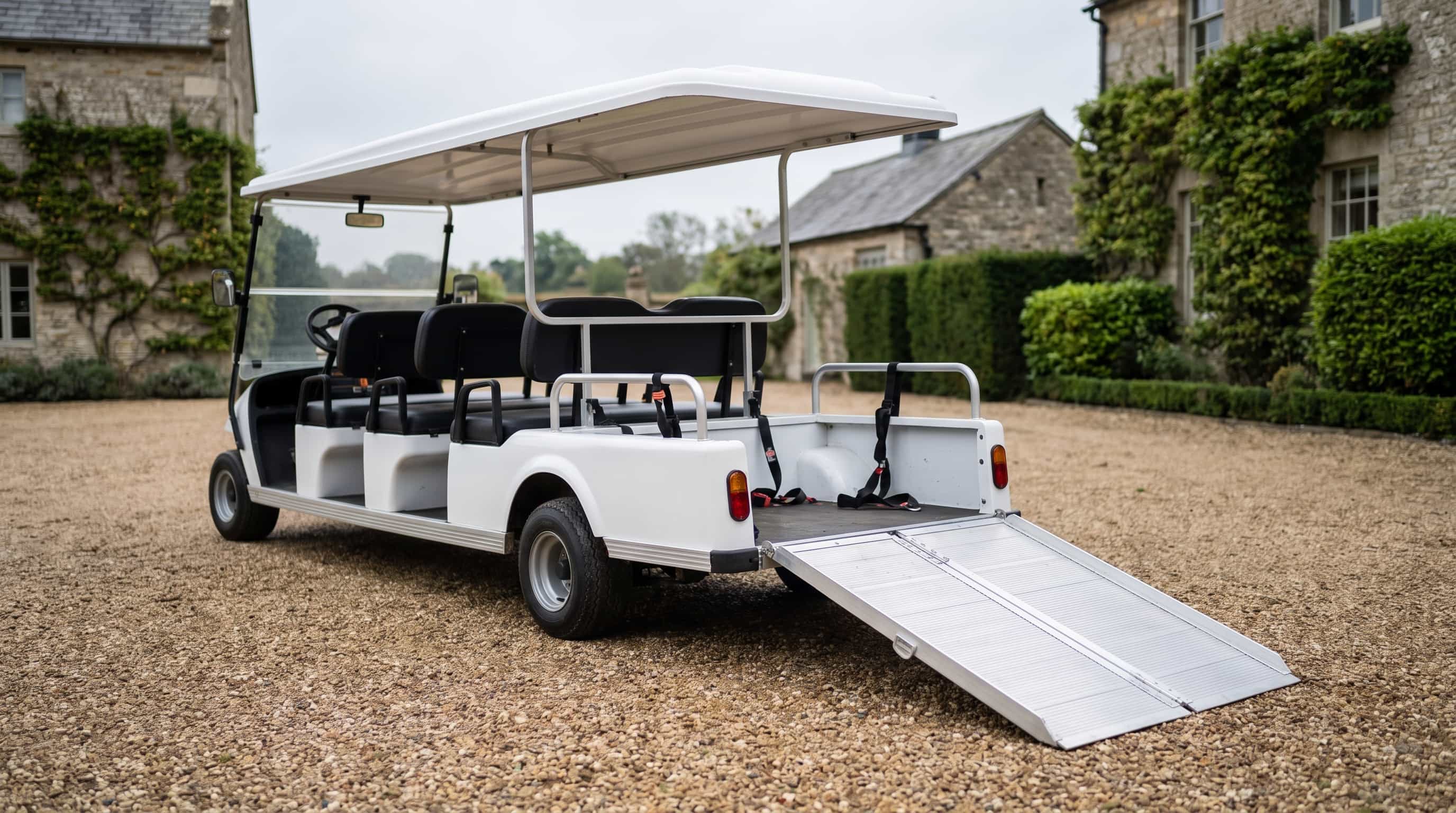 Golf buggies and the Equality Act7 minute read
 Planning accessible routes at large venues5 minute read
 Buggies for guests with limited mobility6 minute read
 England Golf and buggy access: what a club policy should cover11 minute read
- Who may drive a hired golf buggy5 minute read
- Supporting elderly guests at events4 minute read