Buggies for guests with limited mobility
By James Brown · Updated 21 July 2026 · 6 minute read

Buggies help guests with limited mobility reach every part of a venue or event they could not manage on foot: older guests, those recovering from injury or illness, anyone who tires quickly or cannot walk far. It is a broader group than wheelchair users, and the transport should be comfortable, easy to board and run with care.
Key takeaways
- Limited mobility covers far more people than wheelchair users alone.
- Many guests who need help would never describe themselves as disabled.
- Comfort and an easy step in and out matter as much as the ride itself.
- A careful, patient manner is part of the service.
- Offering it openly means guests use it rather than struggling quietly.
A bigger group than you think
When people plan accessibility they often think first of wheelchair users, and rightly, but the larger group is everyone else with limited mobility. Older guests who cannot walk a long distance, someone recovering from an operation or an injury, a guest with a heart or lung condition, a person who simply tires quickly, an expectant mother late in pregnancy. None of them may use a wheelchair, and many would never call themselves disabled, but all of them feel a large venue's distances keenly.
Planning for that broader group is what makes a venue genuinely comfortable rather than technically compliant. The wheelchair-access provision matters, and so does having ordinary passenger buggy capacity for the many guests whose need is real but less visible.
The barrier is often quiet
A guest with limited mobility rarely announces it. More often they quietly weigh up whether they can manage the walk, and either push through it uncomfortably or decide to miss the part of the day it leads to. Neither is what a host wants. The point of buggy transport for these guests is to remove that quiet calculation, so reaching the far part of the venue is not something they have to steel themselves for or give up on.
That is why offering the transport openly matters. A guest who knows a buggy is available, and that using it is normal and expected, will take it. A guest who would have to ask for a special favour often will not, and misses out rather than making a fuss. How the service is offered shapes whether it is used.
Comfort and boarding
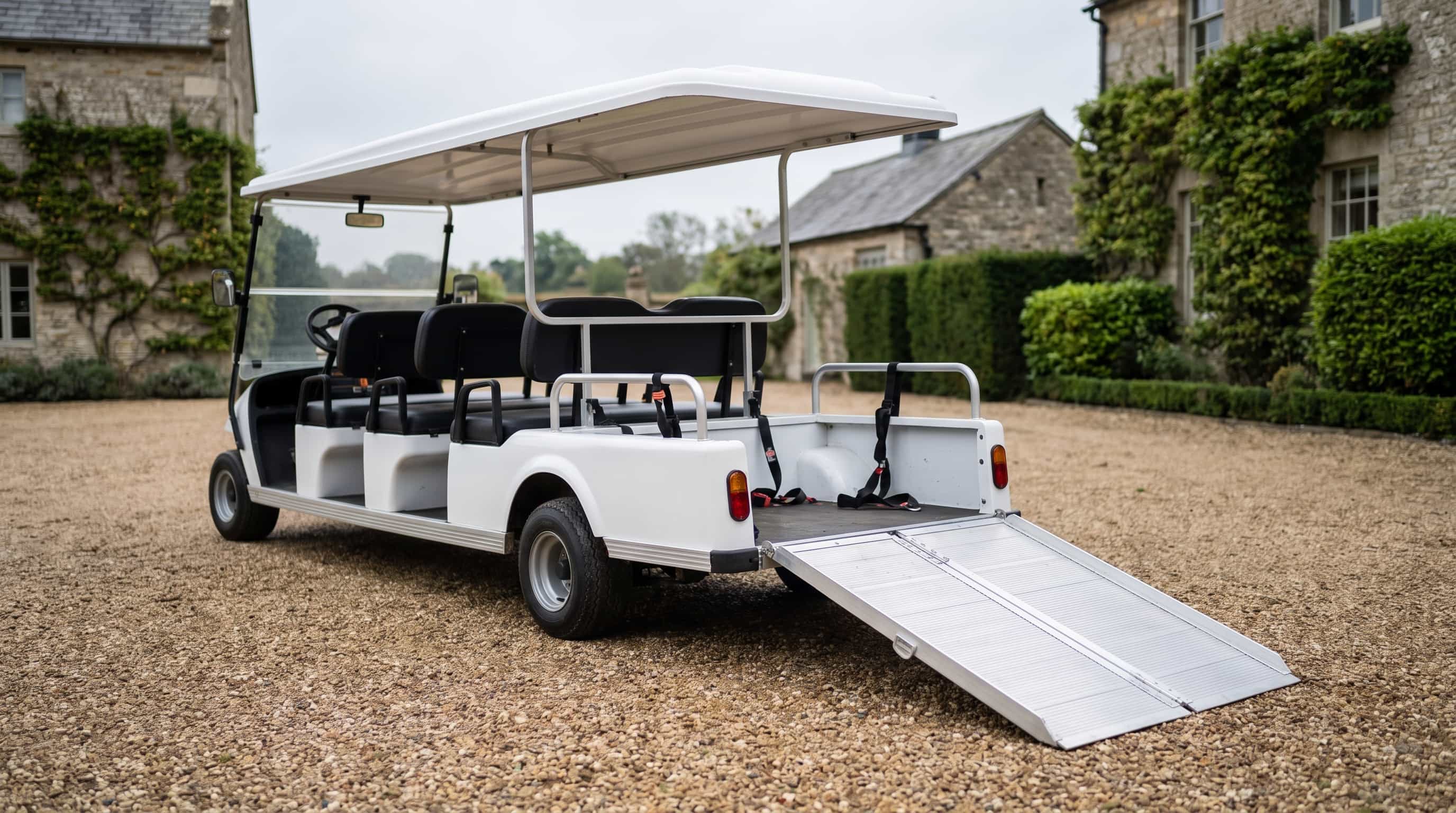
For these guests, the practical detail of the vehicle matters. A comfortable seat, and above all an easy step in and out, make the difference between a buggy that genuinely helps and one that is itself a struggle to use. A guest who finds boarding difficult has not really been helped. Where a guest cannot manage a standard step, the wheelchair-access vehicle removes the boarding problem entirely. Matching the vehicle to the guest is part of doing this well.
Working out what this costs for your own event? Tell us the venue and dates and you will have an itemised written quote within one working hour.
A careful, patient manner
As with any transport for less able passengers, the manner is part of the service. Low speeds, no rush, a patient hand helping someone board, and a driver who understands that the passenger may be frail or in discomfort: these are what make the buggy a kindness rather than just a lift. Run with care, it lets a guest with limited mobility take part fully and comfortably, which is the whole point of providing it.
Common questions
- Who counts as having limited mobility
- A far broader group than wheelchair users: older guests, people recovering from injury or illness, those with heart or lung conditions, anyone who tires quickly or cannot walk far, and expectant mothers late in pregnancy. Many would not call themselves disabled.
- Why offer the transport openly
- Because guests with limited mobility rarely announce it and often quietly decide to struggle on or miss out rather than ask a favour. Offering the buggy openly, as a normal part of the event, means they use it instead of going without.
- What makes a buggy genuinely helpful for these guests
- Comfort and an easy step in and out, so boarding is not itself a struggle, plus the wheelchair-access vehicle where a standard step is too much. Matching the vehicle to the guest is part of doing it well.
- Does the manner of the service matter
- Yes. Low speeds, no rush and a patient, understanding driver are what make the buggy a kindness rather than just a lift, and they let a guest who may be frail or in discomfort take part fully and comfortably.
Ready to get a price
Tell us about your event and we will send an itemised written quote within one working hour.