Golf buggy loses power uphill
By James Brown · Updated 21 July 2026 · 5 minute read
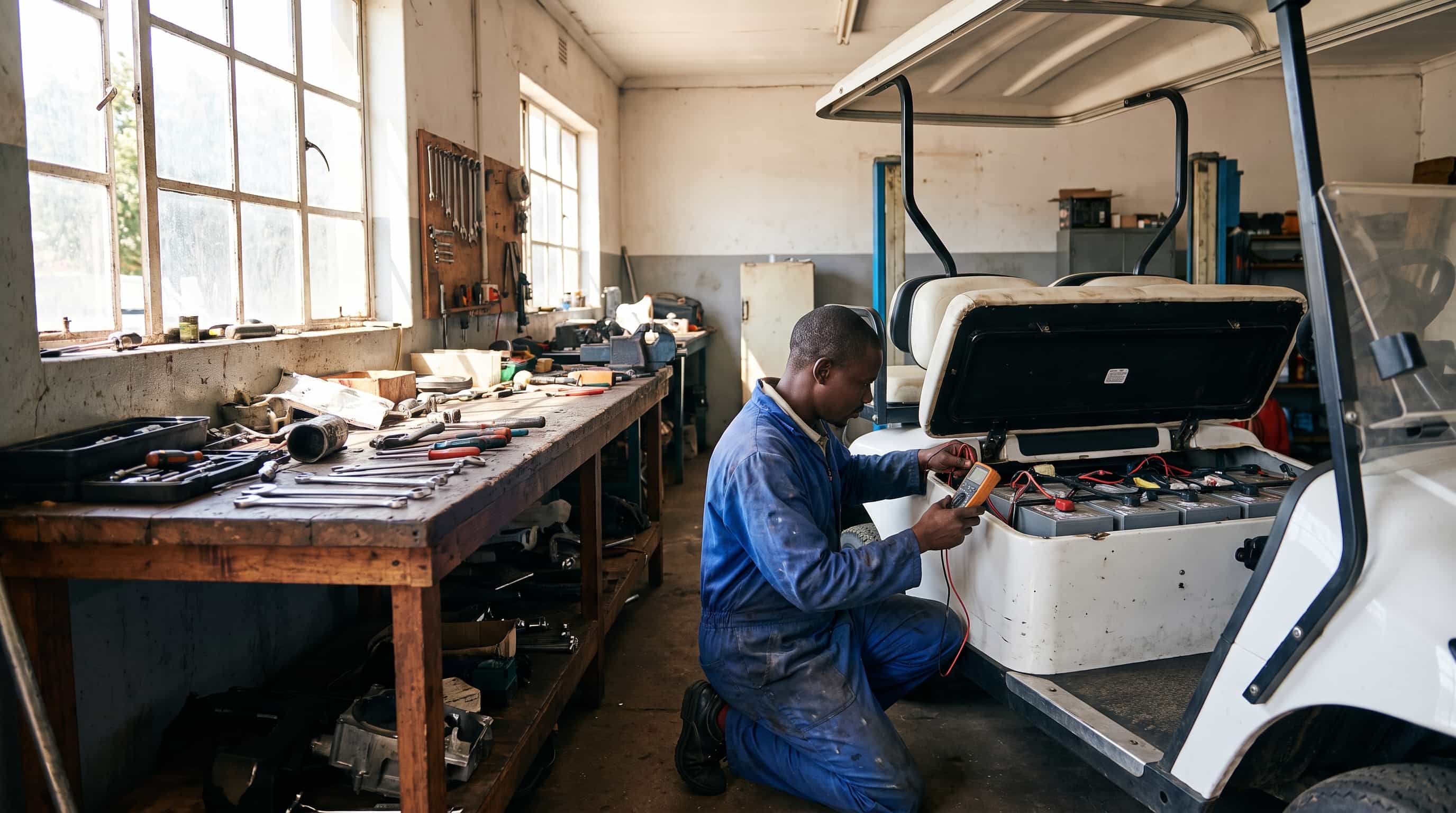
A golf buggy that loses power uphill is most often showing a tired battery set: a hill demands the most from the batteries, so weakness shows there first. Overloading and a controller cutting back to protect itself are the other causes. Check the charge state and battery health before assuming a motor fault.
Key takeaways
- A hill is the hardest demand on the batteries, so a weak set shows there first.
- Check charge state before anything: a low set slows on hills long before it dies flat.
- Overloading has the same effect, so count the passengers and the load.
- A controller can cut power to protect itself from heat or over-current.
- If the batteries are healthy and the load is sensible, then it is worth an engineer.
Why hills expose battery weakness
Climbing a slope is the single most demanding thing you ask of a buggy. It draws the most current, and current is exactly what a tired battery set struggles to deliver. So a set that seems fine on the flat can sag noticeably on a hill, because the hill is asking for more than it can still give.
This is why loss of power uphill is so often a battery story rather than a motor one. The flat ground masks the weakness and the slope reveals it.
Check charge and load first
Start with the state of charge. A buggy at half charge will climb a hill more slowly than the same buggy full, and near the bottom of its charge it may barely climb at all. If it slows on hills late in the day but not in the morning, that is a charge and battery-health picture, not a fault.
Then count the load. Buggies are rated for a number of people and a weight, and a hill with four adults aboard is a very different ask from the same hill with one. Persistent overloading both slows the climb and shortens the life of the batteries doing the work.
The controller protecting itself
Controllers monitor their own temperature and current draw, and if either climbs too high, they cut power back deliberately to avoid damage. On a long or repeated hill climb, particularly on a hot day, this can feel like the buggy fading.
That is the controller doing its job rather than failing. If power returns once things cool or the demand eases, protective cut-back is the likely explanation rather than a fault.
If yours is doing this and the checks here have not settled it, we diagnose and repair buggies, including a callout to wherever it is.
When it is worth a proper look
If the batteries are healthy and fully charged, the load is within rating, and the buggy still cannot climb a hill it used to manage, then the fault is worth diagnosing properly. It could be the motor, the controller or the drivetrain, and those need testing rather than guessing.
As always, the useful thing to tell an engineer is what you have ruled out: full charge, healthy set, sensible load, still slow. That points them straight at the harder-to-reach causes.
Common questions
- Why does my buggy slow down on hills but not on the flat
- Because a hill demands far more current, and a tired battery set can supply enough for the flat but not for the climb. Flat ground hides the weakness; the slope reveals it. Check charge and battery health first.
- Could carrying too many people cause this
- Yes. Every buggy has a rated capacity, and a hill with a full load is a much harder demand than with one person. Persistent overloading both slows hill climbs and shortens battery life.
- My batteries are new but it still struggles uphill
- If the set is genuinely healthy and charged and the load is sensible, the cause is more likely the motor, controller or drivetrain, and that is worth an engineer with the right test gear rather than continued guessing.
Still not right
We diagnose and repair golf buggies, service them on a plan, and send an engineer out to where the buggy is. Tell us the symptom and we will say what it usually means.