How far does a golf buggy go on a charge
By James Brown · Updated 21 July 2026 · 6 minute read

How far a golf buggy goes on a charge depends on the battery set's health and capacity, the load it carries, the terrain, and how it is driven. The manufacturer's rated range for your specific buggy is the honest starting point, and we confirm it for the actual model. Rather than quote one figure that would be wrong for your event, we then size the hire so there is charge in hand for the day you have, hills and all.
Key takeaways
- Range depends on battery health, load, terrain and driving style, not one fixed number.
- Hills and heavy loads shorten range considerably.
- A tired battery set gives noticeably less range than a healthy one.
- We size a hire with charge to spare rather than to the limit.
- For continuous all-day use, an extra vehicle or a mid-day charge is the answer.
Why there is no single range figure
It is tempting to want a number: how many miles, or how many hours. The honest answer is that it varies enough that a single figure would mislead you. The same buggy that comfortably lasts a flat, light day would struggle through a hilly, fully loaded one, and quoting the flat figure for the hilly event would leave you short.
So instead of a headline number, we work out what your event actually demands and size the hire to it, which is both more useful and more honest.
What uses the charge
Four things matter. The battery set's health and capacity set the ceiling: a tired set gives markedly less than a healthy one, which is one reason we maintain the fleet properly. The load matters, because a full buggy draws more than a light one. The terrain matters most of all, since hills draw far more current than flat ground. And driving style matters, because constant stopping and starting uses more than a steady pace.
None of these is dramatic on its own, but together they are why one buggy's day is not another's.
Planning for a long day
If your event runs continuously from morning to night with the buggy barely stopping, planning for range becomes important. There are two sensible answers: an overnight or mid-day charge if the pattern allows a break, or a second vehicle so one can rest while the other works.
We will talk this through when we quote. Tell us the shape of the day, the distances and the ground, and we will make sure you are not caught short at six o'clock with a flat buggy and a queue of guests.
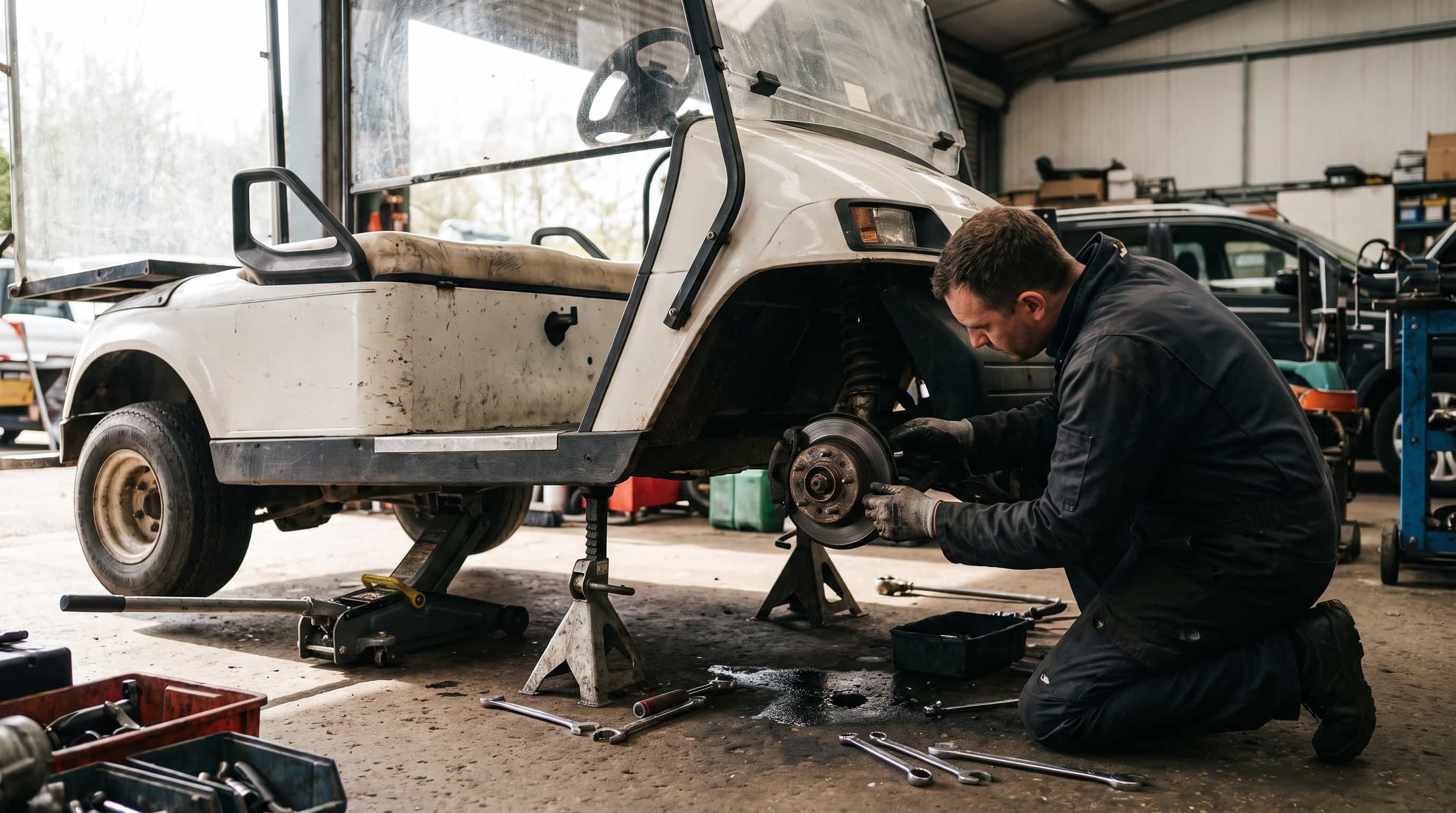
If yours is doing this and the checks here have not settled it, we diagnose and repair buggies, including a callout to wherever it is.
Charging as part of the plan
Range and charging go together. Where a buggy will run hard all day, it needs somewhere to charge overnight, which on some sites means planning it in rather than assuming a socket. On a marquee or festival site in particular, that is a conversation to have with your power supplier early.
Get the charging sorted and range mostly looks after itself. Ignore it and a long event can outrun a single charge, which is avoidable with a little planning.
Common questions
- How many hours will a golf buggy run for
- It depends on the load, the terrain and how hard it is driven, so we will not quote a single figure that might be wrong for your event. Tell us the shape of the day and we will size the hire with charge to spare.
- Do hills reduce the range
- Considerably. Climbing draws far more current than flat ground, so a hilly site shortens range noticeably. We factor that in when sizing your hire rather than sending one vehicle to do a day it cannot manage.
- What if we need it running all day without stopping
- Then we plan for it: either a charging break if the day allows one, or a second vehicle so one rests while the other works. Continuous all-day use is exactly the case where sizing matters, and we will get it right with you at quote stage.
- Does cold weather really affect range
- Yes. Cold reduces the range any battery delivers, noticeably in winter, so plan for less range in cold conditions and charge fully beforehand.
Still not right
We diagnose and repair golf buggies, service them on a plan, and send an engineer out to where the buggy is. Tell us the symptom and we will say what it usually means.