Golf buggy accessories: what is worth fitting
By James Brown · Updated 29 August 2026 · 10 minute read
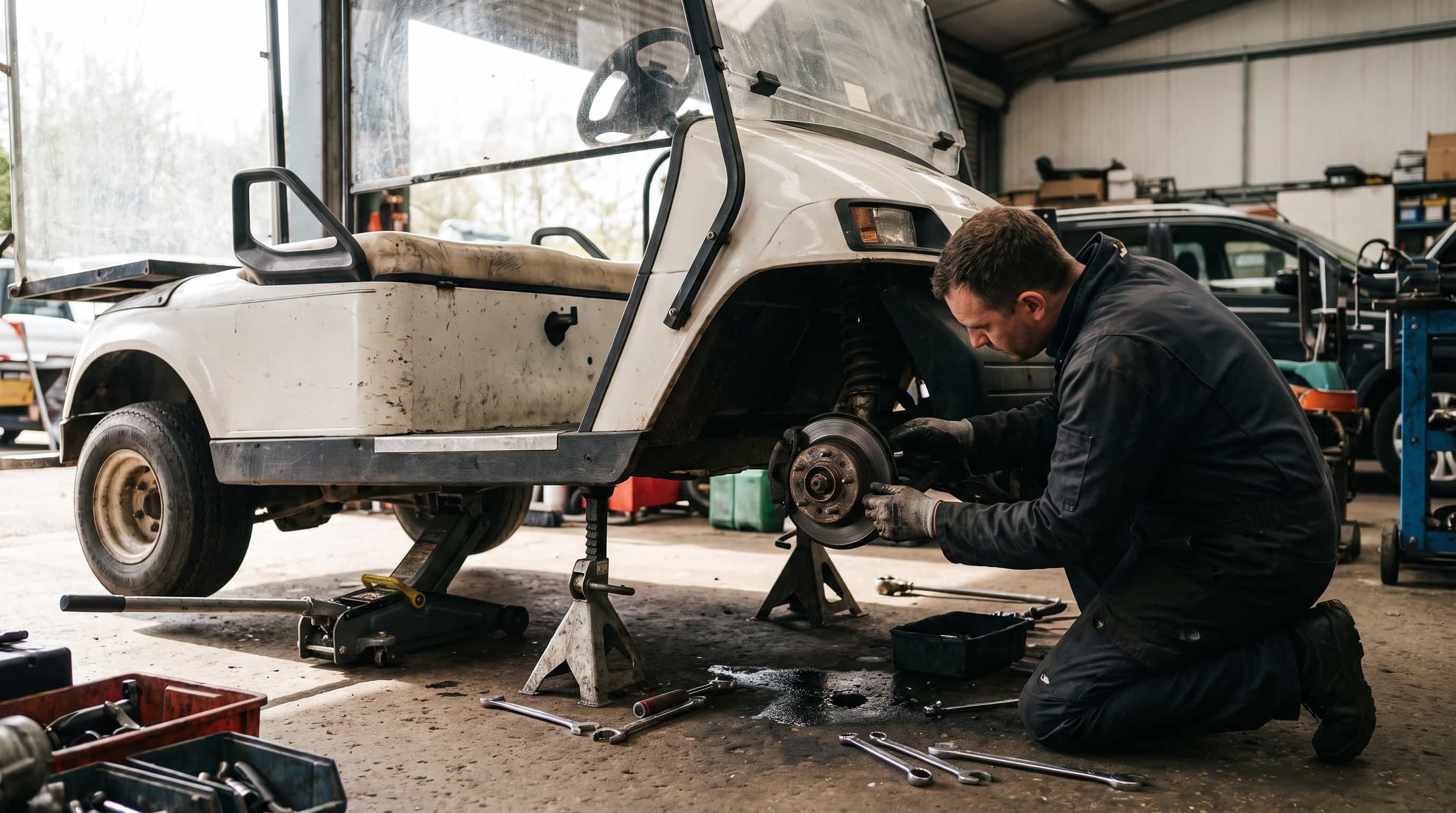
Start from what actually stops you using the machine, which is usually rain, darkness or a shortage of seats. Weather protection and lighting buy usable days, so they earn their place before anything cosmetic. Changes to seating or load change how the buggy stops and how it sits on a slope, so treat those as specification decisions rather than accessories. Comfort and on-board power are cheap and easy to add later. Settle fitting and warranty first, because a retro-fit often costs more than the part.
Key takeaways
- Every accessory adds weight, and weight comes out of range and braking before it comes out of anything else.
- Weather protection and lights buy usable days a year, which is why they repay more reliably than appearance parts.
- Anything that alters seat count or load alters how the machine stops, so it belongs in the specification conversation.
- Accessories drawing from the traction pack take range with them, and a tap across only part of a pack ages it unevenly.
- Belt anchorages and towing points have to go into structure designed for the load, never into bodywork.
- Several fittings are much cheaper ordered with the machine, particularly anything needing a loom or a frame.
- Ask in writing what a fitting does to the warranty, and keep the answer with the machine's paperwork.
Order the list by what stops you using the machine
Accessory lists are arranged by product family, which is rarely the useful order for a buyer. A better one is by what currently prevents the buggy being used. On most sites the honest answers are weather, darkness and capacity: the machine sits in a shed when it rains, comes home before dusk, or cannot carry the people who need carrying. Fittings that solve those change the machine's usefulness across a whole season.
Appearance parts sit at the other end. Alloy wheels, decorative panels, chrome and light bars look like upgrades and change nothing about what the buggy can do on a Tuesday in February. They are not a mistake if you want them, but they should be bought as what they are rather than as improvements, and they should be bought after the practical list is settled.
One principle runs through everything below. Weight is the currency. A buggy is a light vehicle with modest brakes and a finite battery, and every bracket, panel, seat and box comes out of range first and out of stopping distance second. That does not mean fitting nothing. It means knowing what each thing costs before you fit five of them.
Weather protection, the category that buys days
A canopy is the foundation, and on most machines it is either fitted from new or it is a structural job rather than a bolt-on. Everything else in this category hangs from it: a windscreen at the front, a rain curtain or a full enclosure around the sides, a rear screen behind the seat. That means the canopy and its supports end up carrying loads they were never designed for once wind gets behind a set of panels, which is worth checking before ordering an enclosure for an older machine.
A screen is the fitting people underrate. It takes the wind off the occupants, which is what actually makes a winter journey unpleasant, and a folding or tilting screen lets you clear it in warm weather. Rigid screens stay clear longer but scratch if wiped dry, and soft screens distort. A full enclosure is a bigger decision with its own trade-offs around ventilation, misting and getting in and out, and it deserves thinking about separately.
Do not overlook a cover for the machine when it is parked. Buggies deteriorate from standing outside rather than from being driven, and water sitting in seat pans, in footwells and around electrical connections does more damage over one winter than a season of use does. A cover takes minutes to fit and protects the seats, the panels and the wiring at the same time. Fit one that breathes, because a sealed sheet traps moisture against the bodywork.
Seating and capacity
The rear-facing flip seat that turns a two-seater into a four-seater is the accessory most likely to be treated casually and least suited to it. It puts weight behind the rear axle, changes how the machine sits under braking, and adds passengers who are facing backwards with nothing in front of them. If it is fitted, it needs proper grab handles, a footrest and a rule about who sits there, and the site's slopes want thinking about again.
The same caution applies to seat belts. A belt is only as good as what it is bolted to, and an anchorage taken into thin bodywork is worse than no belt at all because it invites confidence the fixing cannot support. Anchorages belong in structure designed to take the load, which usually means a manufacturer's kit for that model rather than a universal one.
If the seat count is genuinely wrong for the job, the cheaper answer is often a different machine rather than a bigger accessory list. Buggies are built in several sizes, and a six-seater designed as a six-seater brakes, steers and carries its load better than a two-seater with parts added to it. On a hire fleet that difference shows up as fewer complaints and less wear, and on a private machine it shows up on the day somebody has to stop quickly on a slope.
Load carrying and towing
Cargo boxes, flat beds and tipping bodies turn a passenger buggy into a working one, and the useful question is where the load sits rather than how much it holds. Weight high and behind the rear axle is the arrangement that makes a machine feel unstable on a slope, and a box that overhangs the back is exactly that arrangement. Low and between the axles is always better, even if it holds less.
Towing is the one to be most careful about. A hitch has to be attached to the chassis or to a frame designed to feed the load into it, not to a bumper or a body panel, and the braking that seemed adequate unladen has a trailer behind it now. Grass, slopes and a load behind you combine badly, and the manufacturer's own figure for what a given model may pull is the only figure worth using.
For sites that genuinely move materials all day, a purpose-built utility vehicle usually costs less over its life than a converted passenger buggy, because the suspension, brakes and gearing were specified for the work rather than adapted to it afterwards. The conversion route makes sense where the load is occasional and light: a bag of tools, a few stakes, a cool box for a shoot day. It stops making sense once the buggy is doing a working vehicle's job every morning.
Lighting, mirrors and being seen
Lighting is a genuine safety improvement and an easy one, and it is the one most often left until after an incident. A machine crossing a car park at dusk is nearly invisible to a driver who is not expecting it, and headlights alone do not solve that: it is the lights facing sideways and backwards that get you noticed. Mirrors cost very little and change how safely a buggy is reversed among people.
Two honest notes. A lighting kit does not make a buggy road legal, and any seller implying otherwise is either careless or worse. Approval and registration are separate matters entirely. And an amber beacon is a site convention rather than a legal requirement in most private settings, so what governs its use is your own risk assessment or the venue's rules.
- Head, tail and brake lights for dusk and dawn, which is when most site collisions happen.
- Side and rear reflectors, cheap and effective where vehicles pass at an angle.
- Mirrors on both sides, particularly on any machine used to reverse near pedestrians.
- A beacon where the site expects one, run from a properly fused supply rather than a spliced feed.
- A reversing alarm where the buggy works around foot traffic, with a thought about noise at a wedding or a ceremony.
If yours is doing this and the checks here have not settled it, we diagnose and repair buggies, including a callout to wherever it is.
Comfort, seats and ride
Comfort fittings are low risk and high reward. Better seat cushions and covers, a steering wheel that suits the driver, sun protection, cup holders and storage all improve the machine every trip and change nothing about how it behaves. On a hire fleet, washable covers pay for themselves simply by surviving a season of muddy shoes. None of it needs a specialist to fit, and none of it commits you to anything, which makes this the group to spend on once the practical decisions are settled.
Suspension is the exception in this group. Upgraded springs, dampers or heavy-duty kits genuinely change the ride, and they also change the ride height, the geometry and the way the machine loads its tyres. If the buggy bounces or rides harshly, the cause is often worn dampers, tyre pressures or a load problem rather than a need for a stiffer spring, and diagnosing that first is cheaper than replacing parts that were doing their job.
On-board power and small electrics
Sockets, phone charging, a small speaker, a coolbox: all of these need a supply, and where they take it from matters more than the fitting itself. On many machines the traction pack is a string of batteries, and a low-voltage accessory tapped across only part of that string discharges those batteries harder than the rest. The pack then ages unevenly and the weakest cells drag the whole set down, which is an expensive way to charge a phone.
The clean answers are a proper converter that draws evenly from the whole pack, or a small separate battery charged independently. Either way, every accessory circuit wants its own fuse close to the supply, and any wiring run needs securing away from steering, suspension and hot components. Wiring is also the fitting most likely to be blamed when an unrelated electrical fault appears, so a tidy, documented installation is worth paying for.
Fitting, warranty and what to order with the machine
Two questions decide more than the choice of parts. The first is who fits it, because a dealer fit usually keeps the warranty position clean while a home fit may not, and the answer differs by manufacturer rather than following a general rule. Ask in writing, before buying, whether a specific fitting affects cover, and file the reply with the machine's papers.
The second is timing. A surprising number of these things are far cheaper specified when a machine is built, because the loom, the mounting points or the frame go in during assembly rather than being retro-fitted around finished bodywork. Lighting, enclosures, rear seats and load bodies all tend to fall in that group. If you are ordering a new buggy, work out how it will be used in its second winter rather than its first week, and specify for that.
- Ask what a fitting does to the warranty, and get the answer in writing rather than over the counter.
- Tell your insurer about anything that changes seats, speed, structure or towing capability.
- Prefer the manufacturer's own kit for that model where the fitting is structural or safety related.
- Order looms, mounting points and frames with the machine, and leave cosmetic parts for later.
- Keep every instruction sheet and receipt with the buggy, because the next owner inherits the questions.
Common questions
- Which golf buggy accessories are actually worth the money?
- The ones that add days of use. A screen and a canopy make winter journeys tolerable, lights extend the usable day and reduce the chance of being hit, and a parking cover slows the corrosion that ends most buggies. Comfort fittings are cheap and pleasant. Appearance parts change nothing about capability, which is fine as long as you are buying them knowingly.
- Will fitting accessories void my buggy warranty?
- It depends on the manufacturer and on what is being fitted, and nobody can answer it generally. Structural, electrical and drivetrain changes are the ones most likely to affect cover. Ask the seller or the manufacturer in writing about the specific part before buying, and keep the reply. A dealer fit usually keeps the position cleanest.
- Can I add a back seat to a two-seater golf buggy?
- Often yes, using a kit made for that model, and it changes more than the seat count. Weight moves behind the rear axle, braking and balance shift, and the passengers face backwards. Fit proper grab handles and a footrest, review the slopes on your site, and tell your insurer. If four seats are a permanent need, a four-seat machine is usually the better buy.
- Do lights make a golf buggy road legal?
- No. Road legality comes from approval and registration, which apply to the whole vehicle and have to exist before it goes on a public road. Lights are equipment, not evidence. Fitting them is still worthwhile for private-ground use at dusk, and it improves how visible the machine is to drivers in a car park, but it changes nothing legally.
- Do accessories reduce a golf buggy battery range?
- Yes, in two ways. Weight and wind resistance make the motor work harder, so an enclosure and a loaded cargo box both cost range. Electrical accessories draw directly from the supply. The draw from lights or a socket is small next to the traction motor, but a poorly wired tap across part of a battery string can shorten the life of the pack itself.
- Should I buy accessories with a new buggy or add them later?
- Order anything involving a wiring loom, a mounting frame or a structural fixing with the machine, because fitting it during assembly is normally cheaper and tidier than retro-fitting it. Covers, cushions, mirrors and storage can wait until you know how the buggy is actually used, which is often not how you expected.
Still not right
We diagnose and repair golf buggies, service them on a plan, and send an engineer out to where the buggy is. Tell us the symptom and we will say what it usually means.
Related pages
Related guides
 Weather enclosures and cab doors for a buggy10 minute read
 Lift kits and larger wheels: what changes10 minute read
 Golf buggy canopy, windscreen and weather protection4 minute read
 What to specify when you order a new buggy10 minute read
 Finding parts, original versus pattern5 minute read
- Rear flip seats and seat kits explained10 minute read