What to specify when you order a new buggy
By James Brown · Updated 29 August 2026 · 10 minute read

Order forms are short and their consequences are long. Seating and body configuration, battery chemistry with its matching charger, tyres, roof and screen, lighting, restraint, load fittings, livery and the speed setting are all decided once and lived with for years. Some can be changed afterwards at sensible cost. Others are structural, affect a warranty, or turn out to be unavailable at the moment you want them. Work through each of them with the supplier, and write the answers into the order rather than leaving them in the conversation.
Key takeaways
- Body and seating are the least reversible decision, because they determine the chassis and the frame you keep.
- Battery chemistry sets your charging routine, your daily availability and where the machine can safely be left.
- A charger belongs to the battery decision rather than to the accessory list, and a mismatched one shortens pack life.
- Tyres are cheap to change and still worth getting right at order, because the wrong ones damage ground you then have to repair.
- Lighting fitted during the build is tidier, better protected and generally cheaper than lighting added afterwards.
- Livery applied over a standard finish is easier to refresh or remove than a colour baked in at build.
- The speed setting is a management decision rather than a performance one, and it should be recorded in writing at handover.
Start from the job, not from the options list
Write down what the machine does in a normal week before you look at anything a supplier offers. Who drives it, how many people ride, what it carries, how far it goes between charges, what surface it spends its life on, where it is parked and who is responsible for plugging it in. Half the options answer themselves once that is on paper, and the other half become a short list of genuine questions rather than a menu.
Then separate the decisions into two piles. One pile is things you can add later without much pain: a cargo box, a windscreen, a beacon, a set of tyres. The other is things that are effectively fixed at build, or that need a return to a workshop and a conversation about warranty: the body and seating, the battery and charger, anchorages for belts, and the wiring loom behind any lighting. Spend your attention on the second pile.
Body and seating, the choice you cannot undo
Seating decides the chassis. A two seat machine, a four seat machine with a rear facing bench, a forward facing six and a two seat vehicle with a cargo bed are different vehicles rather than different trim levels, and swapping between them later means a different frame. Order for the load you actually carry rather than for the largest party you can imagine, because every extra seat costs you weight, length and turning space on the days you carry nobody.
Think about how people get on and off as well as how many of them there are. A rear facing bench is compact and it asks passengers to step up and turn round, which is fine for staff and less so for elderly visitors. A flip seat that converts between passengers and a bed sounds like the answer to everything and is a compromise at both jobs. If the vehicle has one dominant use, specify for that and hire something else for the exception.
Battery chemistry and the charger that goes with it
The chemistry decides your routine. Lead acid packs need topping up with the correct water, want a full unhurried charge rather than short bursts, and suffer badly if left flat or partly charged for weeks. Lithium packs need no watering, tolerate the opportunistic top ups a working day allows, weigh less and carry their own management electronics. The purchase cost runs the other way, so the decision turns on how the machine is used rather than on which technology sounds better.
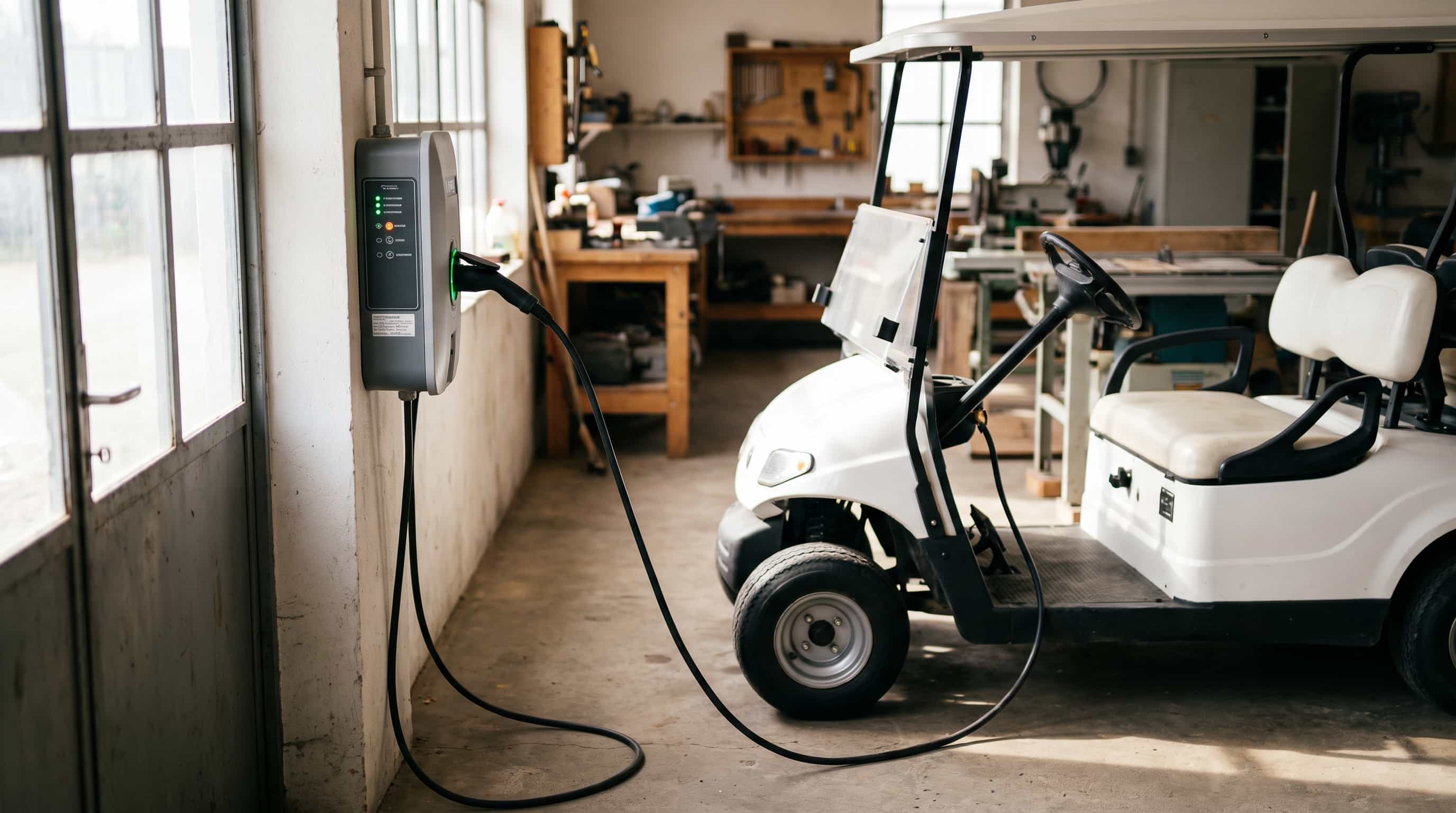
Treat the charger as part of the battery rather than as an accessory. It has to match the chemistry and the pack, and using the wrong one is a reliable way to shorten a pack's life or to void the cover on it. Ask what happens if you replace the pack in a few years with a different chemistry, whether the charger and wiring carry over, and who holds the battery warranty. Get those answers in writing, from the supplier, before the order goes in.
Ask about charging on site while you are there. How many machines will be on charge at once, what that means for the circuit, and whether an electrician needs to look at it. Ventilation matters for lead acid in particular, and where the machines park is often decided by where the sockets are rather than by where you would like them. It is much cheaper to sort out before delivery than after.
Tyres, roof and weather equipment
Tyres are the cheapest specification decision with the biggest effect on where the machine can go and what it does to your ground. Turf tyres spread load and mark grass least. All terrain tread grips loose and muddy going and is harder on fine turf. Street patterns suit sites that are all tarmac and concrete. The right answer follows from the surface you actually cross most, and pressures come from the maker's own figure rather than from habit.
Weather equipment is worth ordering at build even where it seems optional. A full length roof, a fixed or folding screen, and mounting points for side curtains are neater and better sealed when they are fitted in the factory, and the screen decision in particular affects the frame. Consider who uses the machine in January before deciding this is a summer purchase. Sites that skip it often order it within a year and pay twice for the labour.
- The tyre pattern matched to the surface the machine crosses most, not to the one it crosses occasionally.
- Roof length, since a short roof keeps rain off the driver and off nobody else.
- A screen, and whether it folds, because a fixed screen without a wiper collects rain exactly where you look.
- Mounting points for side curtains or an enclosure, fitted at build even if the curtains come later.
Lighting, mirrors and being seen
Lighting is not only about seeing. On a working site the point is being seen, by people on foot, by drivers of larger machines and by anyone reversing a van. Head and tail lights, brake lights, indicators, a reversing light and a beacon are all worth considering, and a factory loom keeps the wiring inside the frame where it is protected. Retrofitted lighting works, and it is usually the wiring rather than the lamps that ages badly.
Mirrors are cheap and are ignored more often than they should be. A machine that reverses in a busy yard, or that is driven by many different people, wants both of them. None of this makes a buggy road legal, which is a separate question of approval, registration, tax and insurance settled by DVLA rather than by fittings. Ask the supplier plainly what the machine is and is not approved for, and take that in writing.
Working out what this costs for your own event? Tell us the venue and dates and you will have an itemised written quote within one working hour.
Restraint, grab handles and load fittings
Belts need anchorages designed for them, and an anchorage is a structural item. Retrofitting to a seat frame that was never intended to carry the load is not a job for a workshop bench, so if there is any prospect of the machine carrying staff, children or the public, ask at order what restraint options the maker offers and have them fitted then. Hip restraints and grab handles address the way people actually fall off these vehicles and are worth specifying regardless.
Load fittings follow the same logic. A bed, tie down points, a cargo box, a ladder rack or a rated tow hitch are far better mounted to points the maker designed than bolted through a panel later. Ask what the fitting is rated for as well as whether it can be fitted, since a hitch that exists is not the same as a hitch approved for a load. The plate and the handbook, once again, hold the answer.
- Restraint options offered by the maker for the exact seat configuration you are ordering.
- Grab handles at every passenger position, including the rear facing bench if you specify one.
- Tie down points inside the bed rather than a bare tray, so a load can be secured properly.
- A tow hitch supplied and rated by the maker, with its figure recorded on the paperwork.
Colour, livery and the fleet you will own later
A colour chosen at build is in the panels, which means a replacement panel has to match it and a change of branding means paint or a wrap over the top. A standard finish with vinyl livery applied afterwards is easier to refresh, easier to remove when the machine is sold, and cheaper to repair, because a scuffed panel can be replaced and re-liveried without a paint match. For a fleet that carries a name or a sponsor, that flexibility is usually worth more than a bespoke colour.
Think about the fleet rather than the machine. Uniform colours across a fleet look deliberate and make numbering, allocation and recovery simpler. Mixed colours accumulated over several orders are the usual result of deciding this one purchase at a time. Numbering the machines visibly, in a position readable from the front and the rear, is a small thing that pays back every time somebody has to report a fault or find a vehicle.
Speed, keys and what goes on the order form
Many machines can have their top speed limited by the controller, and on a site with pedestrians that is a management decision rather than a compromise. Decide it before delivery, have it set at build, and record the setting on the handover paperwork so that a service visit does not quietly restore the default. Ask who is able to change it and what the process is, because a setting anybody can alter is not really a control.
Then settle the dull items that cause the most irritation later. Keys, whether the fleet runs on a common key or individual ones, and how many spares arrive. What is in the handover pack: handbook, charger, battery documentation, the plate details and the serial numbers written down where you will find them. And a delivery inspection agreed in advance, so that damage in transit is somebody else's problem rather than an argument three weeks afterwards.
- The speed setting, in writing, with a note of who may change it.
- Key arrangements across the fleet, and the number of spares supplied.
- Serial and plate details recorded on your own records at delivery, not just on the invoice.
- A written handover list covering charger, handbook, battery paperwork and any warranty registration.
Common questions
- What is the most important thing to get right when ordering a buggy?
- The body and seating configuration. Nearly everything else can be added, swapped or upgraded later at a sensible cost, but the number and arrangement of seats decides the chassis and cannot be altered without effectively buying a different vehicle. Order for the work the machine does most weeks, and take something hired for the occasional day when you need more capacity.
- Can I change from lead acid to lithium later?
- Often, but it is not a straight swap. A conversion needs a compatible pack, tray and wiring, a charger matched to the new chemistry, and in many cases the approval of the maker or a converter who will stand behind the work. Warranty cover is the part people discover too late. Ask the supplier what a later conversion involves before you order, so the answer is not a surprise.
- Should I order lights if the buggy stays on private land?
- Usually yes, because the reason is being seen rather than seeing. Winter afternoons are short, sites are busy with vans and larger machines, and a beacon or a brake light does more for safety than headlamps do. Factory wiring is tidier and better protected than anything added later. Lights do not make a machine road legal, which remains a separate matter of approval and registration.
- Do new golf buggies come with seat belts?
- Many golf specification machines do not, because they are designed around passengers getting on and off constantly at low speed. If the vehicle will carry staff, visitors or children, raise restraint at the order stage: belts need anchorages designed into the seat structure, and retrofitting them properly is far harder than specifying them. Your risk assessment should drive the decision, not the standard build.
- How long does a new buggy take to arrive?
- Lead times move with the specification, the configuration and the time of year, so no honest general answer exists. Plainer builds tend to arrive sooner than heavily optioned ones. Ask the supplier for a date in writing, ask what would move it, and plan for the machine being late rather than assuming it will not be, particularly if it is replacing something already retired.
- Is it worth ordering a buggy in our own colour?
- For most buyers, no. A standard finish with vinyl livery gives the same effect, refreshes cheaply when branding changes, and makes a damaged panel far easier to replace, since no paint match is needed. A bespoke colour makes more sense for a large uniform fleet where the appearance is part of the site. Ask what a replacement panel involves either way.
Ready to get a price
Tell us about your event and we will send an itemised written quote within one working hour.
Related pages
Related guides
 How to choose the right golf buggy for hire7 minute read
 Seat belts, hip restraints and passenger safety fittings10 minute read
- Load ratings and why they are quoted differently10 minute read
 Golf buggy accessories: what is worth fitting10 minute read
- What size golf buggy to buy5 minute read
 Lithium versus lead-acid batteries in buggies6 minute read