Rear flip seats and seat kits explained
By James Brown · Updated 29 August 2026 · 10 minute read

A rear seat kit turns a two-seat buggy into a four-seater by replacing the bag rack with a rear-facing bench that flips down to seat passengers and folds up to give a flat load deck. The useful kits carry a grab rail, a footplate and a way of restraining the people on them. The harder question is not fitting the seat but what two adults sitting behind the rear axle do to grip, steering and stopping.
Key takeaways
- A flip seat and a load deck are often the same fitting used two ways, and only one of them is engineered to carry people.
- The cushion is the easy part; the way the frame mounts into the chassis is what decides whether it is sound.
- Passengers sit behind the rear axle, which lifts weight off the front wheels and makes the steering feel vague.
- A kit adds seating positions without changing what the vehicle is rated to carry, and that rating lives in the maker's manual.
- Rear-facing passengers need somewhere to put their feet and something solid to hold before anything else is considered.
- An extended roof is a separate purchase, and a rear seat without one leaves two people out in the weather.
- Hire agreements, venue rules and insurers all count seats, so tell them what has been fitted.
What a flip seat actually is
Behind the seat of a standard two-seat buggy there is usually a rack for golf bags, sitting over the rear body. A rear seat kit replaces that rack with a hinged frame carrying a cushioned bench. Flipped down, it faces backwards and seats two people. Flipped up, its back becomes a flat deck for bags or kit. That is the whole idea, and it is why the fitting is so often sold as a combination seat rather than as a seat on its own.
Two quite different things get sold under the same name. A factory four-seat machine is designed around four people from the start: the rear frame, the springs, the brakes and sometimes the motor and controller are specified for it. A retrofit kit is a bracket, a frame and a cushion added to a vehicle that left the works as a two-seater. Both can be perfectly sound. They are not the same purchase, and it is worth knowing which one is in front of you.
Passenger seat or load deck: the difference that matters
A great many kits are honestly described as a load deck with a cushion on it. They will hold a person, in the sense that a person can sit on them, but they were designed to support a static load lying flat rather than a moving body that leans, grips and gets thrown about under braking. The distinction shows in the details: the depth of the cushion, whether there is any support at the hips, and whether the frame ties into the chassis or bolts through a body panel.
If people are going to ride on it, ask the supplier plainly what the fitting is rated for as a seat rather than as a rack. An answer that talks only about cargo weight is telling you what the thing is. A load deck is a useful item to own and there is nothing wrong with buying one; the mistake is buying one and then putting two guests on it for a long run over rough ground.
- A passenger fitting has hip support, a grab rail and a footplate as part of its design, not as options.
- A load deck has tie-down points, a flat floor and no thought given to a body sliding sideways.
- Chassis-mounted frames feed load into structure; panel-mounted ones feed it into thin sheet or a moulding.
- Where the supplier quotes only a cargo rating, treat the fitting as cargo equipment.
The fittings that should come with it
Rear-facing passengers have nothing in front of them. Everything a forward-facing occupant leans against during a stop is behind them, and everything they would instinctively grab is out of reach. So the valuable part of a kit is not the cushion, it is the ironmongery around it. A rail across the back of the front seat, or a bar at hip height on each side, gives the hands somewhere to go. A footplate gives the feet somewhere to rest that is not the ground going past.
Some sites will want lap belts and some will not, and that is a judgement about speed, terrain and who is being carried rather than a universal rule. Where belts are fitted, the anchorage is the part that decides whether they are worth having, because a belt bolted to a plastic seat base is decoration. Our separate guide on restraint goes further into that, and your insurer is likely to have a view worth asking for before the kit is ordered rather than after it is on.
- A grab handle within easy reach of both rear passengers, fixed to the frame rather than to trim.
- A footplate wide enough for two, with a lip or kick rail at the outer edge.
- Side bars or hip restraints, so a body cannot slide outwards on a turn.
- A step usable with one hand occupied, since most people are carrying something.
- Belts where the machine and the site call for them, anchored into structure rather than into the cushion base.
What two more people do to the way it drives
This is the part owners discover afterwards. Two adults on a rear seat sit behind the rear axle, so their weight does not simply add to the vehicle, it levers weight off the front wheels. Light front wheels steer badly. The wheel goes vague, the machine wants to run wide on a turn, and on a loose or wet surface the front pushes straight on where it used to bite. Nothing has broken. The balance has changed.
Braking changes as well. Many buggies brake on the rear wheels alone, and the added mass has to be stopped by the same shoes on the same drums. Stopping distances lengthen, brakes run hotter on a long descent, and a pedal that felt firm with two up feels softer with four. Downhill with a full load is where this is noticed first, which is exactly the moment it is least welcome.
Slopes are the third change. Shifting load rearward and upward makes the machine keener to lift a wheel on a cross-slope and keener to unload the front on a climb. None of that makes a four-seat conversion a bad idea. It means the driving has to change with the seat: gentler on turns, earlier on the brakes, and straight up or straight down a bank rather than across it.
Where the load actually goes
A seat is only as good as the thing it is bolted to. Sound kits pick up on the chassis rails, or on the mounting points the maker used for the rear body, with bolts passing through steel and load-spreading washers behind. Weaker ones bolt into the rear body panel, which on many machines is a moulding never intended to carry anything but its own shape and a set of clubs.
Ask to see how it mounts before buying, and ask whether the fitting instructions come from the maker of the vehicle or from the maker of the kit. Where the two disagree, the vehicle maker's manual governs, and a fitter who will not look at it has told you something useful. If the seat is going on at the same time as a lift kit or larger tyres, treat that as one change rather than two, because the effects compound.
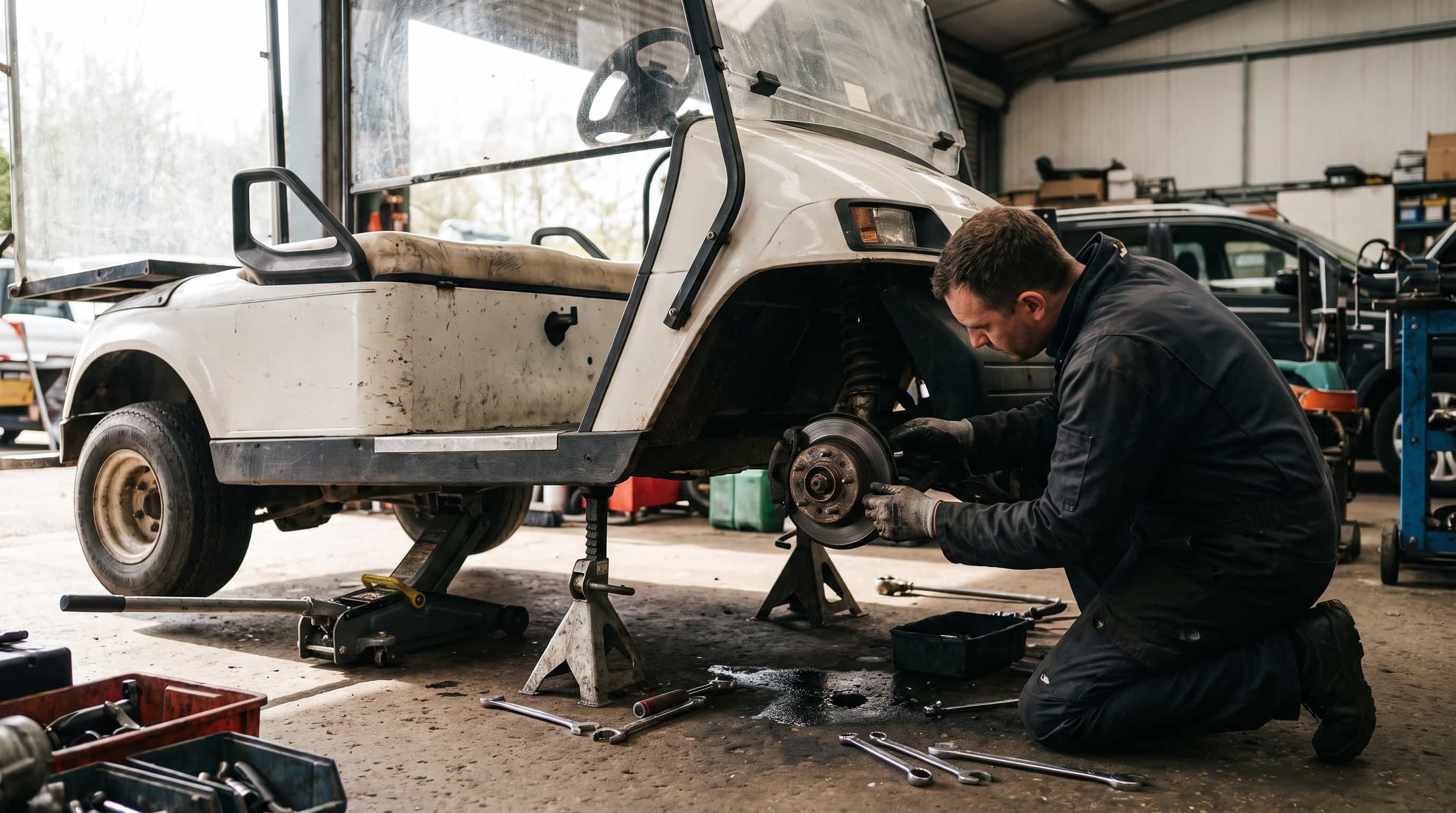
If yours is doing this and the checks here have not settled it, we diagnose and repair buggies, including a callout to wherever it is.
Whether the machine is rated to carry four
There is a figure for this and we are not the ones who hold it. Every vehicle has a rating for total laden weight, and many carry a stated seating capacity as well, and both live in the maker's own manual and usually on a plate fixed to the machine. A seat kit adds places to sit. It does not change the rating, the springs, the brake capacity or the axle. If four people plus their bags exceeds what the vehicle is rated for, fitting a seat has not made that sensible, only possible.
So the order of work is: find the rating, add up the real load including driver, passengers, bags and anything on the deck, and then decide. Where the machine is older and the manual has gone, the maker or the importer can usually supply the figure for a given model and year. On a hired machine, ask us, because the seat count is part of what is being hired and it appears on the agreement.
Roofs, weather and getting on and off
A standard two-seat roof stops behind the front occupants. Flip the rear seat down and two people are sitting outside it, which is tolerable in July and miserable in November. Extended roofs exist for most machines that take a rear seat, and they usually need to be bought alongside the seat because the rear supports often share its mounting points. Ordering a seat and then discovering the roof does not reach is a common and avoidable annoyance.
Getting on and off deserves a thought too. Rear passengers step down at the back of the vehicle, into the space anything following is using. On a busy site that is the argument for a beacon, for a habit of stopping clear of a lane, and for the driver being the person who says when it is safe to step off. It is a small piece of briefing and it costs nothing to give.
Rules, agreements and road use
Seats get counted. A venue that permits buggies often permits a number of occupants, an event insurer will ask how many people are carried, and a hire agreement states the configuration supplied. Fitting a seat to a hired machine without asking is a plain breach of that agreement, and fitting one to a machine covered by somebody else's policy may quietly undermine it. A phone call before the kit is ordered settles all of that.
Road use is a separate world again. Seating, restraint and construction for a vehicle used on a public road are decided by the requirements for the route that vehicle is registered under, and DVLA rather than an accessory seller is the authority. If the machine touches a road at any point, get that answer from the authority before changing what it carries.
Common questions
- Can I fit a rear seat kit to any golf buggy?
- Not to every one. Kits are made for specific chassis, and mounting points differ between models and between generations of the same model. Some machines have a factory four-seat version, which usually means the parts exist; others were only ever built as two-seaters. Give the supplier the model and the year, and check against the maker's own parts list if there is any doubt.
- Does a flip seat make the buggy a four-seater legally?
- On private land, seating is a matter for the landowner's rules and the vehicle's own rating rather than for the law. On a public road it is a matter for the approval route the vehicle uses, and DVLA holds that answer. Fitting a seat adds a place to sit; by itself it does not change what the vehicle is permitted to do or carry.
- Are seat belts required on a rear flip seat?
- There is no single answer, because it depends on where the machine is used and under whose rules. Many sites decide through their own risk assessment and some venues insist. Where belts are fitted, the anchorage matters more than the belt itself: it has to go into structure. Ask your insurer and the site owner before assuming either way.
- Will a rear seat slow the buggy down?
- It makes the machine work harder, which shows in hill climbing and in how far a charge goes rather than in a lower speed on the flat. Two extra passengers is a large proportional increase in load for a small vehicle. On hilly ground the effect is obvious, and a lead-acid pack reaches the end of its useful charge sooner under the heavier draw.
- Can the rear seat carry tools instead of people?
- Yes, and folded up it is designed to. That is why so many are sold as combination fittings. Carrying kit is easier on the vehicle than carrying people, provided the load is tied down. Loose tools slide forward under braking and come to rest against the back of the front seat, with somebody sitting in it.
- Do I need a bigger roof as well?
- If rear passengers are to be carried in British weather, yes. Extended roofs are model-specific and often share mounting points with the seat frame, so order them together. A rear seat under a standard roof is usable for short hops around a dry site and unpleasant for anything longer or wetter.
Still not right
We diagnose and repair golf buggies, service them on a plan, and send an engineer out to where the buggy is. Tell us the symptom and we will say what it usually means.
Related pages
Related guides
 Golf buggy accessories: what is worth fitting10 minute read
 Cargo boxes and load beds for a buggy9 minute read
 Buggy lighting upgrades for private sites10 minute read
- Seat belts, hip restraints and passenger safety fittings10 minute read
- How many passengers can a golf buggy carry4 minute read
- Load ratings and why they are quoted differently10 minute read