Buggy lighting upgrades for private sites
By James Brown · Updated 29 August 2026 · 10 minute read
Lighting a buggy for private ground is three separate jobs: seeing where you are going, being seen by people who are not looking, and dazzling nobody in the process. They want different lamps. A shaped headlamp beam does the first, marker lights and a beacon do the second, and work lamps do neither while the machine is moving because they wreck the driver's night vision. Road use is a different problem with its own rules on colour, position and approval.
Key takeaways
- Seeing, being seen and not dazzling are three jobs, and one very bright lamp does only the first.
- A beam with a cut-off keeps light out of the eyes of anyone the machine is approaching.
- Work lamps belong on their own switch and should be off whenever the vehicle is moving.
- Amber is the beacon colour for a slow-moving vehicle; blue and red are reserved for emergency use.
- LED draw while driving is small, and the real harm comes from a parked machine running lights with nothing recharging it.
- Every added circuit needs its own fuse near the supply and a proper earth wire rather than a painted bracket.
- Anything that dazzles the driver gets switched off, so fit what people will keep using.
What lighting on private ground is actually for
Most factory buggy lighting was designed to make the vehicle visible on a course at dusk, not to light a path at midnight. That is a reasonable design decision, and it is why so many machines feel under-lit the first winter they are used for anything other than golf. Before buying lamps, separate the three jobs. Seeing is about the ground well ahead of the wheels. Being seen is about the shape of the vehicle from the side and from behind. Not dazzling is about everybody else sharing the site.
Those jobs pull in different directions, which is why a single very bright lamp usually makes things worse rather than better. It lights the near ground, throws the far ground into contrast by comparison, and puts the driver's own eyes into a state where anything outside the beam has gone. A modest, well-aimed beam plus decent marker lighting does more good on most sites than a floodlight on a stalk.
Headlamps and why beam shape beats brightness
The useful upgrade to a headlamp is not more output, it is a beam with a shape and a top edge to it. A lamp with a cut-off puts light on the ground ahead and keeps it out of the eyes of anyone walking towards the machine. A bare flood does the opposite: mounted at buggy height, which is roughly chest height on an adult, it lights faces. On a site with pedestrians that is not a minor discourtesy, it is the thing that produces the near miss.
Aim matters as much as the lamp. Set it on level ground against a wall, with the vehicle loaded the way it is normally used, because a loaded buggy sits nose-up and throws its beam higher than it did empty in the workshop. Spot beams reach further and light a narrow corridor. Flood beams light wide and close. On winding paths at low speed, wide and close is generally the more useful of the two.
Colour temperature is worth a thought as well. Very cool white light looks bright and shows less in rain, mist and dust, because shorter wavelengths scatter more and throw light back at the driver. A warmer beam scatters less. On a site that works in fog or around dusty ground, that is a real difference rather than a matter of taste. It also affects how tired the driver gets over a long evening, which is a reason to avoid the harshest lamp on the shelf.
Work lamps, and why they should be off while moving
A work lamp is for standing still. Mounted on the roof edge or at the rear, it floods an area so somebody can change a sprinkler head, load a bed or find a dropped tool. It is exactly the wrong lamp to drive with, because it lights the ground close to the vehicle so brightly that the eye adapts to it and everything further out goes black.
So wire work lamps to their own switch, put that switch where the driver notices it, and where the site is disciplined enough, interlock them so they cannot come on above walking pace. A rear-facing work lamp left on during a forward run is the classic case: the driver never sees it, and everybody behind is dazzled for the length of the site.
Marker lighting, beacons and being seen from the side
Marker lighting is the quiet workhorse. A buggy is low, narrow and silent, and from the side it presents very little for the eye to catch. Small lamps at the corners of the roof, or a strip along the lower body, give an outline and a width to judge. On a shared campus path that outline is what stops somebody stepping out in front of it.
Beacons divide opinion for good reason. On a service road shared with vans, an amber beacon is read instantly and earns its place. On a quiet path where it flashes past the same office windows all day, it becomes wallpaper very quickly and people stop registering it at all. Use one where there is traffic to warn, keep it on a switch rather than permanently live, and accept that a beacon which is never off is a beacon nobody sees.
- White to the front and red to the rear, as a general convention people already read correctly.
- Amber is the beacon colour for a slow-moving vehicle; blue and red flashing lights are reserved for emergency use.
- Corner markers at roof height show width, where low ones get lost behind parked cars.
- Reflective tape works with no power at all and is the cheapest item on this list.
What extra lighting takes from the battery
Everything added draws from somewhere. Most buggies run accessories through a converter that steps the traction pack down, or from a separate accessory battery charged off the pack. Either way, the energy comes out of the same place that moves the vehicle. Modern LED lamps draw a small fraction of what an equivalent halogen lamp does, which is why they have replaced them nearly everywhere, and it is why draw is rarely the problem while the machine is driving.
The problem is standing still. A machine parked for an evening with lights and a beacon running takes current with nothing recharging it, and on a lead-acid pack a deep discharge does lasting damage rather than causing temporary inconvenience. If the vehicle is used as a light source at events, that is an argument for a separate accessory battery, or for a charge between sessions, rather than for quietly accepting a shorter pack life.
Ask the maker or the installer what the accessory circuit is designed to supply before hanging much on it. That figure belongs to the machine. Overloading a converter tends to show up as flickering lamps and a controller behaving oddly rather than as a blown fuse, which makes it a slow fault to diagnose. It is the sort of question an installer answers in a minute and an owner otherwise spends a winter chasing.
If yours is doing this and the checks here have not settled it, we diagnose and repair buggies, including a callout to wherever it is.
Wiring that survives a winter
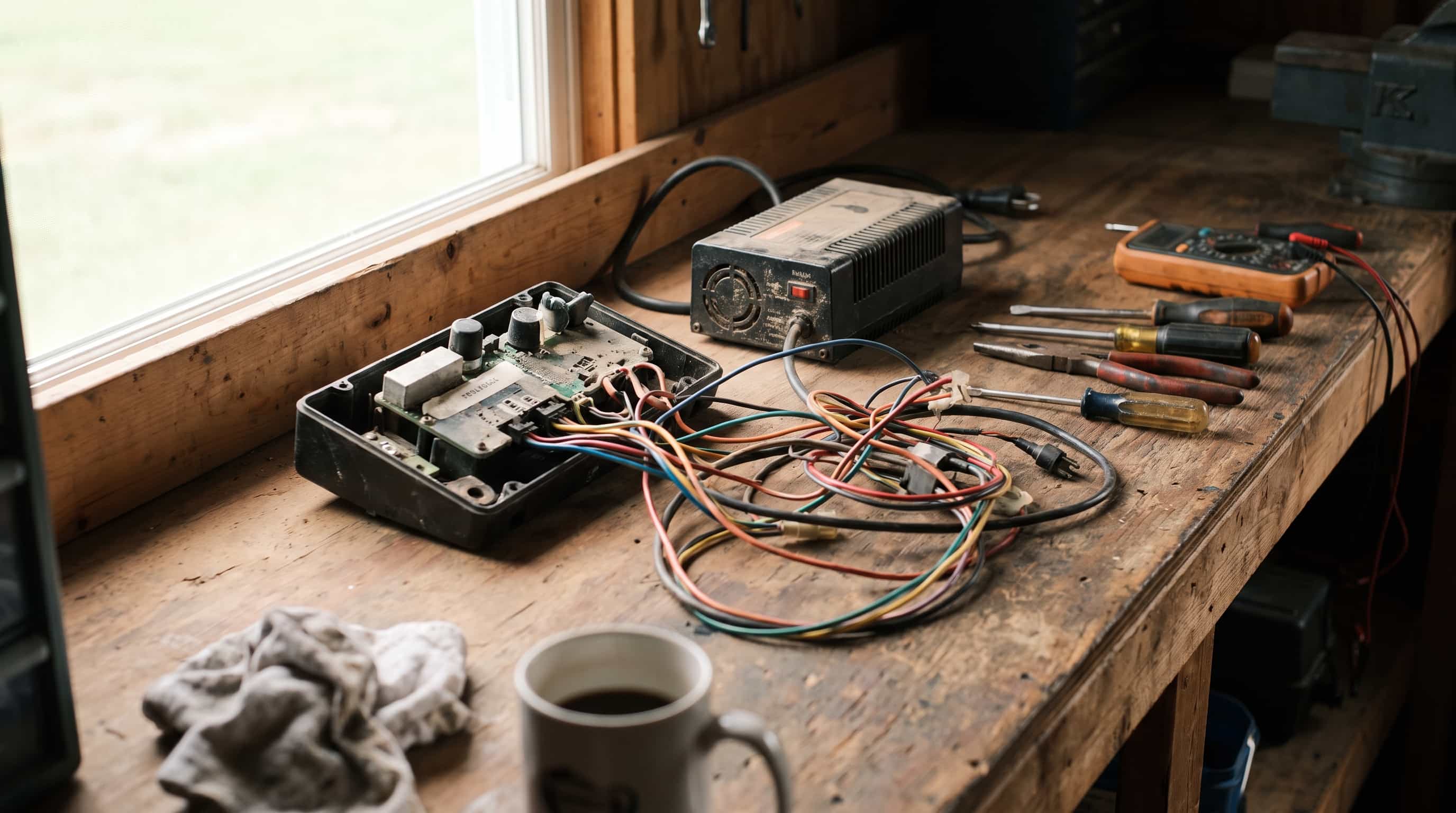
Buggies live outdoors, get pressure washed and spend their working lives shaking. That is a harder environment for wiring than a car, because a car has a body wrapped around its loom. Anything added should assume water, vibration and somebody standing on it. Automotive-grade parts are the sensible floor, and the joints matter more than the cable, because most faults found on a buggy loom turn out to be connections rather than broken wire.
The failure that catches people out is the earth. A lamp bolted to a painted bracket has no reliable path back, works intermittently for a while and then fails on a wet night, and the fault looks like a dead lamp rather than a bad connection. Run a proper earth wire to a known point instead of trusting the frame to do it, and the afternoon that would otherwise be spent under the machine in February never happens.
- One fuse per added circuit, sited as close to the supply as it will go.
- A relay for anything with real current draw, so the switch carries a signal rather than the load.
- Sealed connectors, with joints facing downwards so water runs away rather than in.
- Loom routed clear of steering, suspension and anything hot, and clipped often enough not to swing.
Road use, insurance and where the rules come from
None of the above is about road use. On a public road, lamp colour, position, aim and approval are all specified, and a light that is sensible on private ground can put a vehicle out of compliance on a road. If the machine crosses or uses a road at any point, the answer comes from the requirements for the route the vehicle is registered under, with DVLA as the authority rather than a supplier.
Insurance is the other thing to check first rather than last. Electrical modifications are the sort of change an insurer wants to know about, and work done by somebody competent, documented and declared costs nothing extra at the time and settles any argument later. Where the machine is on hire from us, ask before anything is wired in, because it is our vehicle and our policy.
Common questions
- Can I fit brighter headlights to a golf buggy?
- Usually yes, and beam shape will improve the result more than raw output does. The limit is the accessory circuit the machine provides, so ask the maker or the installer what it is designed to supply. Check the aim after fitting, with the vehicle loaded the way it is normally used, because a nose-up buggy throws its beam into people's eyes.
- Do I need lights on a buggy used only on private land?
- The law does not require them there, but the site's own risk assessment may, and darkness is where most trouble on shared ground begins. If the machine works after dusk around people, marker lighting and a working beam are sensible whatever the rules say. On private ground the landowner sets the requirement, so ask them rather than guess.
- What colour beacon should a buggy have?
- Amber, because it is the colour people already read as a slow or working vehicle. Blue and red flashing lights are reserved for emergency use and do not belong on a buggy. Keep the beacon on a switch so it is used where there is traffic to warn, since one that flashes all day everywhere stops registering with anybody.
- Will adding lights reduce the range?
- Barely, where the lamps are LED and the vehicle is moving, because the draw is small next to what the motor takes. The case that does harm is a stationary machine running lights for hours with nothing recharging it, which on a lead-acid pack risks a deep discharge and a shorter life. Charge between sessions if the buggy is used as a light source.
- Can I wire lights straight to the main battery pack?
- No. Traction packs run at a voltage the lamps are not built for, which is why machines use a converter or a separate accessory battery. Take the supply from whatever the maker provides for accessories, fuse the new circuit at that point, and use a relay for anything drawing real current so the switch is not carrying the load.
- Do fitted lights make a buggy road legal?
- No. Lighting is one requirement among several, and the full list depends on the route the vehicle is registered under. Construction, registration, insurance and the driver all come into it. Fitting road-pattern lamps to a machine that is not otherwise compliant changes nothing, and DVLA holds the definitive answer for any given vehicle.
Still not right
We diagnose and repair golf buggies, service them on a plan, and send an engineer out to where the buggy is. Tell us the symptom and we will say what it usually means.
Related pages
Related guides
 Golf buggy accessories: what is worth fitting10 minute read
 Mirrors, horns and warning devices on a buggy10 minute read
 Tyre choices: turf, all-terrain and road patterns10 minute read
 Using buggies after dark, lighting and visibility5 minute read
 Lighting and indicators for road use10 minute read
 Lights and electrics not working5 minute read