Reading golf buggy controller error codes
By James Brown · Updated 21 July 2026 · 4 minute read
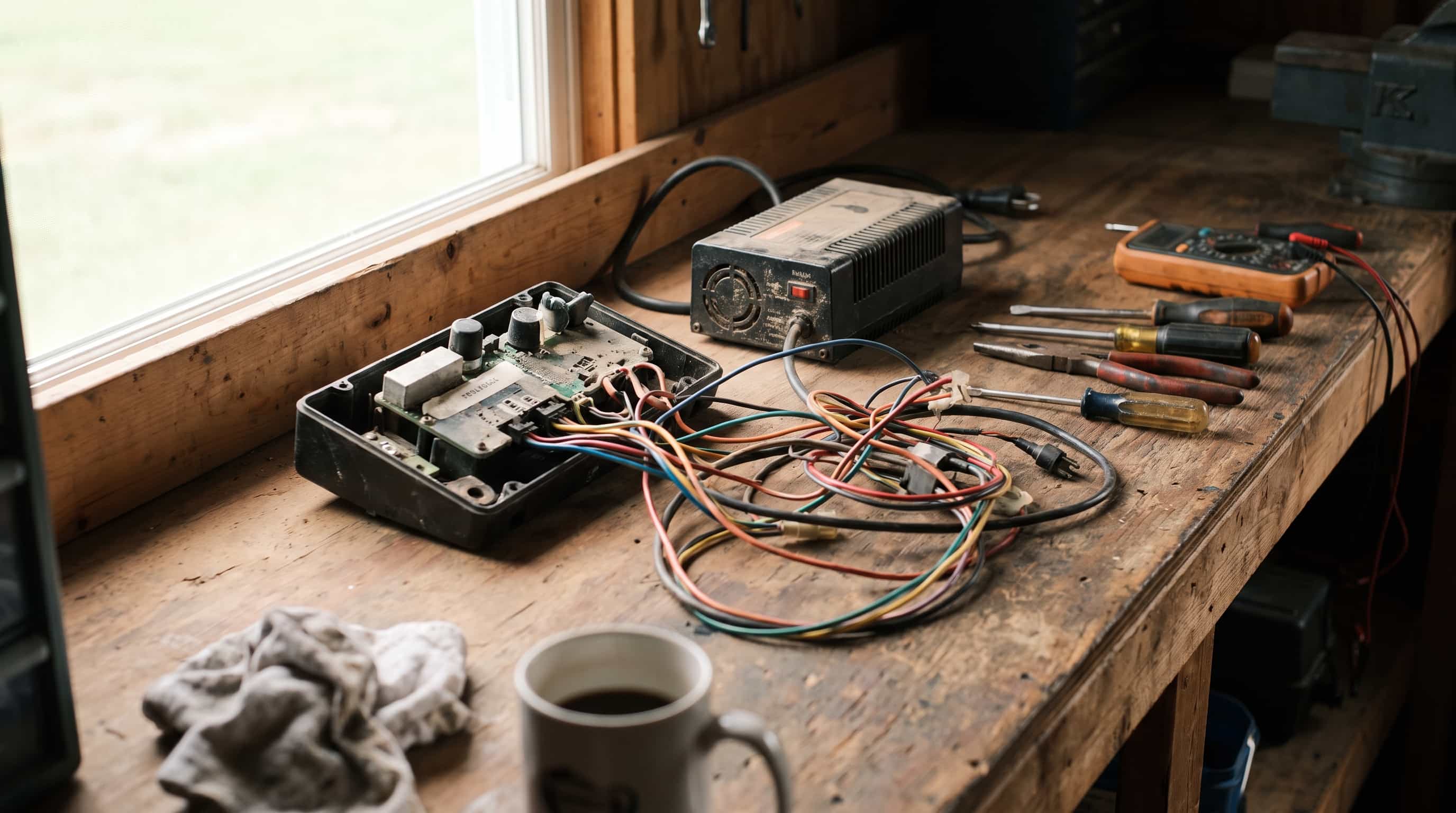
Most controllers report a fault as a blink code on a light, or as a message on a handheld reader, and reading it first is the fastest route to a diagnosis. A code points at where to look, throttle, over-temperature, main contactor, motor, rather than proving the exact part. Count the pattern, read it against the maker's list for your controller, and check what it indicates.
Key takeaways
- Controllers usually report faults as a blink code or a handheld reader message.
- Reading the code first saves guessing and avoids expensive wrong replacements.
- A code points at an area, throttle, temperature, contactor, motor, not the exact part.
- Codes are specific to the controller, so use the maker's list for your unit.
- Some codes describe protection kicking in rather than a broken part.
Why the code comes first
When a buggy will not drive properly and a light is flashing, the flashing is not noise, it is the controller telling you what it has found, and reading it is the single most efficient first step. The alternative, replacing parts on a hunch, is how owners end up paying for an expensive controller or motor that was never the fault. So before touching anything, find out whether your controller reports through a blink code on a dashboard light or through a handheld reader, and read what it is saying. That habit turns a mystery into a directed search.
Blink codes and readers
There are two common ways controllers report. Many use a blink or flash code: a fault light flashes a pattern, a number of blinks, sometimes in groups, that corresponds to a particular fault in the maker's list. You count the pattern carefully, note it, and look it up. Others, and often the same ones, can be connected to a handheld programmer or reader that displays the fault in words or a code, which is clearer and can show more detail. If you have access to the reader for your controller, it is the better route; if not, the blink code is usually available and free to read once you know the pattern.
The code points, it does not prove
It is worth being clear about what a code does and does not tell you, because owners sometimes treat a code as a diagnosis in itself. A code points at an area: a throttle fault means look at the throttle and its wiring, an over-temperature code means the controller was protecting itself from heat, a main contactor code points at the solenoid and its circuit, a motor fault code points at the motor side. What it does not do is prove which exact part has failed within that area, or rule out a wiring or connection fault that made a good part look bad. So a code is where you start looking, not where you stop, and reading it alongside the symptom and the checks in the relevant guide is what pins down the actual cause.
If yours is doing this and the checks here have not settled it, we diagnose and repair buggies, including a callout to wherever it is.
Using it well, and the limit
Used well, the code saves time and money: read it, go to the guide for that area, check the cheap and common causes it points at first, a loose throttle connector, a low battery, a hot controller given time to cool. Some codes will resolve to nothing more than protection that has cleared. Where a code points genuinely inside the controller or motor, or where the code and the symptom do not add up, that is the point to bring in an engineer with the right reader and knowledge of your unit, rather than replacing the expensive part yourself and hoping the code was telling the whole story. The maker's code list for your exact controller is the reference throughout, since codes differ between units and a general list would mislead.
Common questions
- What does the flashing light on my buggy mean
- It is almost certainly a fault code from the controller. Count the flash pattern carefully and read it against the maker's list for your exact controller, or connect a handheld reader if you have one. The code tells you which area to investigate, so read it before replacing anything, since guessing risks paying for a part that was never the fault.
- Does the code tell me exactly what to replace
- No. A code points at an area, throttle, temperature, contactor or motor, rather than proving the exact part, and it does not rule out a wiring or connection fault making a good part look bad. Treat the code as where to start looking, then check the common causes in the relevant guide before condemning any component.
- I do not have a reader, can I still get the code
- Usually yes. Many controllers show a blink code on a dashboard light that you can count and look up without any special equipment, so the code is often available for free once you know your controller reports that way. A handheld reader gives more detail, but the blink code is enough to point you at the right area for most faults.
Still not right
We diagnose and repair golf buggies, service them on a plan, and send an engineer out to where the buggy is. Tell us the symptom and we will say what it usually means.
Related pages
Related guides
 Golf buggy troubleshooting, a complete guide9 minute read
- Golf buggy motor brushes explained4 minute read
 Golf buggy bushings and kingpins4 minute read
- Controller faults and error behaviour6 minute read
 Golf buggy throttle and potentiometer faults5 minute read
 Motor problems, symptoms and causes6 minute read