Controller faults and error behaviour
By James Brown · Updated 21 July 2026 · 6 minute read

The controller is the brain that turns the throttle signal into motor power. It rarely fails outright. More often it protects itself, cutting power when it is too hot, sees too much current, or reads a bad signal from the throttle or switches, and it reports this through error codes or limp behaviour. Read the code before assuming the controller itself is broken.
Key takeaways
- The controller converts your throttle input into controlled motor power, and monitors itself constantly.
- Most controller symptoms are protection kicking in, not the controller failing.
- Many controllers report faults as blink codes or on a handheld reader, so read them before replacing.
- A hot day and a hard climb often trigger protective cut-back rather than a real fault.
- A controller is an expensive part to guess at, so diagnosis before replacement matters.
What the controller does
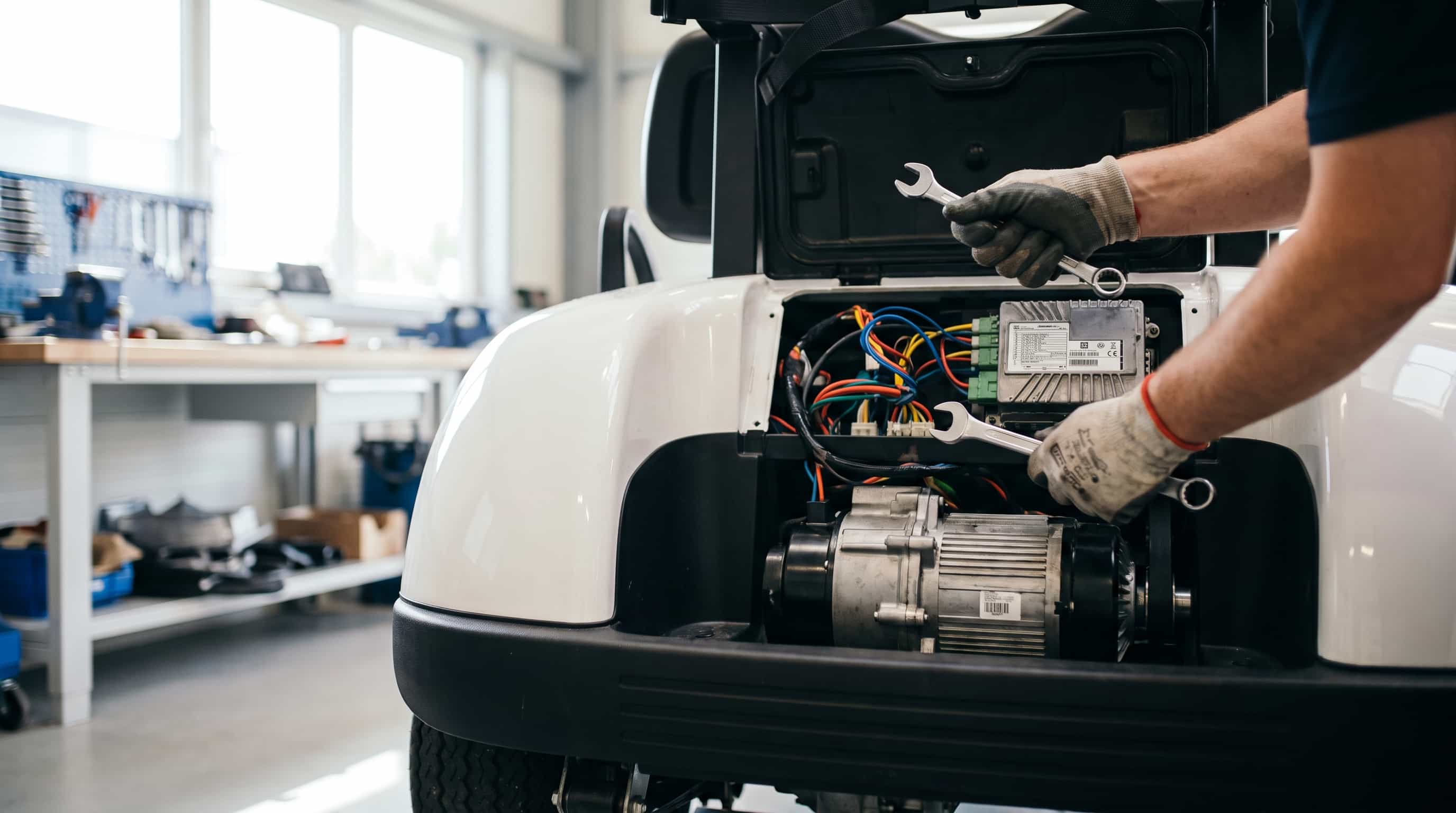
Between the throttle and the motor sits the controller. When you press the pedal, the throttle sends a small signal, and the controller decides how much of the battery's power to deliver to the motor, smoothly and in the direction selected. It also watches its own temperature, the current it is passing, and the health of the signals coming in, and it will act to protect itself and the buggy when any of those go outside safe limits.
That self-protection is the key to understanding controller symptoms. The controller is designed to reduce power or shut down rather than damage itself, so a lot of what looks like a controller fault is the controller behaving exactly as intended in bad conditions.
Protection versus failure
The difference matters because it changes what you do. Protective behaviour is provoked by conditions: a long hot climb, an overloaded buggy, a low battery, or a poor connection making a signal look wrong. It comes and goes with those conditions, and power returns when things cool or the demand eases. A genuine failure is present regardless of conditions and does not recover.
So when a buggy fades on a hill on a warm day and drives fine again once cool, that is almost certainly protection, and the fix is to address the heat, load or battery, not the controller. When it will not drive properly cold, warm, loaded or empty, a real fault is more likely.
Reading the error behaviour
Most controllers do not fail silently. They report through a fault light that flashes a code, or through a handheld programmer that displays a message, and that report is the fastest route to a diagnosis. A flashing pattern that means throttle fault sends you to the throttle and its wiring. One that means over-temperature confirms you were seeing protection. One that means main contactor or motor fault sends you elsewhere again.
Reading the code first, against the maker's list for your specific controller, is what separates a five-minute fix from an expensive wrong guess. The guide on controller error codes covers how to find and read them.
If yours is doing this and the checks here have not settled it, we diagnose and repair buggies, including a callout to wherever it is.
When it is worth an engineer
An owner can read a code, check the obvious causes it points at, and clear the simple things: a loose throttle connector, a low battery, a hot controller given time to cool. Beyond that, controllers are sealed, expensive electronics, and diagnosing a genuine internal fault needs test equipment and knowledge of that specific unit. Replacing a controller on a hunch is one of the more expensive mistakes in buggy repair, so if the code points inside the controller, or if the behaviour makes no sense, that is the point to get it properly diagnosed rather than buy a part and hope.
Common questions
- My buggy goes into limp mode on hills
- That is usually the controller protecting itself from heat or high current, especially on a warm day or with a full load. If normal power returns once it cools and the demand eases, it is protection rather than a fault. Address the load, heat and battery charge before suspecting the controller.
- There is a flashing light when it will not drive
- That flashing is likely a fault code. Count the pattern and read it against the maker's list for your controller, or connect a handheld reader if you have one, because the code tells you where to look. Replacing the controller without reading the code risks paying for a part that was never the problem.
- Are controllers easy to replace
- Physically it is a recognised job, but they are expensive and often programmed to the specific buggy, and a wrong diagnosis means an expensive part fitted for nothing. Because of that, controller work is usually better diagnosed and carried out by an engineer with the right reader and knowledge of the unit.
Still not right
We diagnose and repair golf buggies, service them on a plan, and send an engineer out to where the buggy is. Tell us the symptom and we will say what it usually means.