Onboard versus offboard golf buggy chargers
By James Brown · Updated 21 July 2026 · 4 minute read

An onboard charger is built into the buggy, so you plug the mains straight in; an offboard charger is a separate unit with a lead to the buggy. Both do the same job of charging the pack to a proper profile. The important thing with either is that the charger matches the battery type and pack, since a mismatched charger charges badly or unsafely.
Key takeaways
- An onboard charger is built into the buggy; you connect mains power directly.
- An offboard charger is a separate unit connected to the buggy by a lead.
- Both charge the pack to a battery-specific profile; the location is the main difference.
- The charger must match the battery type and pack, especially for lithium.
- A mismatched or wrong charger charges poorly or unsafely, so replacements must suit the set.
The simple difference
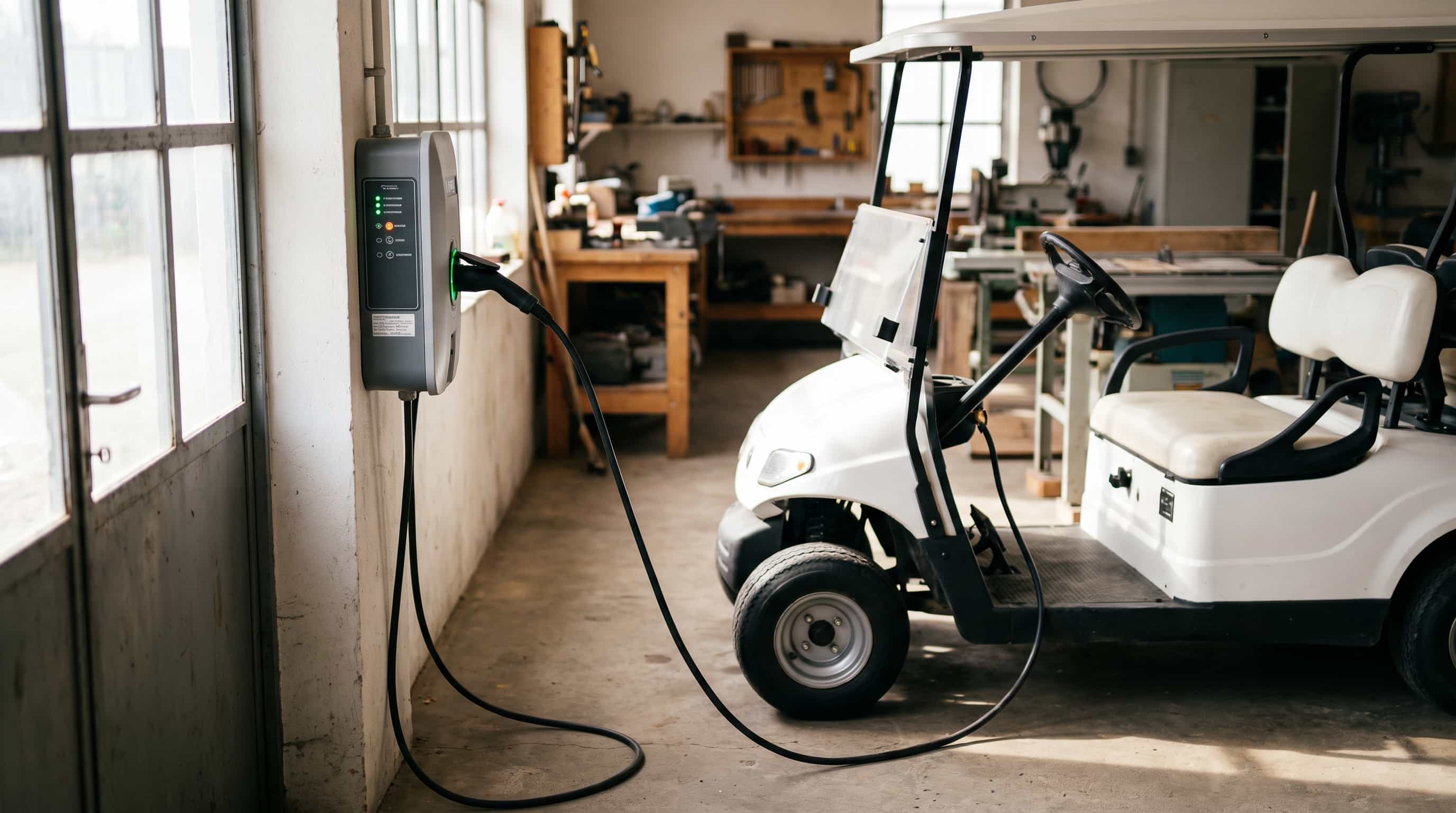
The distinction is mostly about where the charger lives. An onboard charger is fitted inside the buggy, so charging is a matter of plugging a mains lead straight into the buggy, convenient because there is no separate box to carry or lose. An offboard charger is a standalone unit that sits on the floor or a bench, with a lead that connects to the buggy's charge socket. Functionally they do the same job, reading the pack and delivering a controlled charge, and neither is simply better; they are two ways of packaging the same task, and buggies come with one or the other.
What it means for charging and faults
For everyday charging, the routine is similar: connect, let the charger run its profile, and read its indicator lights. The location does change a couple of practical things. An onboard charger travels with the buggy, so a buggy can be charged wherever there is a mains socket without carrying a unit, which suits a buggy that moves between sites. An offboard charger can be shared or swapped more easily and kept in one place, and being separate, a faulty offboard charger can be substituted for testing without touching the buggy, which helps diagnosis. When charging fails, the diagnostic approach in the charging guides applies to both; you are just checking a built-in unit in one case and a separate one in the other.
The thing that really matters
Onboard or offboard is a detail next to the point that matters most: the charger must match the batteries. A charger is designed around a battery type and pack, and it runs a charge profile suited to them. Put the wrong charger on a set, particularly a charger meant for one battery type on another, and at the least it charges poorly, at worst it charges unsafely. This is especially true for lithium, which needs a charger designed for it and its battery management system, and must not simply inherit an old lead-acid charger. So whenever a charger is replaced, or a set is changed, the charger and the batteries have to be matched, and that is worth confirming with someone who knows the buggy rather than assuming any charger with the right plug will do.
If yours is doing this and the checks here have not settled it, we diagnose and repair buggies, including a callout to wherever it is.
Replacing a charger
When a charger fails and needs replacing, the sensible route is to fit one suited to your exact pack and battery type, onboard or offboard as your buggy is built for, rather than the cheapest unit that fits the socket. Getting the match right protects the batteries, which are the expensive part, and keeps charging safe. If you are unsure what your buggy takes, the maker's documentation or an engineer who knows the model will specify it, which is a small step that avoids charging a valuable set on the wrong profile.
Common questions
- What is the difference between onboard and offboard chargers
- An onboard charger is built into the buggy, so you plug mains power straight in, while an offboard charger is a separate unit connected by a lead. Both charge the pack the same way to a battery-specific profile; the main difference is where the charger lives and the convenience that follows, not how well they charge.
- Does it matter which type I have
- Not much for everyday charging, since both run a controlled profile and you read their lights the same way. It matters more for practicalities: an onboard charger travels with the buggy, an offboard one can be shared or swapped for testing. What matters far more than the type is that the charger suits your battery type and pack.
- Can I use any charger that fits the socket
- No. The charger must match the battery type and pack, because it runs a charge profile designed around them, and a mismatched charger charges poorly or unsafely, especially lithium on a lead-acid charger. When replacing a charger, fit one suited to your exact set, confirmed by the maker's documentation or an engineer, rather than any unit with the right plug.
Still not right
We diagnose and repair golf buggies, service them on a plan, and send an engineer out to where the buggy is. Tell us the symptom and we will say what it usually means.
Related pages
Related guides
 Golf buggy troubleshooting, a complete guide9 minute read
 Wheel bearings, symptoms of wear5 minute read
 Golf buggy long-term storage beyond one winter4 minute read
- Charger not working, what to check5 minute read
- Charging faults and how to diagnose them7 minute read
- Golf buggy trickle charging and maintenance charging4 minute read