How to jump start or recover a flat buggy safely
By James Brown · Updated 21 July 2026 · 5 minute read
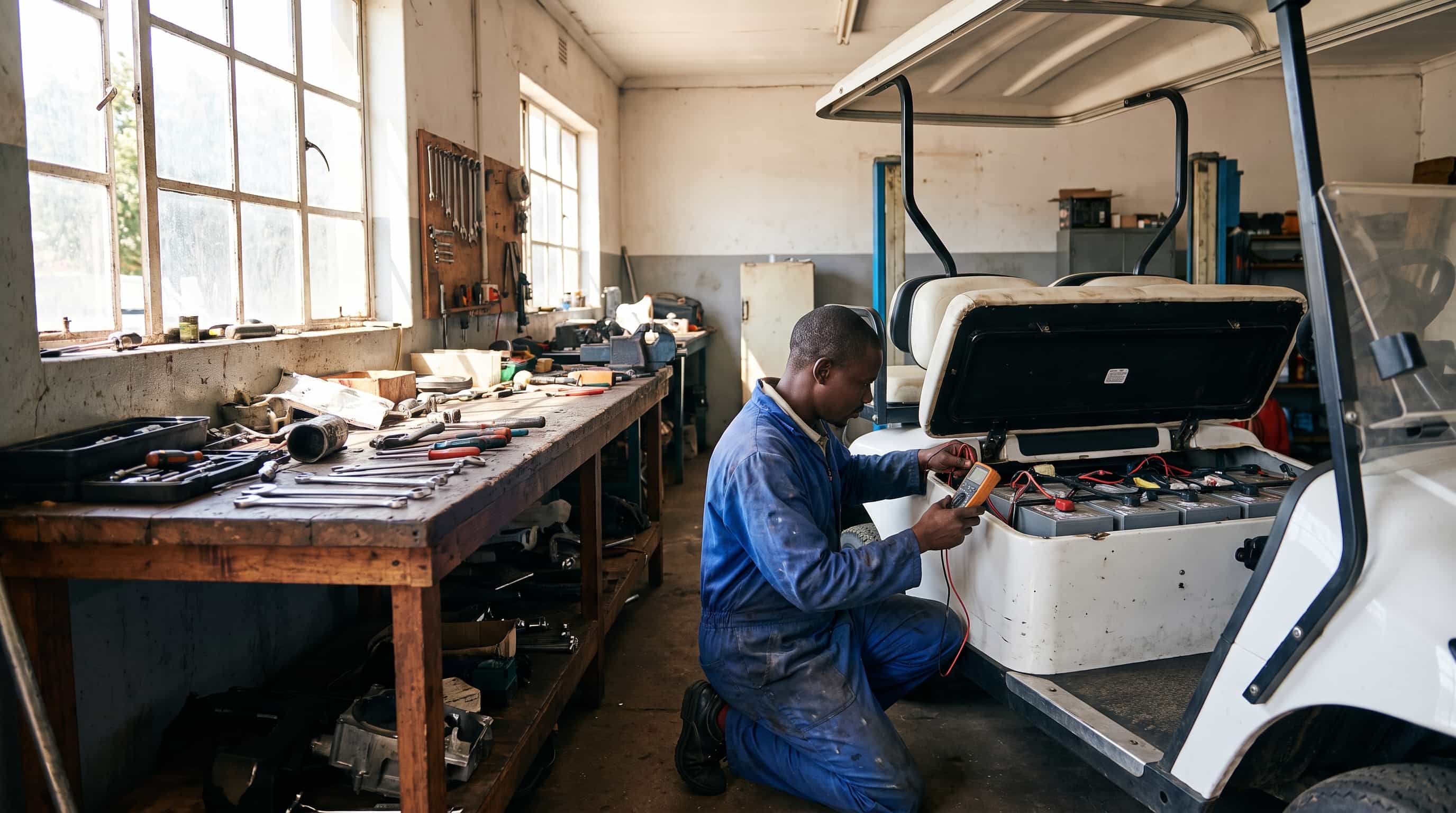
An electric golf buggy is not jump started like a car. A flat buggy is recovered by charging its pack properly, and the usual problem is that a deeply flat pack has dropped below the voltage the charger needs to start, so it appears dead. Recovering from that safely needs the right approach, and it is a job to stop and get help with if you are unsure.
Key takeaways
- Do not treat a buggy like a car battery to be jump started from another vehicle.
- A flat buggy is normally recovered by charging the traction pack correctly.
- A deeply flat pack can sit below the charger's minimum start voltage and look dead.
- Working around a charger's safety cut-out to wake a flat pack must be done carefully or not at all.
- A swollen, hot, leaking or damaged battery is a stop-now situation, not a recovery attempt.
Why a buggy is not a car
People reach for jump leads because that is what you do with a flat car, and it is the wrong instinct here. A golf buggy's traction pack is several batteries wired to deliver a much higher voltage than a car's single battery, and it drives the buggy through a controller rather than cranking an engine. Connecting a car or a random battery to it is not how you recover it, and doing so blindly risks damage or worse. The normal, correct recovery is to charge the pack properly with the buggy's own charger, or a suitable one, and let the charge bring it back.
The deeply flat pack
The common sticking point is the one from the charging guides. Many modern chargers will not start unless they see a minimum pack voltage, a safety feature so they do not force charge into a damaged or absent pack. A set left flat for a long time can sink below that threshold, and then the charger sees what looks like no battery and does nothing. The buggy appears completely dead, the charger appears broken, and neither is quite the truth: the pack is simply too flat to be recognised.
Recovering a pack from that state involves getting a little charge into it by a means that persuades the charger to take over, and that is deliberately working around a safety cut-out. It can be done, but it needs the right equipment and an understanding of what you are doing, because you have removed a protection the charger put there for a reason.
If yours is doing this and the checks here have not settled it, we diagnose and repair buggies, including a callout to wherever it is.
Doing it safely, or not at all
If you are competent and equipped, recovery is a careful, methodical job done with eye protection, in a ventilated space, away from sparks and flames, because a charging pack gives off flammable gas and the electrolyte is acid. If you are not sure, this is a genuinely sensible thing to hand to an engineer rather than improvise with makeshift kit, because the failure modes here, forcing charge into a damaged pack, overheating a battery, an acid or gas incident, are the ones worth avoiding entirely.
And there is a firm stop. If any battery in the pack is swollen, cracked, leaking, hot, or giving off a strong smell, do not attempt to recover or charge it. That is a damaged battery, and it is a hazard to be dealt with by someone competent, not a flat pack to be woken. The whole Repair Centre routes a damaged battery straight to an engineer with no self-fix, and this guide does the same.
Common questions
- Can I jump start my golf buggy from my car
- No. A buggy's traction pack works at a much higher voltage than a car battery and is not recovered that way, so connecting a car to it risks damage. Recover a flat buggy by charging its pack properly with a suitable charger, not with jump leads from another vehicle.
- My pack is so flat the charger will not start
- That is the common deeply-flat case: the pack has dropped below the minimum voltage the charger needs to begin, so it does nothing and looks dead. Recovering it means carefully getting some charge in so the charger takes over, which works around a safety cut-out and needs the right equipment. If unsure, have an engineer do it.
- When should I not try to recover it myself
- Stop immediately if any battery is swollen, cracked, leaking, hot or strongly smelling, because that is a damaged battery and a hazard, not a flat one. Also stop if you lack the right equipment or are unsure, since forcing charge into a damaged pack is exactly the risk worth avoiding. Hand those cases to an engineer.
Still not right
We diagnose and repair golf buggies, service them on a plan, and send an engineer out to where the buggy is. Tell us the symptom and we will say what it usually means.
Related pages
Related guides
- Golf buggy troubleshooting, a complete guide9 minute read
- Winter storage, preparing a buggy6 minute read
- Golf buggy voltage systems, 36V and 48V explained4 minute read
 Charging faults and how to diagnose them7 minute read
- Charger not working, what to check5 minute read
- Golf buggy battery safety, acid, gas and handling5 minute read