Golf buggy tie rods and steering linkage
By James Brown · Updated 21 July 2026 · 4 minute read

The tie rods and their ends connect the steering to the front wheels and set how the wheels point. As they wear, play develops, giving loose, wandering steering and often uneven tyre wear as the tracking drifts. Checking for play is fair owner work, but replacing steering parts and setting the tracking is an engineer job, because steering is safety-critical.
Key takeaways
- Tie rods and their ends link the steering to the front wheels and set the tracking.
- Wear in these parts gives play, so the steering feels loose and wanders.
- Worn linkage lets the tracking drift, which shows as uneven tyre wear and a pull.
- Checking for play by rocking the wheels is fair owner observation.
- Replacing steering parts and setting tracking is safety-critical engineer work.
What they do
The steering wheel does not connect directly to the road wheels; it acts through a linkage, and the tie rods are a key part of it. They transmit the steering movement to the front wheels and hold them at the correct angle, and their ends, the joints that let the linkage pivot as the suspension moves and the wheels steer, are designed to move freely but without slack. It is a small set of parts doing an important job, and because they carry the loads of steering and take knocks from rough ground, they wear.
How wear shows
Worn tie rod ends develop play, clearance where there should be none, and that play shows up in two linked ways. At the steering wheel, it feels like slack: you turn and nothing happens for a moment, and you find yourself making constant small corrections to hold a line, the loose, wandering feel covered in the steering guides. At the tyres, the play lets the wheels drift from their set angle, so the tracking wanders and the tyres wear unevenly, often more on one edge, which ties in with a buggy that pulls to one side. Uneven tyre wear alongside vague steering is a strong pointer at worn linkage.
Checking, within limits
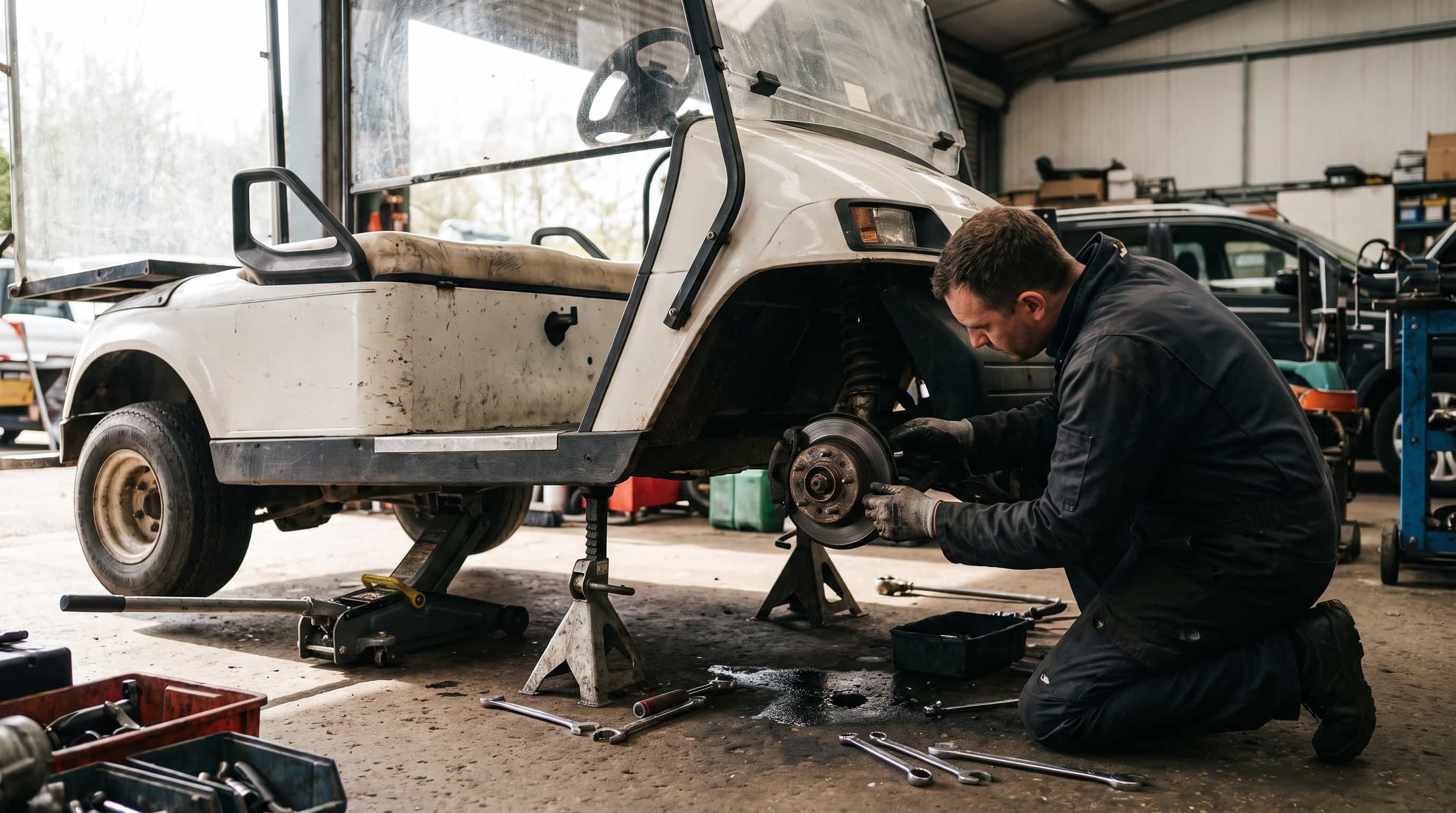
An owner can gather useful evidence safely. With the buggy stationary and the front raised where it is safe, taking hold of a front wheel and rocking it, and watching and feeling the tie rod ends and joints, reveals obvious play, a knock or a looseness where the joint should be tight. Feeling for movement in the linkage as a helper gently turns the steering does the same. This confirms whether there is play and roughly where, which is exactly what an engineer needs to know. It does not replace a proper inspection, but it turns a vague feel into a located suspicion.
If yours is doing this and the checks here have not settled it, we diagnose and repair buggies, including a callout to wherever it is.
Why the repair goes to an engineer
Here the guidance is firm, as with all steering. Replacing tie rods and their ends, and setting the tracking correctly afterwards, is safety-critical work. A steering joint that comes apart or is fitted wrong can take away your control of the buggy, and tracking set by eye rather than measured makes the buggy handle badly and wears the tyres. So the repair belongs with an engineer, and the Repair Centre routes steering faults there. And a sudden change in steering feel, rather than a slow drift into vagueness, is a stop-and-check now, not a monitor-it, because losing steering while moving is serious.
Common questions
- There is play in my steering before the wheels turn
- That slack is often worn tie rod ends or linkage joints, which develop play as they wear. Confirm it by safely rocking a raised front wheel and feeling for movement in the joints. It grows rather than settles, and it wants an engineer, since a worn steering joint can eventually fail and steering is safety-critical.
- Why are my front tyres wearing unevenly
- Worn steering linkage lets the tracking drift from its set angle, so the wheels scrub and the tyres wear unevenly, often heavier on one edge, and the buggy may pull. Uneven tyre wear with vague steering points at worn tie rod ends. Have the linkage checked and the tracking set, which is measured engineer work rather than an eye adjustment.
- Can I replace a tie rod myself
- Steering is safety-critical, and a tie rod or joint fitted wrong, or tracking set by eye, can leave the buggy handling badly or, worse, unsafe. Checking for play is fair owner work, but the replacement and the tracking set belong with an engineer who can do it properly and measure the result.
Still not right
We diagnose and repair golf buggies, service them on a plan, and send an engineer out to where the buggy is. Tell us the symptom and we will say what it usually means.