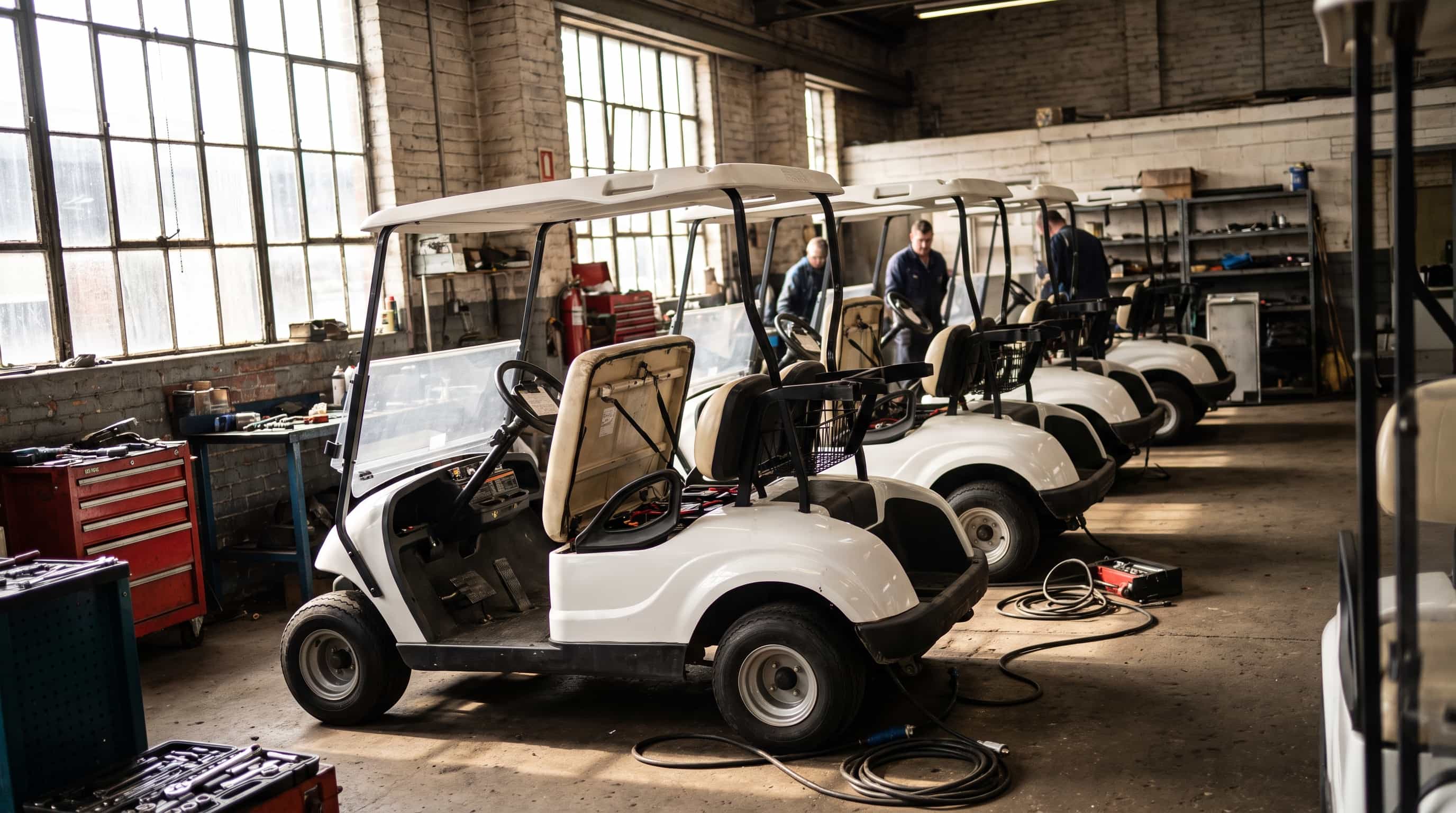
Security marking and registers for a golf buggy
By James Brown · Updated 29 August 2026 · 10 minute read

Buggies are stolen because they are simple to move and hard to identify. Marking answers the second half of that: a visible mark that makes a machine awkward to sell on, a forensic mark that survives a repaint, and photographs of the identification plate taken long before you need them. Behind the marks sits a register naming each machine, its serial number, its marking reference and where it is kept. That record is what a police report and an insurance claim are built from, and it has to exist beforehand.
Key takeaways
- A buggy used off the road has no registration document and no number plate, so nothing links it to you unless you create that link yourself.
- Visible marking works by making a machine slow and awkward to sell rather than by making it harder to lift.
- Forensic marking survives a repaint and a panel change, but only where the sample is registered and the warning label is displayed.
- Photographs of the identification plate and of a machine's odd details carry far more weight in a claim than a description.
- Battery packs, chargers and controllers carry their own numbers, and they are often what actually leaves the site.
- A register is only useful where it is kept somewhere the fire, the flood or the thief cannot reach it.
- Storage conditions are frequently a policy requirement rather than a suggestion, and your broker should state them in writing.
Why marking matters more on a buggy than on a car
A road vehicle carries a registration, a number plate and a document trail, and moving a stolen one is difficult because of all three. A golf buggy used on private land has none of that. It has a serial number on a plate somewhere, and beyond that it is a machine that looks like every other machine of its type, loads onto a trailer in a couple of minutes and sells to somebody who will never think to ask a question about it.
Marking fills that gap. It does not make the buggy harder to take, and nothing written on a panel ever will: locks, anchors, immobilisers and a locked building do that job. What marking does is make the machine harder to convert into money, and give you something concrete to point at when one turns up. The two jobs are separate, they fail in different ways, and a sensible arrangement does both rather than choosing.
Visible marking and what it costs a thief
Visible marking is the cheap half and often the effective half. A site name or postcode applied to body panels, a fleet number, tamper-evident labels that shred if lifted, and a decal stating that the machine is marked and registered. The point is not decoration. Somebody viewing a buggy with another organisation's name across the rear panel starts asking questions, and a thief who must remove or overpaint the marks has spent time and left evidence behind.
Put the marks where a single panel change cannot remove all of them. One on a moulded body panel, one somewhere structural, one somewhere unglamorous that nobody would think to check. Keep a record of where each one went, with photographs, because you will not remember on the day it matters. Where the machine is one of several, number them and use the same numbers in every record you keep, so nothing has to be worked out twice.
Forensic marking and how it actually works
Forensic systems put a unique and effectively invisible signature on the machine and hold the record of it on a database that the police can query. Chemical marking, microdot systems and similar schemes all rest on the same principle: the mark survives handling, cleaning and repainting, and the identity itself lives in the register rather than on the vehicle, where it cannot simply be scraped off with the paint.
Two things decide whether it earns its keep. The first is registration, because an unregistered kit is a bottle of liquid with nothing behind it, so complete the paperwork on the day you apply it rather than at the weekend. The second is the warning label, since deterrence needs the thief to know before they start. Apply the mark at several points, including ones that anybody stripping the machine would disturb, and reapply after a repair that renews a panel.
An ultraviolet pen is better than nothing and it is not a forensic system. The mark fades with sunlight and cleaning, it comes off with the right solvent, and there is no database standing behind it, so nobody who finds the machine has any way of tracing the writing back to you. Use one where it is all you have, then treat it as a stopgap rather than as the answer, and record where you wrote it.
The identification the machine already carries
Before adding anything, record what is already there. Buggies carry a serial or chassis number as a plate, a sticker or a stamping, and the location varies by make and by age: under a seat, on a frame rail, behind a body panel or on the dash. Find it in daylight, clean the area, and photograph it so that it stays legible when the picture is printed or emailed rather than only on a bright screen.
The major components carry numbers too. Motor, controller, charger and battery pack usually have their own identification, and where a stolen machine has been broken for parts those numbers are the only thread left to follow. They are also what an insurer asks for and what a careful purchaser checks, which makes recording them useful long before anything goes wrong. Write them into the same document as the serial number rather than keeping four separate notes.
Photographing a machine before you need it
Descriptions make weak evidence and photographs make strong evidence. A set taken on a dry day, with the machine clean, does most of the work: four corners, the seats, the wheels, the dashboard, the identification plate close enough to read, and the marks you have applied. Add the details that make this buggy yours rather than one of a batch, because those are what somebody recognises later in an online listing or on the back of a lorry.
Store them where a fire or a theft cannot take them along with the machine. A folder in cloud storage, named for the buggy and dated, is enough. Retake them after any repair, respray or accessory fitted, since a photograph that no longer matches the machine is an argument waiting to happen. Keep the purchase invoice in the same folder, and keep it in a form you can forward to somebody in a hurry.
- All four sides, plus the seats, the wheels and the dashboard.
- The identification plate, close and legible, with the serial readable when printed.
- Component numbers from the motor, controller, charger and battery pack.
- The oddities: a repair, a mismatched panel, a scuff, a non-standard seat or accessory.
- The security marks themselves, with a note of exactly where each one sits.
Looking for one of your own? Every buggy we list carries its specification and the checks this guide describes, so you can compare them on the same terms.
The register a claim can rest on
A register is a list of machines with enough attached to each one that a stranger could identify it. For a single privately owned buggy that can be a page. For a club fleet it needs to be a document somebody owns and updates. Either way the test is the same: if the machine went tonight, could you give the police and the insurer everything they need quickly, working from memory of where the file lives rather than memory of the machine?
Keep key control in the same document. Who holds a key, how many exist, and what happens when a member of staff leaves. Buggy keys are frequently common to a make rather than unique to an individual machine, which is worth confirming rather than assuming, because it changes what a key in the wrong hands actually means and what a locked machine is really protected by.
- Make, model, serial number and the date and source of purchase, with the invoice attached.
- Battery pack make, chemistry and installation date, plus the charger that belongs to it.
- The marking scheme used, its reference number, and where each mark was applied.
- Dated photographs, refreshed after any repair or change to the machine.
- Where the buggy is kept, who is responsible for it, and who holds keys.
- Service and repair dates, which also evidence that the machine was maintained.
What an insurer tends to expect of storage
Cover for a buggy usually arrives with conditions about how it is kept, and those conditions are requirements rather than advice. A locked building, a ground anchor, an immobiliser, a tracker, keys held away from the machine: which of them apply depends on the value, the location and the insurer. Get the list in writing from your broker and keep it with the policy, because a condition remembered from a telephone call is no use to anybody.
Then meet them and be able to show that you did. Photographs of the anchor in place, an invoice for the tracker, a note of the marking scheme and its reference. Claims are declined for failing a condition far more often than for anything dramatic, and the failure is usually a small detail nobody wrote down. Where your storage changes, including a machine moved for the season, tell the broker before the change rather than afterwards.
- Ask the broker for the storage and security conditions in writing, then read them.
- Photograph the storage arrangement as evidence that the conditions were actually met.
- Keep keys away from the machine, and record who holds each one.
- Tell the insurer when storage changes, including a buggy moved to another site for the season.
Keeping the record alive
A register goes stale quietly. Machines are sold, batteries are replaced, somebody leaves and takes a key with them, a panel is renewed and takes a mark away with it. Set a rhythm instead of relying on memory: pin the review to something you already do, an insurance renewal for a private owner or the service round for a fleet, then walk the machines with the register open and correct whatever has drifted since anybody last looked.
Record disposals as carefully as purchases. When a machine goes, note the date, the buyer and the serial number, and remove it from any marking database or tracker account. A buggy still listed as yours after you sold it is a nuisance at best. On the day something is taken, the value of all this is that the report writes itself, and the sooner accurate details are circulating, the better the chance of the machine being recognised.
Common questions
- Does security marking stop a golf buggy being stolen?
- Not on its own. Marking makes a machine difficult to sell and possible to identify, which deters an opportunist and helps recovery afterwards. What prevents the theft itself is physical: a locked building, a ground anchor, a wheel clamp, an immobiliser and control of the keys. The two do different jobs, and neither one substitutes for the other.
- Where is the serial number on a golf buggy?
- It varies by make and by age. Common locations are under a seat, on a frame rail towards the front or rear, on the dash panel, or behind a body panel, as a plate, a sticker or a stamping. Look in daylight, clean the area, and photograph it once you have found it so that nobody has to go searching again in a hurry.
- Will marking my buggy reduce my insurance premium?
- Some insurers recognise marking and tracking schemes and some treat them as conditions rather than as anything that changes the price. There is no general answer, because it depends on the insurer, the value and where the machine is kept. Ask your broker directly what they recognise, and get any storage or security requirement in writing before you rely on it.
- Do I have to register a golf buggy with DVLA?
- A machine used only on private land is not registered the way a road vehicle is, which is exactly why a private record matters: nothing external ties the buggy to you. Where you intend to use one on a public road, approval, registration, tax and insurance all come into play, and DVLA is the authority on what applies to your specific machine.
- What do I give the police if a buggy is stolen?
- The make and model, the serial number, component numbers where you have them, the marking scheme and its reference, recent photographs and the purchase invoice. Report it promptly and send the same pack to your insurer. Everything on that list is straightforward to assemble in advance and very difficult to assemble once the machine has gone.
- Is a tracker worth fitting to a golf buggy?
- It depends on where the machine lives and how quickly anybody would notice it missing. A tracker helps recovery and can satisfy an insurance requirement, but it needs a subscription, a power source and somebody willing to act on an alert at an inconvenient hour. On a remote site with machines left out, it earns its place. Inside a locked, alarmed building it may add little.
See what is for sale
New and used buggies, each listed with its specification and history, so you can apply what this guide covers before you go and see one.