What a golf buggy service history should show
By James Brown · Updated 29 August 2026 · 10 minute read

A buggy has no statutory inspection and no standard service book, so its history is whatever an owner chose to keep. What you want to see is battery installation dates and a watering routine, the charger checked and matched to the pack, brake and steering work with dates against it, any controller or motor work including settings that were changed, and the name of whoever did each job. A thin history is not proof of neglect, but it moves the whole burden onto the machine itself and onto the inspection.
Key takeaways
- There is no statutory inspection for a buggy used off the road, so paperwork is voluntary and its presence tells you about the owner.
- The battery record is the most valuable page: installation date, chemistry, whether the pack went in as a set, and how it was watered.
- A pack holding blocks of two different ages behaves like the oldest of them, which makes replacement dates worth reading closely.
- Charger records matter because the wrong charger damages a pack slowly and leaves no obvious mark behind.
- A changed speed setting is a maintenance record, an insurance question and sometimes a warranty question all at once.
- An owner's dated notebook with receipts can be better evidence than a folder of invoices that say service carried out and nothing more.
- A machine with no history is still worth considering, provided the inspection carries the weight the paperwork was not there to carry.
What a history is actually evidence of
It is evidence that somebody was paying attention. That is a smaller claim than it first sounds and a genuinely useful one. A buggy used off the road has no MOT, no statutory inspection and no standard service book, so nothing at all forces a record to exist. Where one does exist, it exists because an owner or a fleet decided to keep it, and people who keep records tend to be the same people who top up batteries and report noises early.
It is not evidence that the machine is sound today. Paperwork describes the past, and a pack replaced two seasons ago has done two seasons since. Read the history to understand how the buggy has been treated and what is now due, then inspect the machine to find out where it has actually got to. The two answers together are worth considerably more than either one on its own.
The battery record above everything else
The pack is the largest cost hiding in a used buggy, so its record is the page to read first. You want the installation date, the make and the chemistry, and confirmation that the whole pack went in together. A pack assembled from blocks fitted at different times performs like its oldest member, because the weakest cells set the behaviour of the whole string, and a single replaced block is a flag rather than a repair.
On lead-acid, the watering routine is the other half of the story. Topping up with distilled water, at the right point in the charge cycle, is what keeps a pack alive, and a fleet that recorded its watering rounds is telling you something real about how the machine was run. Look for equalisation charges where the pack calls for them. Lithium packs need no topping up and instead bring management electronics with their own firmware and fault history worth asking about.
- Installation date, make and chemistry, with the invoice where one exists.
- Whether the pack was replaced as a set or built up block by block over time.
- Watering records on lead-acid, and equalisation charges where the pack calls for them.
- Any pack fault, replaced block or warranty claim, with the date against it.
Chargers, and evidence that charging was done properly
A charger is part of the vehicle rather than an accessory. The record should show which charger belongs to the machine, that it matches the pack for chemistry, voltage and capacity, and that it has been checked or replaced when it failed. Chargers fail gradually as often as suddenly, finishing a cycle early or never reaching the finishing stage at all, and a pack starves quietly while everybody assumes it is being looked after.
Ask what the charging routine was as well as what the equipment is. Charged after every use, or charged when somebody remembered. Plugged in through the winter, or shut in a shed in October. On its own socket, or on an extension reel shared between three machines. Some fleets run chargers that log their cycles, and where that data exists it is usually the most honest document in the folder.
Brakes, steering and the safety work
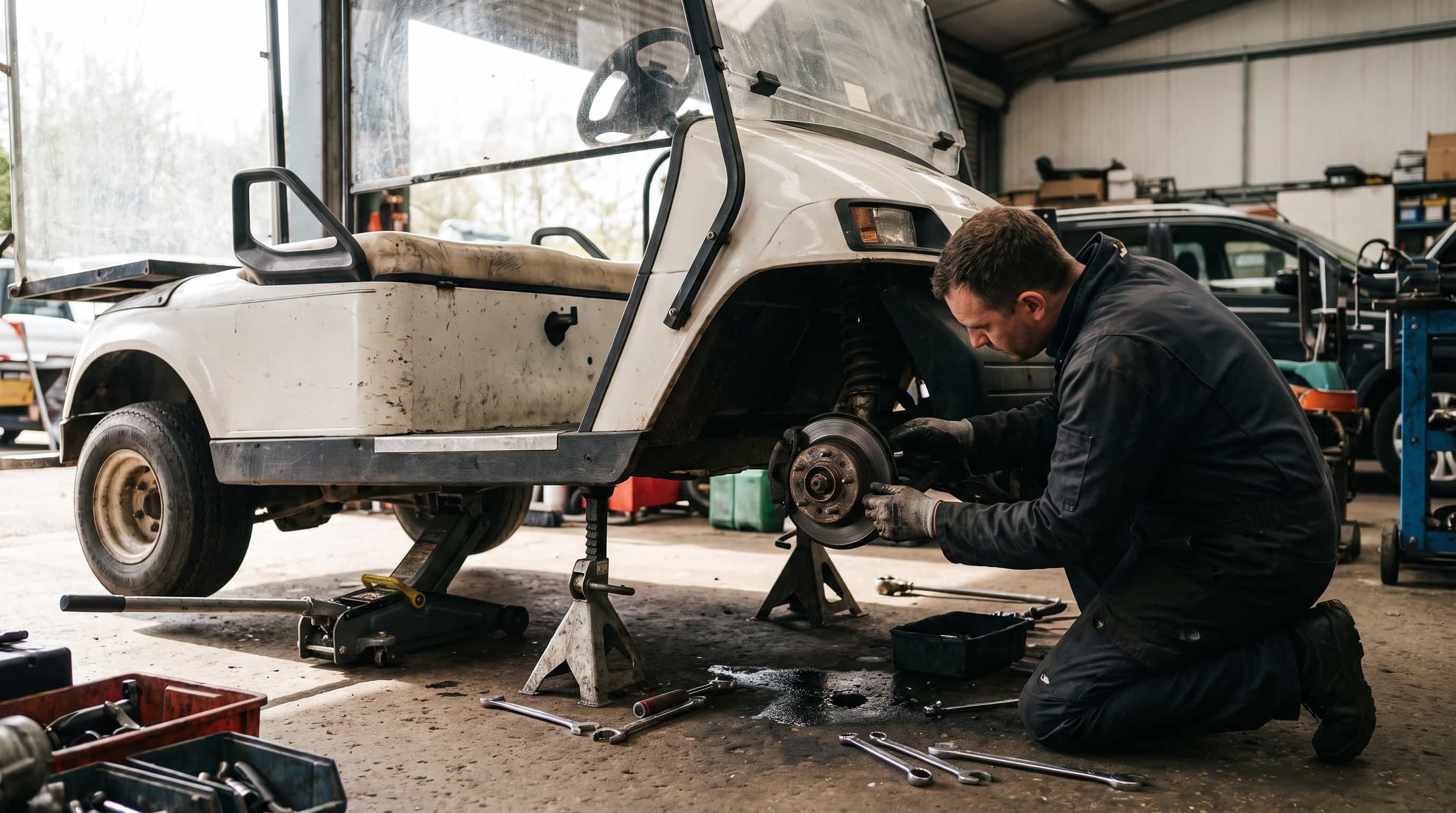
These entries date themselves usefully. Brake shoes or pads renewed, cables adjusted or replaced, the parking brake set up, cylinder work on a hydraulic system, wheel bearings, kingpins, tie rod ends and alignment. Each of those is ordinary wear on a working machine, and seeing them appear at sensible intervals through a life is reassuring rather than alarming. A machine that has worked has consumed things, and the folder should say so.
What you are hunting for is the absence that does not fit. A buggy with obvious high use and no brake work recorded anywhere has either had none, which is a problem waiting on a slope, or had it done without a record, which tells you the folder is incomplete and should be read as such. Tyres are the same test: four of the correct pattern, replaced at some point in a long life, is what a genuine history looks like.
Controller, motor and the settings somebody changed
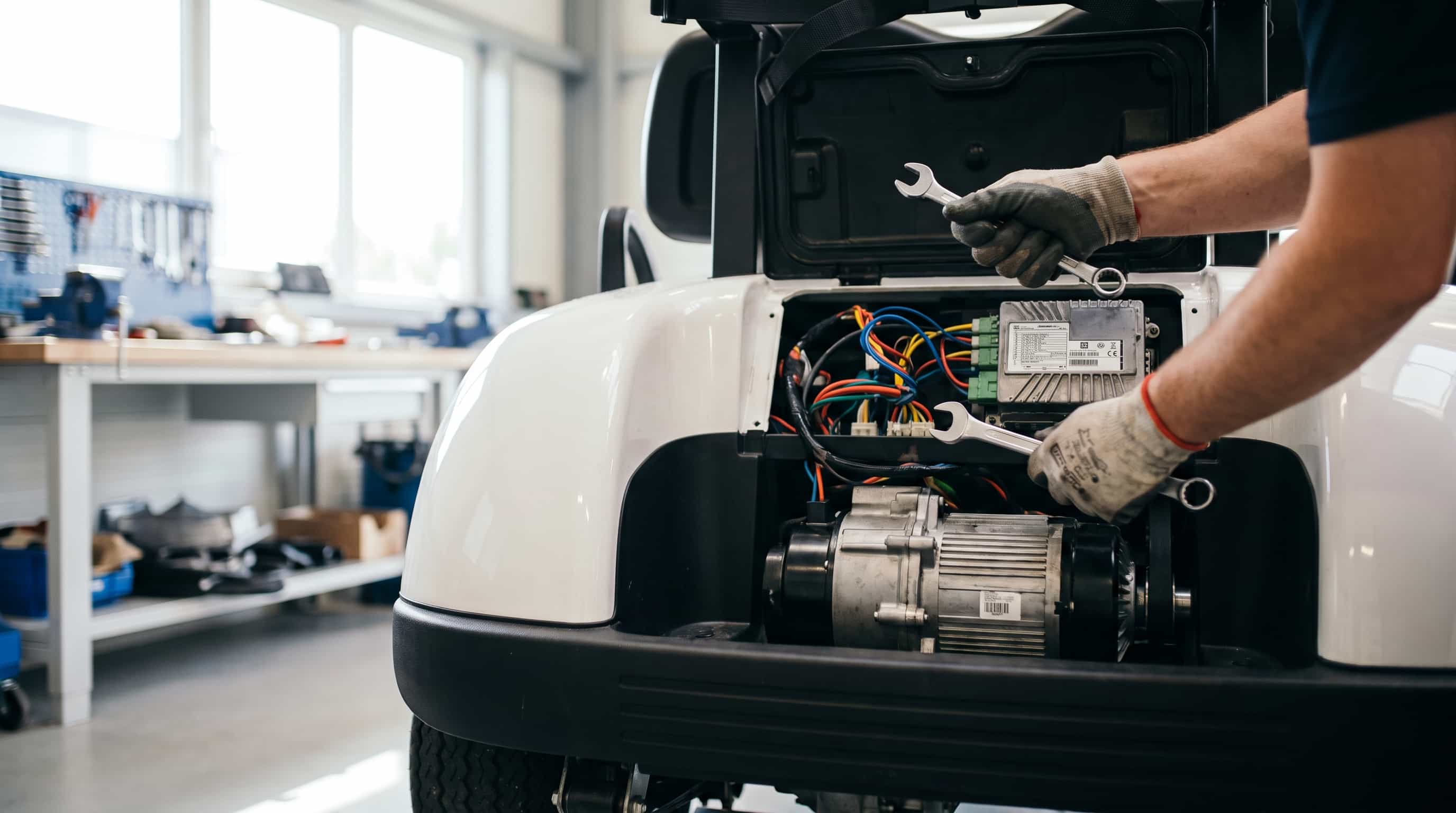
Drivetrain entries carry more information than they appear to. A replaced controller, a rebuilt or replaced motor, a new contactor or solenoid, transaxle oil changed, a new throttle sensor. Any one of those is normal across a long life. Several of them inside a short period suggests something upstream was never properly found, and that is a question to put to the seller directly rather than to work around quietly.
Settings deserve separate attention. Controllers on many machines can be reprogrammed for speed and response, and a change made to suit one site may not suit yours at all. It also reaches beyond driving: a machine altered from its original configuration can affect what a warranty covers and what an insurer was told about it. Where the history records a settings change, ask what was changed and why. Where it does not, have the current settings read rather than assuming they are standard.
Looking for one of your own? Every buggy we list carries its specification and the checks this guide describes, so you can compare them on the same terms.
Who did the work, and why the name matters
An entry with a name against it can be followed up. A dealer, a mobile buggy engineer, a club's own workshop, or the owner: each is a real answer and none of them is automatically the better one. What matters is that you can ring somebody and ask what the machine was like to work on. An engineer who has known a particular buggy for years will tell you more in one telephone call than any folder manages across a decade.
Owner-maintained is not a warning in itself. A competent owner with a dated notebook, receipts for the parts and photographs of the work is offering better evidence than a wallet of invoices that say service carried out and list nothing else. Judge the detail rather than the letterhead. An invoice that names parts and hours is worth several that name neither, and a photograph of a job now hidden is worth both.
Reading a thin history honestly
Most used buggies come with very little, and treating that as proof of neglect would rule out most of the market. Absence of paperwork is absence of information rather than evidence of a fault. What it does is shift the burden onto the inspection and onto the seller's answers, and it should shift the price as well, because you are now carrying the uncertainty that a folder would have taken off your hands.
There is a difference between a machine that has been maintained and one that has been prepared. Fresh paint, new seat covers and clean wheels take a day. Clean battery terminals, correct electrolyte levels, an even brake bite, four matched tyres and a charger that genuinely belongs to the machine take a habit. Where the cosmetics are well ahead of the mechanics, ask why the money went where it did before you decide what the buggy is worth.
Ask specific questions rather than general ones. When did the pack go in, who fitted it, and what was the last thing that went wrong with the machine. General questions invite general answers, and a seller with nothing to hide finds the specific ones easy. Write the replies down along with the date you were given them, because an answer that later turns out to be wrong is worth far more to you in writing than in recollection.
Starting a history on a machine that has none
Begin with a baseline. Have the machine inspected properly when you take it on, write down what was found, what was done and what was deliberately left, and photograph the identification plate, the battery pack and the charger. That single record turns an unknown machine into a known one from your ownership onwards, and every later entry hangs from it rather than floating on its own.
After that, keep it dull and keep it consistent. A book that lives with the machine, or a note on your phone, recording the date and what happened. It takes a minute and it pays back twice: once when a fault repeats and the pattern is already written down in front of you, and again at resale, when you are the person being asked what the pack is and when it went in.
- A dated baseline inspection when you take the machine on, including what was left undone.
- Battery installation date, make and chemistry, plus the charger that belongs to the pack.
- Every watering round, brake adjustment, tyre and repair, with the date and who did it.
- Photographs of the identification plate and of any work that will be invisible afterwards.
- Receipts kept with the log rather than in a drawer at the other end of the building.
Common questions
- Do golf buggies have a service book?
- Not as standard, and there is no statutory inspection for a machine used off the road. Some makers publish a maintenance schedule in the manual and some dealers keep their own records, but nothing forces a book to exist or to travel with the machine. In practice a history is a folder of invoices, a fleet maintenance sheet or an owner's notebook, and any of the three can be good evidence.
- How often should a golf buggy be serviced?
- It depends on how much it is used, the ground it works on and what the maker specifies, so the schedule in your own manual is the starting point rather than any general interval. A machine out most days needs attention far more often than one used at weekends. Battery care on a lead-acid pack is the part that cannot wait for a service, because it is a routine rather than an event.
- What if the seller has no paperwork at all?
- Buy on the inspection instead, and price the uncertainty in. Have the battery pack tested properly, run the machine under load and on a slope, check brakes and steering, and ask the seller direct questions about dates rather than general ones about condition. Plenty of sound buggies have no folder at all. What you should not do is pay as though the folder existed.
- How can I tell how old the batteries are?
- Look for date stamps on the batteries themselves, which most makers apply in some form, though the format varies between manufacturers and is not always obvious at a glance. An invoice with an installation date is stronger evidence. Where neither exists, an engineer can test the pack's condition, which answers the more useful question anyway, since a well-treated older pack can beat a neglected younger one.
- Does a service history affect what a buggy is worth?
- It affects how confidently anybody can price it, which amounts to the same thing. A documented battery date, evidence of brake and steering work and a named engineer remove most of the unknowns a buyer would otherwise be pricing against. Two machines in the same apparent condition will not attract the same interest where only one of them can show where it has been.
- Can I write up a service history myself?
- Yes, and it counts, provided it is dated and specific. Record what was done, when, by whom and which parts were used, then keep the receipts with the log. Photographs of work that will be hidden afterwards are worth adding. Anybody reading it later is looking for detail and consistency rather than a printed letterhead, and a careful owner's notebook reads as exactly that.
See what is for sale
New and used buggies, each listed with its specification and history, so you can apply what this guide covers before you go and see one.