Buggy roofs compared: standard, extended and hard tops
By James Brown · Updated 29 August 2026 · 10 minute read
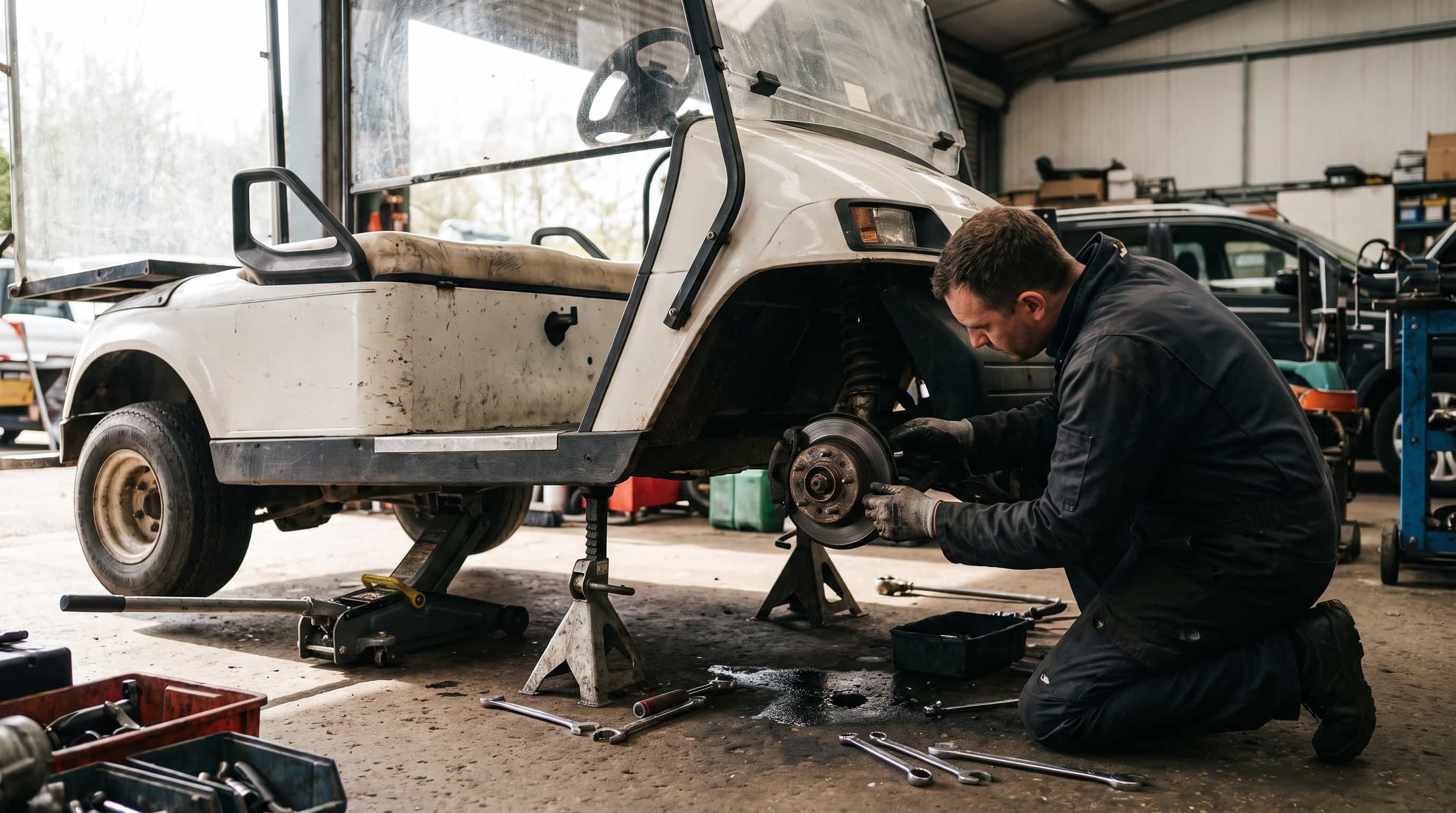
A roof is part of the structure rather than a cosmetic panel. It is carried on struts tied into the frame, it takes wind load at speed and on a trailer, and passengers grab it getting in and out. A standard top covers the front seats. An extended top reaches over a rear seat and puts weight and leverage behind the rear axle. Moulded and hard tops carry weather equipment better; fabric tops are lighter and cheaper to replace. Measure the finished height first, because a store door decides more than the description does.
Key takeaways
- The roof feeds wind and handling loads into the frame, so the struts and fixings matter more than the panel material does.
- A standard top keeps rain off the front seats and does very little once the machine is moving into weather.
- An extended top is the only way to cover a rear seat, and it adds area and leverage high up and behind the rear axle.
- Moulded tops take the fixings that screens, curtains and enclosures hang from, which quietly decides what weather equipment you can fit later.
- Rattles almost always start at the mountings, and a rattle left alone becomes a crack around a fixing point.
- Overall height with the roof and any beacon fitted is the dimension that decides storage, container loading and trailer transport.
- Anything carried on a roof sits well above the centre of gravity, and only the maker can say what the roof is rated to take.
A roof is structure before it is shelter
The panel is the part you see, and it is the least interesting part. What holds it up is a set of struts bolted into the chassis, the seat frame or both, and every load the roof meets travels down those struts into the machine. Wind at speed, a low branch, the weight of a passenger hauling themselves up by the front leg: all of it ends at the mounting points. When you compare tops, compare the mountings first, then the material, then the shape.
It is worth being blunt about what a roof is not. Weather equipment is not rollover protection, and a top that looks substantial is not a roll cage unless the maker says so in writing and the machine was built around it. If your ground has slopes that worry you, that is a question about the vehicle and the route rather than a question about the roof, and the answer comes from the maker's own documentation rather than from a supplier's catalogue.
What a standard top actually covers
A standard top covers the front seats and the area around the wheel, and in still air that is genuinely useful. Rain rarely falls straight down in Britain. Driving into a shower puts water onto your legs and the front of the seat, a crosswind puts it onto whoever is on the windward side, and the rear edge of the roof drips onto the seat back or into the bag deck once the run-off starts. Parked outside in wind, the seats get wet regardless.
For a course machine that meets occasional showers, a standard top with a screen is usually enough, and it is the arrangement most fleets run for good reasons. It is light, it does not change the handling, and it is cheap to put right after a knock. What it will not do is keep a passenger dry in sustained rain, keep the seats usable when the machine lives outdoors, or cover anybody sitting behind the front row.
- Front seats and the steering area, in light rain and reasonable wind.
- Shade, which matters more than people expect on an exposed course in summer.
- A mounting platform for a screen, and often for a beacon or a light bar.
- Not the legs, not the bag deck, not a rear seat, and not a parked machine in a gale.
Extended tops and covering a rear seat
An extended or long top carries the roof back over a rear-facing flip seat or a load deck. If the machine moves people rather than clubs, this is not a refinement. Anyone in the back of a standard machine is sitting under open sky with the run-off from the front roof landing near them, which is fine for a hundred metres and unacceptable for a shuttle run around a site in November. The extension is what makes the rear seat usable in the weather that made you buy the seat.
The cost is weight and leverage. You are adding area high up and behind the rear axle, which is the worst place to add both. On a side slope the machine feels different, in a crosswind it wanders more, and on a trailer at road speed the wind load on that overhang is real. Check the extended section has its own rear struts into the frame rather than being cantilevered off the front pair, because a cantilevered extension works the front mountings hard every time the machine moves.
Moulded, hard and fabric tops
Moulded plastic tops are what most fleet machines wear. They are stiff, they take fixings for screens and enclosures, they shrug off branches, and they chalk and fade with sun over the years without going anywhere. Metal hard tops turn up on utility and industrial machines: strong, easy to mount things to, and noisy in heavy rain. Fabric and vinyl tops stretched over a frame are lighter, cheaper to replace and often fold, which suits a machine that has to fit somewhere awkward.
The trade that matters most is what you can hang off the top. Curtains, doors and full enclosures fasten along the roof edge, and they are designed around a particular roof profile. A fabric top with no fixing rail limits you to a windbreak and a screen, and sagging with age turns it into a place for water to pool. If a full enclosure is anywhere in your plans, pick the roof with that in mind rather than solving it two winters later.
- Moulded plastic: stiff, common on fleets, takes accessory fixings, fades slowly rather than failing suddenly.
- Metal hard top: durable and easy to mount to, heavier, and loud under rain and hail.
- Fabric over a frame: light, foldable and cheap to replace, but it sags, pools water and leaks at the seams as it ages.
- Any top: the fixing points along the edge decide which weather equipment will ever fit.
Fixings, struts and the rattle problem
A roof that has started to rattle is telling you something has moved. Fasteners back off, rubber isolating washers harden and shrink, the holes in a plastic panel elongate, and struts that were tightened unevenly at fitting work against each other every time a wheel drops into a rut. The noise is the early stage. Left alone, the same movement puts star cracks around the mounting holes, and by then you are replacing a panel rather than a washer.
The routine is simple and nobody does it. Put the roof fixings on the same schedule as the wheel nuts, use the torque figures from the maker's manual rather than your own judgement, and replace hardware rather than tightening past the point where plastic gives up. New isolating washers cure most noises for a season. If cracks keep appearing at the same mount after fresh hardware, the loads are wrong somewhere: a bent strut, a seized bush, or an extension the front mountings were never meant to carry.
If yours is doing this and the checks here have not settled it, we diagnose and repair buggies, including a callout to wherever it is.
Height, doorways and trailers
Height is the dimension that catches people, because it is the one nobody checks until the machine is nose-first at a doorway. Measure the buggy as it will actually be, with the roof, any beacon, any aerial and any rack, on the tyres it runs on, to the highest point. Then measure the store door lintel, the roller shutter, the container aperture, the barn beam and the canopy at the clubhouse. Do it before the order, not on delivery day.
Transport has its own version of the same problem. On a trailer the machine sits higher again, and the combined height matters for low bridges, for tree cover on a lane and for what the tow vehicle's mirrors can see past. Some tops lift off in minutes and some are structural to the point where removal is a workshop job. Ask which yours is before you plan around taking it off, because repeated removal and refitting wears the mountings that were the weak point to begin with.
Roof racks and weight carried high
The roof is a flat area above a machine with limited load space, so the idea of racking it comes to everyone eventually. The physics are against you. Buggies fall over sideways rather than forwards, they do it on slopes and in turns at low speed, and anything on the roof sits further above the centre of gravity than any other load you could carry. Even light, bulky items change how the machine behaves before they change what it weighs.
If a rack is genuinely the answer, mount it to the roof's own structural points or, better, to a frame that reaches the chassis. Get the load the roof will accept from the maker rather than from the rack supplier, strap everything so nothing can shift or blow off, and treat the height as a permanent change to your storage measurement. Nobody rides on a roof and nobody stands on one to reach a load, whatever the panel appears to be made of.
What the roof does not settle
Weather equipment tends to be bought in the wrong order. The roof is the foundation the rest hangs from, so a screen, curtains, doors or a full enclosure should be chosen against the roof you have or the roof you are ordering, ideally from the same maker so the profiles and fixings agree. Mixing suppliers is possible and it is usually where the leaks, the flapping and the drilled holes come from.
None of it touches the legal position. A roof does not make a machine road legal, and it does not change what is allowed on private ground, which is set by the landowner's rules and the ordinary duty of care to everyone on the site. A machine used on a public road needs appropriate approval, registration, tax, insurance and lighting, and fitting a screen can bring further requirements with it. DVLA, the vehicle approval system and your own insurer own those answers, and we would rather send you there than guess for you.
Common questions
- Will an extended roof fit my buggy?
- Only if the frame has rear mounting points designed for it, or the maker offers a strut kit that adds them. An extension bolted to the front struts alone loads them in a way they were not designed for. Check the parts list for your model and confirm with the maker or the dealer, because roof fittings are rarely interchangeable between makes.
- Is a hard top better than a canvas one?
- It lasts longer, mounts accessories properly and survives branches, so on a working machine it usually wins. Fabric earns its place where the machine has to fold down for storage or transport, or where replacement cost matters more than durability. The deciding question is normally whether you will want curtains or a full enclosure later, because those need a fixing edge.
- Can I fit a roof rack to a golf buggy?
- Sometimes, and it needs care. Ask the maker what the roof is rated to carry and mount the rack to structural points rather than to the panel. Remember that load sits higher than any other load on the machine, which affects stability on slopes and in turns. Strap everything down, and remeasure your storage height afterwards.
- Why does my buggy roof rattle and creak?
- Nearly always the mountings rather than the roof. Fasteners work loose, isolating washers harden, and holes in a plastic panel wear oval. Refit with fresh hardware and new washers to the maker's torque figures rather than tightening harder. If cracks appear around the same mount again, something else is loading it, such as a bent strut or a rear extension without its own supports.
- Will the buggy still fit in my store with a roof on?
- Measure rather than assume. Take the height to the top of the roof with any beacon or rack fitted, on the tyres the machine runs, and compare it with the door lintel, the shutter and anything overhead inside. Trailer transport needs the same figure again with the trailer deck added. Doing this before ordering saves an awkward delivery.
- Does a roof protect people if the buggy tips over?
- Do not assume so. Standard tops are weather equipment and are not designed as rollover protection. Some utility machines are offered with a structure that is, and that is stated by the maker in the specification rather than implied by how solid the roof looks. If tipping is a genuine risk on your ground, that is a vehicle and route decision, not a roof decision.
Still not right
We diagnose and repair golf buggies, service them on a plan, and send an engineer out to where the buggy is. Tell us the symptom and we will say what it usually means.
Related pages
Related guides
- Golf buggy accessories: what is worth fitting10 minute read
 Fitting GPS and telematics to a buggy9 minute read
 USB sockets, phone mounts and on-board power9 minute read
 Golf buggy canopy, windscreen and weather protection4 minute read
- Weather enclosures and cab doors for a buggy10 minute read
 Trailers and towing a golf buggy on the road10 minute read