USB sockets, phone mounts and on-board power
By James Brown · Updated 29 August 2026 · 9 minute read

Adding a socket to a buggy is not the same job as adding one to a car, because a traction pack sits far above the voltage an accessory expects and there is no low-voltage supply sitting there to borrow. The tidy answer is a converter that draws evenly from the whole pack and feeds a fused accessory circuit. Tapping across two batteries in the string works for a season and then unbalances the pack. Mount a phone where it can be glanced at rather than stared at, and where it will not end up under a pedal.
Key takeaways
- A traction pack is a series string, so drawing from part of it discharges those batteries harder than the rest and the charger cannot correct the difference.
- A converter takes the whole pack voltage down to the accessory voltage while loading every battery equally, which is the point of fitting one.
- Size a converter on the continuous draw of everything you will run plus headroom, using the ratings printed on the equipment rather than an estimate.
- Fuses protect cable, so the fuse belongs close to the supply rather than close to the device it feeds.
- A permanently live accessory circuit will empty a pack over a winter, which is why key-switched feeds and an isolator earn their keep.
- Sockets in an open vehicle are washed, rained on and left out, so sealed automotive fittings with covers outlast the cheap panel-mount kind.
- A phone mount belongs in the glance zone rather than the sight line, and vibration on turf is harder on a phone than most owners expect.
Why you cannot simply tap two batteries
It is the first idea everybody has, and it is the one that costs money. A traction pack is a string of batteries wired in series, and the charger treats the string as a whole. Take a feed from part of it and those batteries do all the accessory work while the rest do none. Within months they sit at a different state of charge from their neighbours, and no amount of charging the string brings them back into line, because the charger cannot address them individually.
On lead-acid that shows up as a pack that dies early and unevenly, with one or two cells always the culprit. On a lithium pack it is worse and quicker: the battery management system exists precisely to keep cells matched, an external drain on part of the pack works directly against it, and some systems will simply fault. There is also the fusing question, because a tap made with a spade terminal and no protection sits on a supply capable of a very large fault current.
What a converter is actually doing
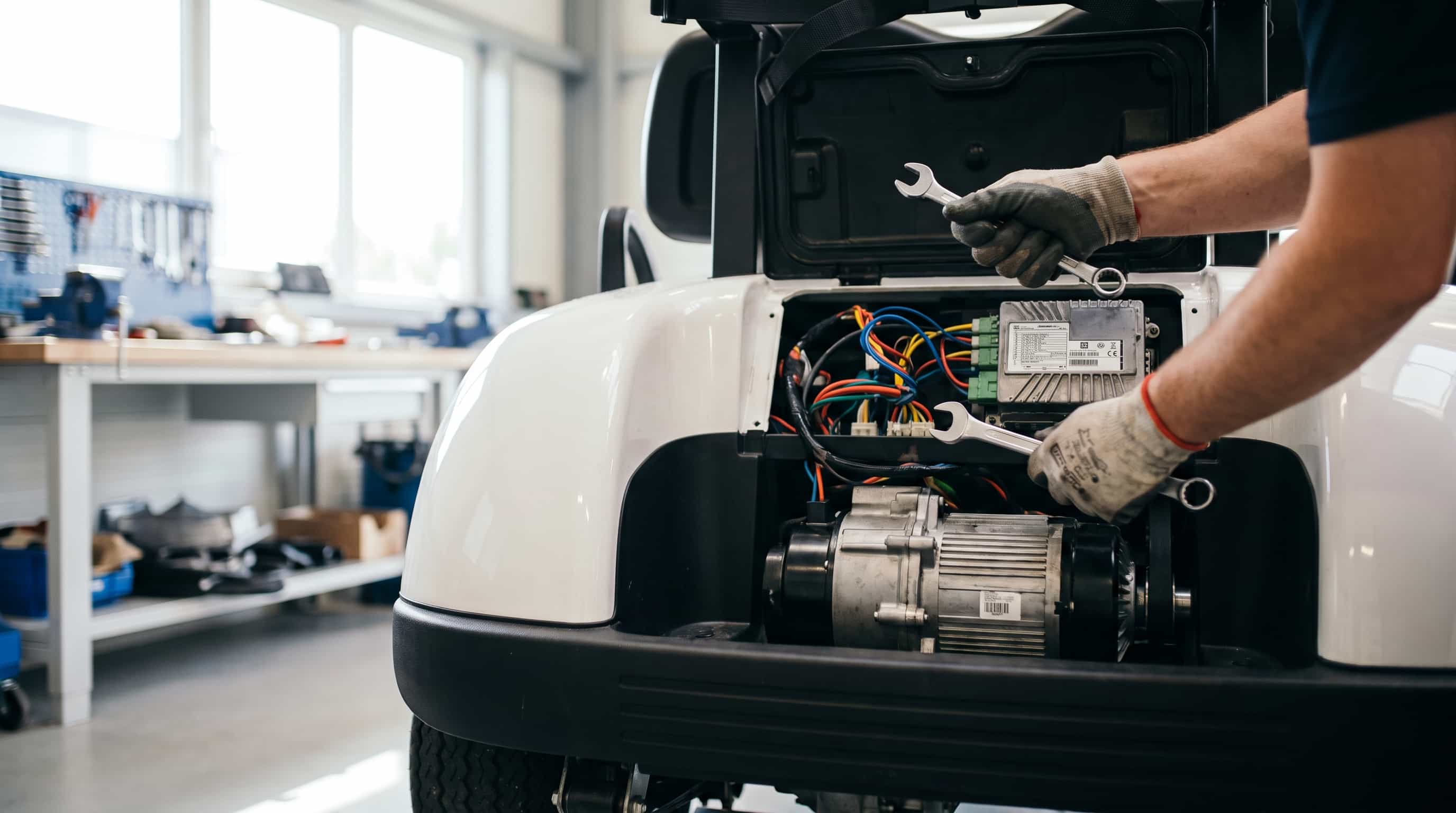
A converter sits across the whole pack and produces a stable low-voltage output for accessories. Because it loads the entire string equally, the balance problem disappears. Most buggies with factory lights already have one, which is the first thing to check before you buy anything: if there is a working accessory circuit, you may only need a spare fused way on it rather than new hardware. On older machines that circuit may already be close to its limit, so find out what it is feeding before adding to it.
Converters have a continuous rating and a higher short-term rating, and the continuous one is the number to design around. They produce heat in proportion to how hard they are worked, so they need air around them and a mounting away from the exhaust of nothing in particular and well away from water. Some are electrically isolated from the pack and some are not, which changes how the earth side is wired. That is a question for the converter's own instructions and, on anything you are unsure about, for an auto electrician.
Sizing it without guessing
Write down everything the circuit will feed, take the current or power figure printed on each item or in its manual, and add them up as if they were all running at once, because on a summer afternoon they will be. Then leave headroom, because accessory lists only ever grow. A converter run permanently at its limit runs hot, and heat is what shortens the life of the electronics inside it. Fit it somewhere you can reach, too, since a converter mounted behind a seat pan is a converter nobody ever checks.
Resist the temptation to size on peak draw alone. A phone pulls hardest at the start of a charge and tapers, while a light bar or a cool box draws steadily all day, and it is the steady loads that decide the rating. Where a figure is missing from a device, ask the supplier rather than assuming, and take the converter's own data plate as the authority on what it can deliver. We deliberately do not publish numbers for equipment we have not measured on the machine in front of us.
Fusing and wiring that survives a season
A fuse protects the cable, not the gadget. It belongs as close to the supply as you can reasonably put it, so that a chafed wire anywhere downstream blows the fuse instead of glowing. Each accessory circuit gets its own fuse, sized for the cable rather than for the device, and a small fuse block makes that tidy and makes fault-finding possible later. Blade fuses are the ones every parts counter stocks, which matters at the point where something has failed on a wet Friday.
The rest is ordinary vehicle practice that buggies rarely get. Cable sized for the current and for the length of the run, since a long thin run drops voltage and makes chargers behave oddly. Crimped terminals with heatshrink over them rather than twisted joints and tape. Grommets where anything passes through a panel. Routing clear of the steering, the suspension and anything that gets hot, secured every so often so nothing swings. Insulation-displacement connectors, the ones you squeeze onto an existing wire, have no place on a vehicle that gets hosed down.
- One fuse per circuit, at the supply end, sized to protect the cable.
- Crimped and sealed terminals, with heatshrink, not twist-and-tape joints.
- Grommets through panels, and cable secured clear of steering and suspension travel.
- An accessible fuse block, labelled, so the next person can find the fault without stripping the dash.
Standby drain and the winter it costs you
Every permanently live circuit draws something. The converter itself has a quiescent draw, chargers for phones draw a little even with nothing plugged in, and a tracker or a radio draws continuously by design. None of it matters on a machine used daily. On a machine that stands from October, small draws add up week after week until the pack is flat, and a flat lead-acid pack left through frost is often finished.
Two habits fix it. Wire accessories to a key-switched feed unless there is a specific reason they must stay live, so the circuit is dead when the machine is parked. And fit an isolator, or use the one the machine already has, so a buggy going into storage can be properly disconnected. If something genuinely must stay powered over winter, follow the maker's storage instructions for keeping the pack maintained rather than hoping it will be fine in March.
If yours is doing this and the checks here have not settled it, we diagnose and repair buggies, including a callout to wherever it is.
Sockets, cables and the water problem
The socket you fit matters more in an open vehicle than in a car. Cheap panel-mount units with an open face collect rain, dust and hose water, corrode at the contacts and then charge intermittently in a way that gets blamed on the phone. Sealed automotive sockets with a sprung cover cost more and last. Mount them where water runs off rather than in, ideally facing down or under an overhang, and keep them out of the direct line of a pressure washer.
The other half of the complaint is almost always the cable. Charging speed is negotiated between the device, the socket and the cable, so a good socket with a worn cable charges slowly and both get blamed. Keep a decent cable with the machine rather than whatever was in the glovebox, and expect to replace it more often than the socket. On a fleet, fixed captive cables solve the theft and the quality problem in one go, at the cost of flexibility.
Mounting a phone where it is usable
The useful position is in the glance zone: low and central enough that a look away from the path is brief, reachable without leaning across, and never blocking the view of the ground ahead or of anyone stepping out. A phone on a long arm in the middle of the screen is the arrangement that gets used most and is the worst of the options. If the machine carries passengers around a site with pedestrians, treat the mount the way you would in a car and set the destination before moving.
Then there is the physical life of the thing. Turf transmits far more vibration into a rigid mount than tarmac does, and a clamp bolted straight to a frame passes all of it to the phone. Choose a mount with some damping, and check the clamp is not squeezing the buttons. Direct sun on a black dash will stop a phone charging, sideways rain will find a lightning connector, and a phone that comes loose ends up in the footwell where the pedals are.
Bigger loads, and where to stop
Cool boxes, radios, sprayers, work lights and hand tools all get plugged into buggies, and they all take their energy from the same pack that moves the machine. That is the trade nobody makes explicitly: a heavy accessory shortens the working day, and on a fleet run to the edge of its range, it is the reason a machine comes back early. Where the load is substantial or intermittent, a separate leisure battery, charged on its own, keeps the traction pack for traction.
Mains equipment is a different job again. An inverter on a small vehicle, on wet ground, with tools in someone's hands, brings earthing and residual current protection into the conversation, and it is not a job for a weekend and a wiring diagram from a forum. Get an auto electrician for anything permanent, keep the receipts, and speak to your supplier before cutting into the loom of a machine still in warranty. A refused claim costs more than the installation did.
Common questions
- Can I wire a USB socket straight to the batteries?
- Not to part of the pack, which is what people mean by this. Drawing from two batteries in a series string discharges them harder than the rest, and the charger cannot rebalance them, so the pack ages unevenly and dies early. Use the machine's low-voltage accessory circuit, or fit a converter across the whole pack and feed a fused circuit from it.
- Do I need a converter on a lithium buggy?
- Usually yes, and the reason is stronger than on lead-acid. A lithium pack has a battery management system whose job is keeping cells balanced, and an external drain on part of the pack fights it directly. Some systems fault rather than tolerate it. Check whether the machine already has an accessory circuit, and take the wiring method from the maker.
- Will a USB socket drain the buggy battery when it is parked?
- A little, continuously, unless it is on a key-switched feed. That is harmless on a machine used daily and expensive on one that stands all winter, because a lead-acid pack left flat through frost is often beyond saving. Wire accessories so they die with the key, and isolate the machine properly before laying it up.
- Where should the fuse go?
- As close to the supply as practical, because a fuse protects the cable rather than the accessory. Size it for the cable you have run, give each circuit its own, and mount the fuse block somewhere reachable and labelled. A fuse fitted next to the socket leaves the whole run unprotected, which is the fault that starts a fire rather than blowing a fuse.
- Can I run a cool box or power tools off a buggy?
- You can, and every hour of it comes out of the pack that drives the machine, so the working range drops. For steady or heavy loads, a separate leisure battery charged on its own is usually the better answer. Mains equipment through an inverter brings earthing and residual current protection into play and should be specified and fitted by an auto electrician.
- Will fitting a socket affect the warranty?
- It can, particularly where the loom is cut into or the pack is tapped. Ask the supplier before the work rather than after a fault, and ask specifically what they will accept: many are perfectly happy with a properly fused feed from an existing accessory circuit and much less happy with anything spliced into the traction side. Keep the invoice and a note of who did it.
Still not right
We diagnose and repair golf buggies, service them on a plan, and send an engineer out to where the buggy is. Tell us the symptom and we will say what it usually means.