Yamaha Umax: the utility line explained
By James Brown · Updated 29 August 2026 · 10 minute read
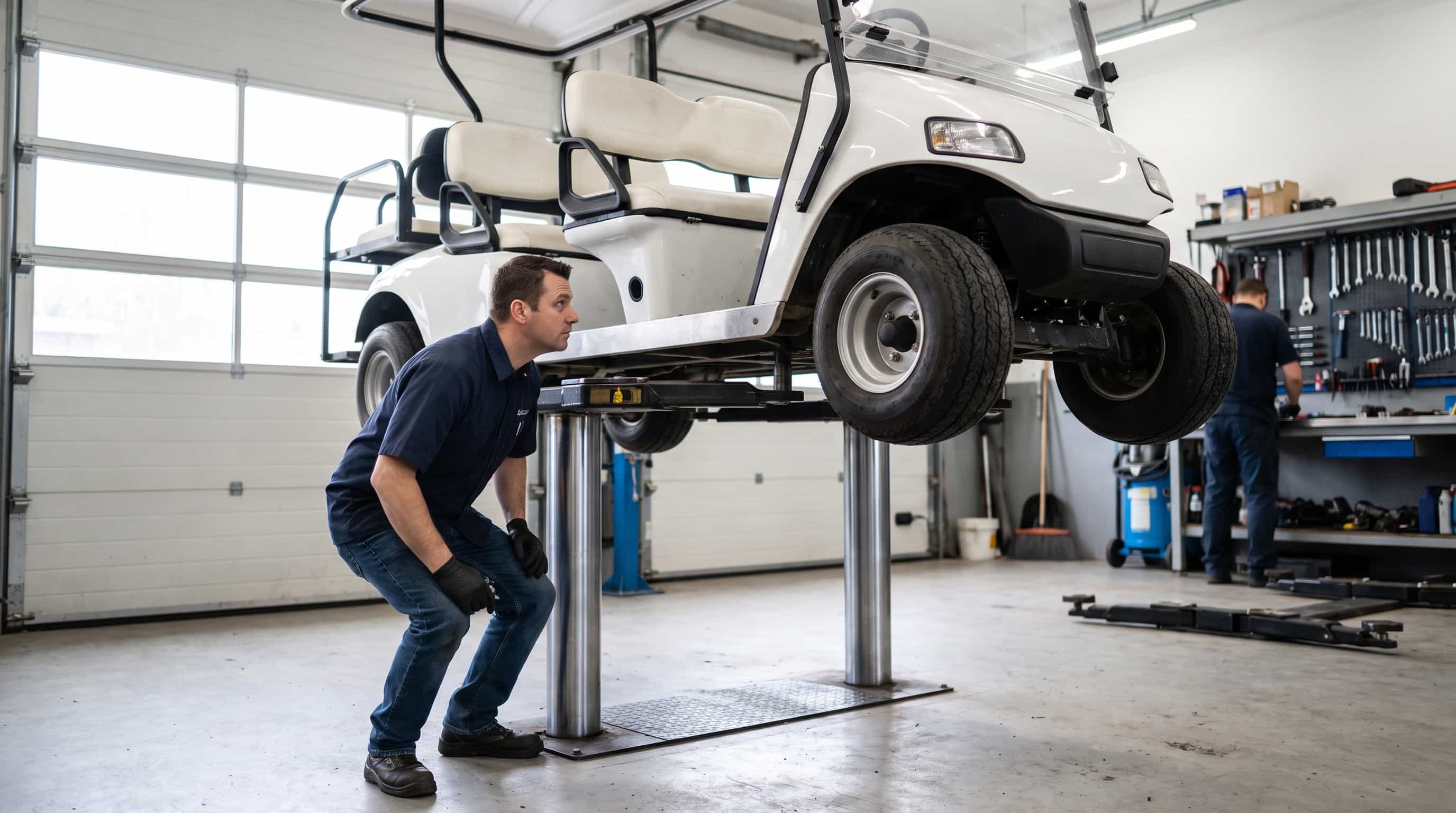
The Umax name marks Yamaha's utility range rather than its golf range: these machines are built around a load bed and site duty instead of a bag rack and a round of golf. In practice that means a rear end specified for weight, bodies including flat, tipping and box options, and fittings aimed at grounds, estates and works teams. Choose one over a passenger buggy when the load, the towing or the daily duty is the point, and take the load and towing limits from the maker's own literature.
Key takeaways
- The utility line is built around a load bed and site duty, not around a round of golf.
- The differences from a passenger buggy are in the frame, rear axle, springs and brakes, not the bodywork.
- A tipping body is what makes a machine get used for loose material, because hand unloading does not happen twice.
- Payload, towing and gradient limits are the maker's figures, they differ by body, and they are on the machine.
- Tyre pattern and pressure decide whether a machine protects turf or grips a wet slope, and it cannot do both.
- Electric or petrol is answered by the shift pattern and the site, not by the specification sheet.
- Nobody rides on the bed, and load restraint prevents more trouble than a speed limit does.
What separates a utility machine from a passenger buggy
The utility side of the range differs from the golf platforms structurally rather than cosmetically. A machine built to carry a load has a rear end designed for it: the frame, the springs, the rear axle and the brakes are specified around weight sitting behind the driver rather than two golfers and their clubs. The bed is the visible part of a set of changes that mostly are not visible at all.
This is why a passenger buggy with a box strapped to the back is not an equivalent. It will do the job for a while, and the bill arrives later in the rear axle, the brakes and the steering. Overloading a golf platform rarely fails dramatically. It wears things out early and quietly, and the machine feels vague for a long time before anything actually breaks.
The other structural difference is the duty cycle a utility machine is built around. Grounds work is stop, start, load, unload, all day, in weather, on surfaces a course fleet never sees. Machines specified for that tend to have heavier duty electrics, more accessible service points and bodywork that expects to be hit by something. That specification is also why they are easier to keep going: the parts that wear are the ones designed to be replaced, and they are reachable without stripping half the machine to get at them.
The bodies, and what each is for
The range is organised around what sits behind the driver. A flat or dropside bed is the general answer and suits tools, bags, materials and anything you can strap down. A tipping body earns its keep the moment you are moving loose material regularly, because shovelling a load out by hand is exactly what stops people using a machine as they intended to. A box or van body keeps tools dry and locked, at the cost of loading anything tall.
Specialist bodies exist as well, including refreshment and service units for venues, and those are worth asking about rather than fabricating in a workshop. What is currently offered, and in which combinations, is the maker's to publish and it changes across the years, so take the body list from Yamaha's own literature for the current range rather than from a supplier's summary.
- Flat or dropside bed: the general purpose choice, loadable from more than one side, needs tie-down points.
- Tipping body: worth it for loose material, and worth asking whether the tip is by hand or powered.
- Box or van body: dry and lockable, awkward for anything tall or long.
- Whatever the body, the load rating belongs to that machine and body combination, not to the marque.
Load, tow and gradient limits belong to the maker
Three things decide what a utility machine can safely do: the rated payload, the towing limit and the gradient limit. All three are the maker's, all three are specific to the model and the body fitted, and they are printed in the manual and on the machine itself. Get them for the exact machine, in writing, before you plan a job around it.
They are also not interchangeable. A payload rating tells you nothing about what the machine may tow, and a towing rating assumes a level surface and a braking arrangement your site may not have. The gradient limit is the one most often ignored and it is the one that matters most, because a fully loaded machine going down a slope is a braking problem rather than a power problem.
Overloading is also where insurance conversations turn awkward. If something goes wrong and the machine was carrying more than its rating, the discussion that follows is not one anybody wants to be having. Weigh a typical load once, properly, rather than estimating it fresh every morning. Weighing it settles arguments internally as well, because the person loading and the person driving rarely agree about how heavy a full bed actually is.
Specifying one for grounds and estate work
Start with the ground. Tyre choice changes the machine more than any other single option: a turf pattern protects a surface and gives up grip on wet slopes, and an all-terrain pattern does the reverse. The right answer depends on which worries you more, the greens or getting home. Pressures matter as much as pattern does, and the maker sets those rather than the fitter.
After the tyres, the additions that actually get used are the practical ones. A roof and a screen make a machine usable in bad weather, which is when most grounds work happens. A hitch matters if anything will be towed. Work lighting and a beacon matter if the machine moves after dark or shares roadways with vehicles. Racks and a lockable box stop tools riding loose on a seat.
Then think about washing it. A machine used on wet ground gets cleaned often, and where the water goes is a real consideration: sealed electrics, drainage in the bed and a body that dries rather than holding water are the difference between a machine that lasts and one that quietly rots from the inside out. Ask the supplier where the machine should not be pressure washed, because the wrong nozzle aimed at a connector or a bearing does more damage than the mud ever would.
If yours is doing this and the checks here have not settled it, we diagnose and repair buggies, including a callout to wherever it is.
Electric or petrol on a working site
The shift pattern answers this rather than the specification sheet. A machine that works a long continuous day away from a socket, or that spends its time in a remote corner of an estate, argues for petrol. A machine that works near buildings, indoors, or around guests and members argues for electric, and so does anywhere with a convenient charging point and a predictable overnight window.
Loading changes the calculation more on a utility machine than on a passenger one, because a full bed all day is a much heavier duty than a couple of passengers. If the machine will spend its day loaded, work out the realistic duty rather than the optimistic one, and build a charging window into the middle of the day if the day is a long one.
Petrol brings the fuel supply, the storage, the noise and the engine servicing schedule onto your site. Electric brings the supply question, the charging routine and a battery pack whose age is a large part of the machine's value. Neither is simply cheaper than the other. The site decides which set of problems you would rather own. Write down the longest day you realistically expect, then choose against that day rather than against an average one.
Where a utility buggy fits against a tractor or a pickup
It is worth being honest about the boundaries. A utility buggy is not a compact tractor: it will not run implements, it will not do heavy haulage, and it will not replace a machine that exists to pull things. It is not a pickup either, and for road distance, heavy loads or a long run between sites the pickup wins comfortably and without argument.
What it wins on is width, weight and manners. It goes through gateways and along paths a tractor cannot, it treads more lightly on turf than either alternative, and a quiet machine near play, guests or livestock is a different proposition from a diesel one. On a site where those three things matter, it does work that neither of the others can do at all.
The failure mode is buying one to be all three. A utility buggy asked to do tractor work gets overloaded, and an overloaded machine is unsafe, expensive and short lived. Size it for the work it will genuinely do most days, and put the exception on a hire or a contractor rather than on the machine. It is also the quickest way to lose the advantage you bought the machine for, because the heavier you specify it the more it starts behaving like the vehicles it was meant to replace.
Running one safely and keeping it running
Speed is rarely the hazard on a work machine. Load and slopes are. Loads that are not strapped down move, and a moving load on a slope changes the machine underneath the driver. Tipping a body while parked across a side slope is another reliable way to have a bad afternoon. A short written briefing covering how to load, where not to tip and who may drive is cheap, and it works.
Nobody should ride on the bed, and that needs saying because it is the rule broken on every site. Seats carry people and beds carry things, and a machine with a passenger sitting on a load is a very different vehicle under braking. Write it down and enforce it rather than assuming it is obvious. The same goes for standing on the bed to reach something while the machine is moving, and for sitting on a tailgate for a short hop across a yard.
Day to day the routine is short: check tyres and pressures, check the brakes, look at the bed floor and the tie-down points, wash the machine and let it dry, and put it on charge or into store dry rather than wet. Keep the manual with the machine rather than in an office drawer, because the person who needs it is the person standing next to it.
Common questions
- What is the difference between a Yamaha Umax and a Yamaha golf buggy?
- The utility machine is built around carrying a load and the golf machine is built around carrying two players. Behind the visible bed sit different springs, a different rear end, different brakes and often heavier duty electrics. That is why strapping a box to a golf platform is not the same thing: it will do the work for a while and wear out early while doing it.
- How much can a utility buggy carry?
- The rated payload is the maker's own figure, specific to the model and the body fitted, so it belongs on the machine and in its manual rather than in a general guide. Get it for the exact machine before you plan work around it. Remember too that a payload rating is not a towing rating, and neither of them accounts for the gradients on your site.
- Can a utility buggy tow a trailer?
- Many are offered with a hitch, and whether yours may tow, and how much, is set by the maker for that model. Two things matter more than the raw rating: whether the trailer has brakes of its own, and how steep the ground is where you will be towing. A rating quoted for level ground is not permission to take the same load down a hill.
- Will a utility buggy damage a golf course or a lawn?
- It depends on the tyre, the pressure, the load, the ground conditions and how it is driven, and the last of those matters more than people expect. Turning tightly under power on soft wet ground is what tears a surface, rather than simply driving across it. Turf tyres at the maker's pressures, sensible routes and a rule about wet ground do most of the work.
- Do drivers need a licence or training?
- No driving licence is required on private land, but that is not the end of the matter. The site owner sets who may drive, and an employer whose staff use a machine at work has duties to make sure they are competent. In practice that means a short recorded briefing covering loading, slopes, tipping and who may ride, and your insurer may set its own requirement on top.
- Is a utility buggy road legal in the UK?
- Not as supplied. These are private-land machines, and using one on a public road brings in requirements around construction, lighting, registration and insurance that are separate from anything the maker provides. DVLA is the authority on what applies. If your site is split by a public road, settle that question before you buy rather than assuming a short crossing will pass unnoticed.
Still not right
We diagnose and repair golf buggies, service them on a plan, and send an engineer out to where the buggy is. Tell us the symptom and we will say what it usually means.