Club Car Carryall and Transporter: load and people
By James Brown · Updated 29 August 2026 · 10 minute read
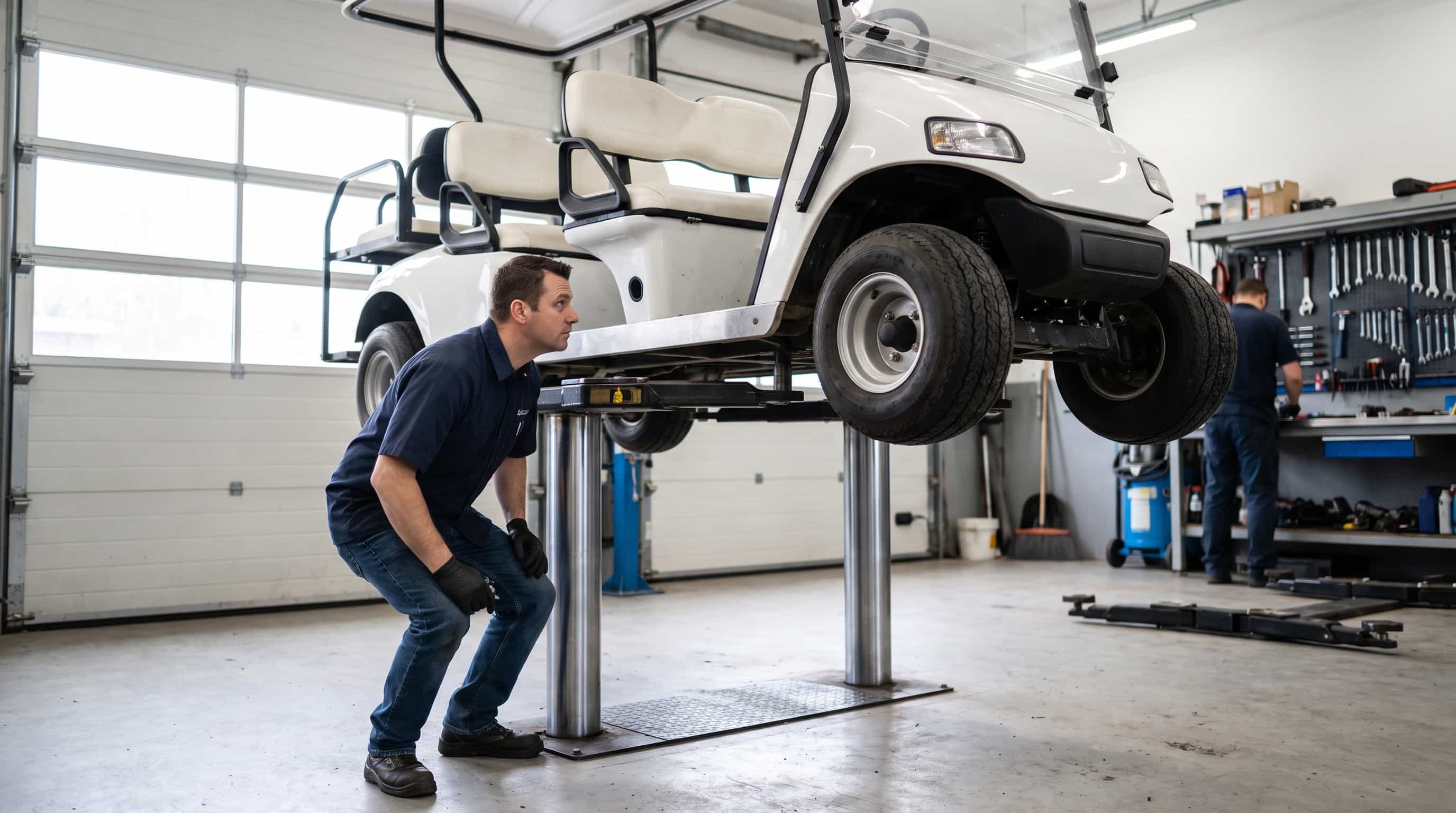
Carryall and Transporter are the two work lines from the same marque, split by what they carry. Carryall is built around a load bed for grounds, works and maintenance duty. Transporter is built around carrying more people across a site, and some models take a rear seat that folds back to give a load area instead. If the daily job is kit, look at Carryall. If it is people with occasional kit, look at Transporter.
Key takeaways
- Carryall puts a bed behind the driver; Transporter puts seats there, with a folding rear on some models.
- Both lines sit on work-specified running gear rather than a golf platform, and that is what you cannot change later.
- A convertible rear is a compromise as a bed and as a seat, and its value depends on how easy the changeover is.
- Count the moments in a week when people and load are needed at once: that number decides whether one machine can do it.
- Payload ratings are the maker's figures tied to a model and a body, not to the line as a whole.
- Nobody rides on a load bed, however short the journey or private the site.
- Which drivetrains and options a UK buyer can actually get is answered by the importer, not by an overseas product page.
The split between the two lines
Both lines are work machines from the same marque, and the split between them is simply what sits behind the driver. Carryall puts a load bed there and treats passengers as the secondary matter. Transporter puts seats there and treats the load as secondary. Neither is a golf platform with additions: the running gear underneath is specified for the heavier, longer duty that site work involves.
That underlying specification is the part worth attention, because it is the part you cannot change later. Springs, brakes, the rear end and the frame are sized for the work, and the marque has long made a point of its frame material, which matters on a machine that lives outdoors in British weather. Confirm the construction of the actual model you are looking at rather than assuming it holds across the whole range.
Both lines also carry the practical fittings a work machine needs and a golf machine does not: places to tie a load down, somewhere to hang a tool, lighting options, and service access that assumes somebody in overalls rather than a dealer workshop with a lift. Those details look minor next to a drivetrain, and they decide whether a machine is pleasant to work from every day or quietly annoying for years.
The convertible rear, and what it actually gives you
Some multi-passenger machines carry a rear seat that folds back to become a load bed, and that arrangement is the reason many venues buy one at all. It is genuinely useful, and it is also a compromise in both directions, which is worth saying plainly before anybody plans a working week around it. It is also the feature described most loosely in adverts, so confirm that the machine in front of you actually has it rather than assuming the whole line does.
As a bed it is shallower and shorter than a dedicated one, and the tie-down arrangement is a compromise around the folded seat. As seating it is rear-facing, which some passengers dislike and which changes how you brief people about grab handles and about staying seated. Neither of those makes it a poor answer. They make it a considered one rather than an obvious one.
The deciding question is how often you will actually change it over. If the changeover is quick and one person can do it, the machine flexes through the day as intended. If it needs more than one person and a toolbox, it will be set one way in spring and stay that way until autumn. Try the changeover yourself before you buy, with the machine in the state it will live in.
Choosing by the shape of your week
The useful exercise is not comparing the two lines but writing down a typical week. Count the days where a load is the job. Count the days where people are the job. Then count the moments where both happen at the same time. That last number is the one that decides things, and it is usually smaller or larger than people assume before they write it down.
If the load is daily and the people are occasional, buy the bed and solve the people problem another way, with a second machine at the peak or by making two trips. If people are daily and the load occasional, the convertible arrangement earns its keep. If both are daily and simultaneous, no single machine is the answer, and buying one clever machine instead of two plain ones is the mistake to avoid.
Seasonality complicates it honestly. A venue that shuttles guests all summer and moves materials all winter has two different weeks rather than one, and a convertible machine suits that pattern rather better than an averaged compromise would. Write both weeks down separately rather than averaging them, because an average week describes a machine nobody actually needs. The winter week usually decides the body and the summer week decides the seating.
What a load bed has to do beyond hold things
A bed is judged by how easy it is to use badly. Tie-down points that sit where a strap naturally goes get used; ones buried under a lip do not, and an unrestrained load is one of the readier ways a work machine hurts somebody. Sides that drop make loading from a pallet or a wall possible without lifting everything over the top of them.
Loading height matters more than bed area on a machine that gets loaded by hand all day. So does whether the bed can be washed out and drained, because a bed that holds water rots, and a bed full of wet grass clippings weighs a good deal more than the same clippings did dry. A tailgate that drops flat, and a bed you can reach across from the side, both matter more than a specification sheet suggests, and both are things to try rather than read about.
The rated payload is the maker's figure for that model and body, printed on the machine and in the manual. Get it for the exact machine and treat it as a limit rather than a target, particularly on a site with slopes, where the braking rather than the pulling is what runs out first. Ask the supplier to confirm the rating for the body actually fitted, since a bed and a box on the same machine will not carry the same load.
If yours is doing this and the checks here have not settled it, we diagnose and repair buggies, including a callout to wherever it is.
Carrying people on a work machine
Seats on a utility machine are not the same proposition as seats on a passenger shuttle. Rear-facing benches need grab handles and a briefing about staying seated, and boarding is often from a yard or a kerb rather than from a made pick-up point. If members of the public will ride, that is a different risk conversation from staff riding between jobs on their own site.
Who may ride, where, and with what restraint is set by the venue's own policy and by its insurer, not by the number of seats on the machine. Belts, where fitted, need using. If your insurer expects belts, settle it before purchase, because anchorages have to be designed into a machine and are not a retrofit. Get the policy written down and dated, and keep it where the person running the shift can actually find it.
The other rule broken everywhere is riding on the bed. A load area is not seating, and it does not become seating because the journey is short or the site is private. Write it down, say it in the briefing and enforce it, because a passenger on a bed under braking is precisely the incident everyone can already picture. Short journeys are where it happens, so the rule has to cover the yard as well as the route.
Drivetrains, options and what reaches the UK
Utility lines are generally offered in more than one drivetrain across the markets they serve, and larger models are commonly available with combustion as well as electric power, sometimes with four-wheel drive. Which of those variants a UK buyer can actually get, new or used, is a separate question answered by the importer and by whatever has come into the country across the years.
That gap catches people out. An overseas product page shows a range a British buyer cannot simply order, and a used advert here may carry specification copied straight from that page. Take the specification from the machine's own plate and from the UK supplier, and treat anything found on an international site as background reading rather than as an order form.
Options tell the same story. Cabs, screens, beds, boxes, lighting and hitches all vary by model and by market, and the list changes over time. Ask the UK supplier what can be fitted to the exact machine and what they hold, rather than assembling a specification from a brochure and discovering the gaps after delivery. Do that before you agree a price, because an option fitted afterwards is a separate job with its own lead time.
Buying a used work machine
Work machines have had a harder life than golf fleet machines and they show it in different places. Look at the bed floor and its corners, at the frame where the bed meets it, and at the hitch, because a hitch that has been abused tells you how the machine was used. Then look at the brakes, which do the most work on a loaded machine and are unwelcome to find worn.
Ask what it carried. A machine that spent its life moving wet sand or fertiliser has aged very differently from one that carried tools around a hotel, and corrosion tends to follow whatever lived in the bed. Ask about the pack and the charger on an electric machine, and ask for the service history on any of them. Ask to see it running rather than only standing, and ask to load it with something heavy while you are there.
Finally, ask a UK parts supplier what they hold for that model before you commit. Work machines are usually bought to keep something else running, and a machine waiting weeks for a brake part is not doing that. Availability rather than purchase price is what decides the real cost of a working vehicle over a season. Ask specifically about brakes and about anything unique to the body fitted, since those are the items that strand a machine.
Common questions
- What is the difference between a Club Car Carryall and a Transporter?
- The bed and the seats swap places. Carryall is the load-carrying line, with a bed behind the driver and passengers as a secondary consideration. Transporter is the people-carrying line, with additional seating and, on some models, a rear seat that folds to give a load area. Both sit on work-oriented running gear rather than on a golf platform, which is what separates them from a fleet buggy.
- Can a Transporter carry cargo as well as passengers?
- On models with a folding rear seat, yes, with two caveats worth knowing. The resulting bed is smaller and shallower than a dedicated one, and the changeover has to be quick enough that people actually bother to do it. Try it yourself before buying. If loads and passengers are both needed at the same time on an ordinary day, two machines will serve you better than one convertible.
- How much can a Carryall carry?
- The payload is the maker's figure for the model and the body fitted, and it is printed on the machine and in its manual. Take it from there rather than from a general figure quoted for the line, because bodies differ from one another. A payload rating also assumes reasonable ground: on a site with slopes, braking with a full load is what limits you before the rating does.
- Are Club Car work vehicles road legal in the UK?
- Not as supplied. Both lines are built for private land, and taking one onto a public road brings in construction, lighting, registration and insurance requirements that are separate matters entirely. DVLA is the authority on what applies to a particular vehicle. If your site is split by a road, get that settled before you buy rather than planning around a short crossing.
- Which one suits a hotel or a wedding venue?
- Write down what the machine will do on an ordinary day. If it mostly moves guests and luggage with occasional materials, the people-carrying line with a convertible rear is the natural fit. If it mostly moves bins, furniture and grounds materials with the occasional staff run, the load line is. Design around the ordinary day and find a separate answer for the exception.
- Do the two lines share parts?
- Some items carry across, and the ones that matter often do not, because a load-carrying machine and a people-carrying machine wear different things out. Brakes, springs and tyres are specified for the duty. Give a UK parts supplier the serial number and ask which wearing items they hold for that exact model, since availability is what decides how long a machine sits idle.
Still not right
We diagnose and repair golf buggies, service them on a plan, and send an engineer out to where the buggy is. Tell us the symptom and we will say what it usually means.
Related pages
Related guides
 Golf buggy makes explained: who builds what10 minute read
 Club Car Villager: the multi-seat line explained10 minute read
 How to identify which golf buggy you own10 minute read
 Club Car buggies: the model lines explained10 minute read
- Mixed guest and cargo needs4 minute read
 Cargo and utility buggies for site work5 minute read