How to identify which golf buggy you own
By James Brown · Updated 29 August 2026 · 10 minute read

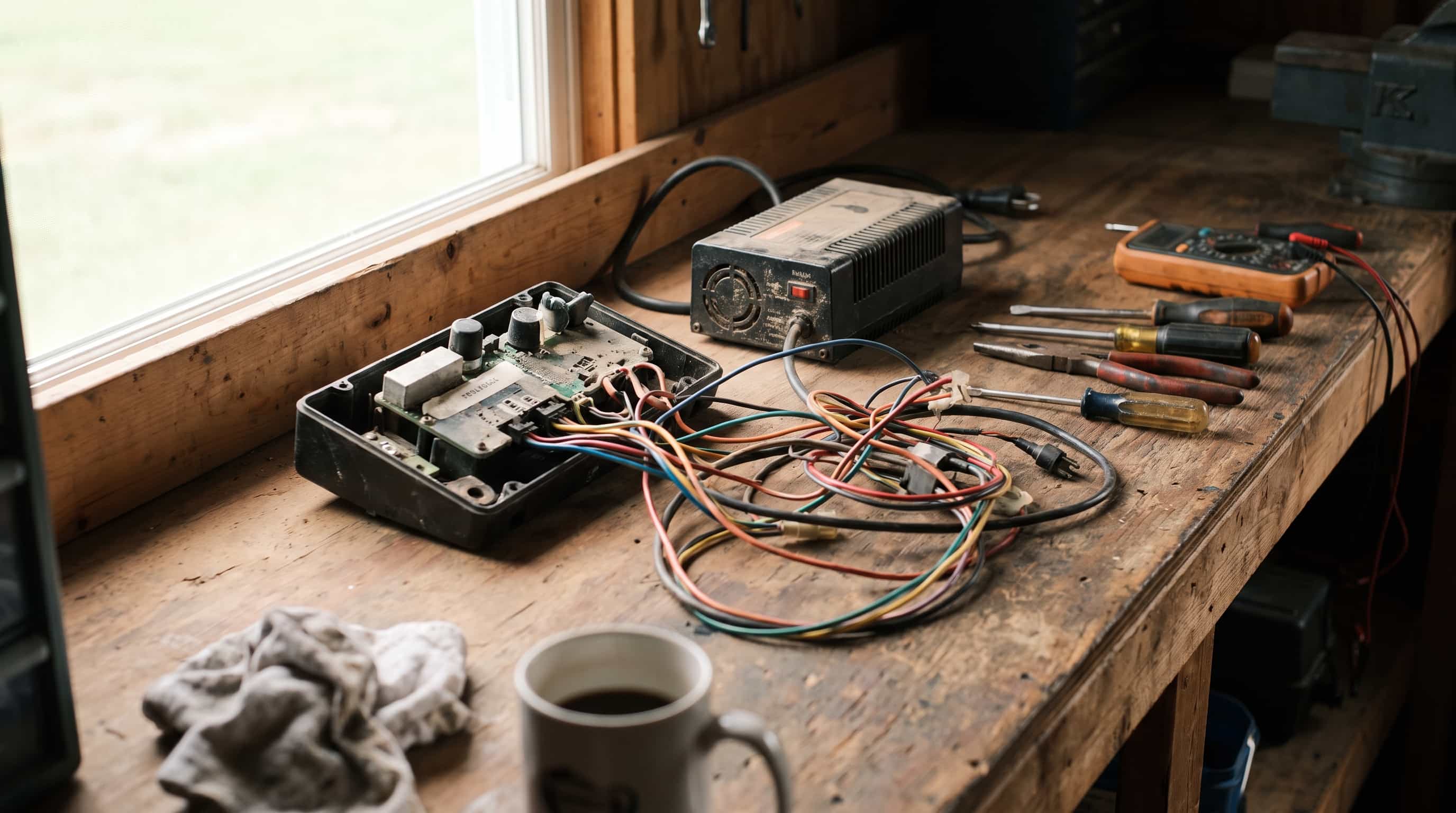
Start with the identification plate rather than the badge. Most machines carry a maker's plate or a stamped frame number, commonly under a seat, on the frame beside the battery bay, or under the dash, and that is what a parts desk actually needs. Badges get swapped and body kits change everything you can see without changing anything you can order by. Photograph the plate, the charger label and the controller label, then let the maker or a dealer confirm what you have.
Key takeaways
- The plate on the frame identifies the vehicle; the badge on the nose only suggests it.
- Replacement panels and body kits are common, so appearance is the least reliable evidence you have.
- The charger and controller carry their own labels, and those name components rather than the buggy.
- A parts desk can usually work from clear photographs, so send those before describing the machine in words.
- Only the maker or its UK distributor can turn a serial into a build record, and no decoding chart found second hand outranks them.
- Record the identification once and keep it with your insurance and service papers, because the next time you need it will be an awkward moment.
Why the badge is the weakest evidence
Start from the frame rather than the nose. A badge is a sticker or a small moulding, it is the first thing a hedge or a trailer strap knocks off, and it is the easiest part on the whole vehicle to replace with one taken from a different machine. Second-hand panels move between buggies constantly, and refurbishers fit body kits over older chassis to bring the look up to date. A buggy that reads as one thing from across the yard can be something else underneath, and nobody involved has necessarily done anything dishonest.
Appearance is not useless, it is just coarse. It tells you reliably enough that the machine is electric or petrol, how many seats it was built around, whether the body is one large moulding or several bolted panels, and how the roof is carried. That puts you in a family and a rough generation. It does not tell you which variant of that family sits in front of you, and the variant is usually what decides which brake component, which loom or which controller you need.
The cost of getting this wrong is dull rather than dramatic: a part ordered, time lost, a restocking argument, and the machine still standing still. Working from the plate takes an afternoon at most and removes that whole category of problem. It also makes every later conversation shorter, because a parts desk that has been given the plate stops asking you to describe the vehicle and starts telling you what fits.
Where the identification plate is usually fitted
There is no single standard location, and it moves between makers and between generations of the same make, so the method is to search rather than to look in one place. Take a torch and work around the frame in an order you can repeat. Plates are frequently tucked where road dirt and grease collect, low down and facing away from the eye, which is why owners who have looked once and found nothing often find one on a second pass with a rag in hand.
Clean gently before you decide a plate is not there. A cloth and a little warm water lift most of it, and a soft brush gets into stamped characters. Do not attack it with a wire wheel or a solvent that strips paint, because a number that has survived years under grease can be destroyed in seconds by enthusiasm. If a plate is riveted and lifting at one corner, leave it alone and photograph it exactly as found rather than straightening it.
- Under the seat base, or on the frame directly beneath the seat once it lifts out.
- On a frame rail alongside the battery bay, sometimes facing inwards where it shows only from below.
- Under the lip of the dash, inside the glovebox, or on the back face of the dash moulding.
- On the frame near the front cross-member, above or behind a front wheel.
- On a printed label inside the rear bodywork, behind the seat back or under the rear panel.
- Stamped straight into a frame tube with no plate at all, which is easy to miss under paint.
What the charger and the controller labels tell you
The charger has a label of its own, and it is worth photographing even though it does not name the vehicle. It states what the charger was matched to and which connector it uses, and that pair of facts is what you need if the charger dies, which is one of the commoner ways a buggy ends up parked. Chargers and battery packs are matched deliberately, so the replacement question is answered by that label rather than by a model name on the bodywork.
The controller is the label that misleads people most. Controllers are very often made by specialist electronics firms and fitted across several buggy brands, so the name and number on the controller identifies the controller, and sometimes the settings loaded into it, and not the vehicle it is bolted into. Ringing a parts desk with a controller number and asking what buggy you own is a conversation that goes nowhere pleasant, and it wastes the goodwill of somebody you may need later.
Photograph both anyway, along with the motor label if you can reach it without dismantling anything. Between them they let an engineer recognise the drivetrain generation on sight, which is often quicker than the paper trail. It also means that if the plate turns out to be missing, you are not starting from nothing: a motor, a controller and a charger that were fitted together tell a knowledgeable person a good deal about what they came out of.
Reading the vehicle when there is no plate at all
Sometimes the plate has gone and you are left describing the machine instead of naming it. That is workable, provided you describe the right things. Note the drive: petrol or electric, and if electric, how the batteries are arranged in the tray and where the charging socket sits. Note the brake arrangement, the steering, whether there is a charger carried on board, how the roof supports meet the body, and whether the seat is a bench or separate cushions.
Note everything non-standard as well, because it is often the most identifying detail on the vehicle. A lift kit, wheels that are not what it left the factory on, a rear seat conversion, added lights, a replaced dash: each of those changes what parts fit, and an engineer needs to know before ordering rather than after. Photograph the modifications specifically rather than hoping they show up in a general shot of the machine.
Then write the description down as a short list and keep it with the photographs. A precise description with pictures beats a confident guess at a model name every time, because a guess sends the conversation down the wrong path and nobody notices until the part arrives. The people who answer parts lines deal with unidentified machines constantly, and what they want from you is evidence rather than a conclusion.
If yours is doing this and the checks here have not settled it, we diagnose and repair buggies, including a callout to wherever it is.
Building the evidence pack
Do the photography once, properly, before you ring anybody. Phone pictures are fine if the light is good and the camera is held still and square to the plate. Take more than you think you need, and take them in a sensible order so you can find them again later without scrolling through a month of everything else. The whole set takes very little time and saves several calls, and it is worth doing while the machine is somewhere you can walk round it.
Send the photographs rather than typing out what they say. Transcribing a serial by eye is where a surprising share of wrong parts begins, particularly with characters that look alike under grime and low light. If you do type it, type it and send the picture as well, so the person at the other end can check you rather than trusting you. That single habit removes most of the friction from a parts enquiry about an unfamiliar machine.
- The plate straight on and filling the frame, then a wider shot showing where on the vehicle it sits.
- The charger label, including the connector end of the lead.
- The controller and any label on it, with the surrounding wiring visible.
- The motor and its label, if it can be reached without taking anything apart.
- The battery tray with the pack in place, and one of the battery labels.
- The vehicle from the front, both sides and the rear, standing on level ground.
- Anything obviously not original, photographed close up.
When to stop guessing and ask
The moment to stop is before money moves. If two plausible answers are still on the table and the part differs between them, the guess is no longer worth making. Ask the maker directly through its own customer service or its UK distributor, and ask in writing, so the answer is something you can keep and show later. A short email with the photographs attached usually does it, and it costs you nothing but the time to write it.
Treat any decoding scheme you find on a forum with suspicion. Makers change their numbering between generations and are under no obligation to publish how it works, so a chart that was accurate for one era of one model line can be confidently wrong about yours. The maker's own published guidance and its own records are the authority here, and nothing found second hand outranks them, including this page.
An independent engineer who works on that kind of machine week in and week out is the other good route, and often the faster one. They recognise drivetrains, axles and dash mouldings on sight, and they will tell you plainly if the vehicle in front of them is a mixture of two, which is more common than people expect on a machine that has been through a hire fleet and a refurbishment.
Keeping the answer once you have it
Write it down in one place and keep it away from the buggy. The model as the maker states it, the serial exactly as it reads, the year if the maker has confirmed one, the controller and charger details, the battery type and the date the pack went in if you know it. That single note answers most of the questions anybody will ever ask you about the vehicle, and it takes one sitting to produce.
It gets used more often than you would think. An insurer wants it on the schedule. A parts order wants it. A safety notice from the maker is matched against it. A buyer will ask, and a buyer told that the owner does not know what the machine is will discount accordingly. If the buggy is stolen, it is the first thing the police ask for and the only thing that reliably ties a recovered vehicle back to you rather than to whoever is standing next to it.
Common questions
- How do I find out what model my golf buggy is?
- Find the identification plate first. Look under the seat base, along the frame beside the battery bay and under the dash, clean the area gently, and photograph what you find. If the plate is there, the maker or its UK distributor can confirm the model from it. If it has gone, an engineer who works on that family of machines regularly is the next best route, and photographs of the drivetrain will do most of the work.
- Can someone identify a golf buggy from photographs?
- Often, yes, if the photographs show the right things. A clear shot of the plate settles it outright. Without a plate, pictures of the motor, the controller, the charger label, the battery tray and the body from each side give an experienced engineer or parts desk enough to narrow it a long way, though they may still stop short of naming an exact variant without the serial.
- What if my golf buggy has no badge or plate at all?
- Work from the hardware instead. Photograph the drivetrain, the labels on the controller, motor and charger, the battery arrangement and the whole body, then describe the machine rather than naming it. If you are buying rather than already owning, treat a missing plate as a question worth pressing: the seller should be able to say where it went and show proof of purchase in their own name.
- Does the controller label tell me which buggy I have?
- No. Controllers are usually bought in from electronics specialists and fitted across several brands and generations, so the number on it identifies the controller and its settings rather than the vehicle around it. It is still worth photographing, because it is exactly what a supplier or engineer needs if the controller itself has to be replaced, repaired or set up again.
- Can I work out what year my golf buggy was built?
- Sometimes, and only from the maker. Some encode build information in the serial and will interpret it for you, others hold it in their records and look it up on request. Dates moulded into plastic panels or printed on components refer to those parts rather than to the vehicle, and they mislead easily, because panels and components get replaced over a working life.
- Do I need to know the model before ordering parts?
- You need the serial more than the model name. Most parts desks work from the serial because it resolves the variant, and a model name on its own can cover several builds with different fittings. Send the plate photograph, say what the part is for, and let them match it rather than matching it yourself and hoping the description carried.
Still not right
We diagnose and repair golf buggies, service them on a plan, and send an engineer out to where the buggy is. Tell us the symptom and we will say what it usually means.