When to repair versus replace a battery set
By James Brown · Updated 21 July 2026 · 5 minute read
Replace a battery set when it no longer holds a useful charge or has a genuinely dead cell, and replace it as a whole set rather than one battery, because a new battery among old ones is dragged down. Nursing a failing set on rarely pays. The honest signs it is done are lost range, slowing on hills, and a set that will not hold charge overnight.
Key takeaways
- A set that has lost real range or will not hold charge overnight is usually at the end.
- Replace batteries as a matched set, not one at a time, or the new one is pulled down by the old.
- A single dead cell in a flooded set often means the whole set is near the end anyway.
- Nursing a worn set on costs range, reliability and often a stranding at a bad moment.
- The decision is about whether the set holds useful charge, not about a number of years.
The signs a set is finished
Battery sets rarely die suddenly; they fade, so the decision is about recognising when the fade has gone too far to be worth living with. The honest signs are consistent: the buggy does not go as far on a charge as it did, it slows on hills it used to climb, and it feels fine in the morning and flat by afternoon. Most tellingly, a genuinely finished set will not hold a charge overnight, sitting noticeably down by morning without being used. When those signs are clear and a proper charge does not restore performance, the set is at the end, and no amount of careful driving brings it back.
Why you replace the whole set
The tempting move when one battery seems weak is to replace just that one, and it is a false economy every time. Batteries in a buggy work as a matched set and age together, and a single new battery placed among several old ones is immediately dragged down to their condition. You pay for a new battery, gain little, and are back to the same problem soon after, having spent money to prove the point. A set is replaced as a set. It is a larger bill at once, but it is the only version that actually restores the range and reliability and then lasts.
The same logic applies to a single dead cell in a flooded set. Yes, one battery has failed, but the others are the same age and use, so they are usually not far behind, and replacing one to leave the rest teetering rarely buys much time.
If yours is doing this and the checks here have not settled it, we diagnose and repair buggies, including a callout to wherever it is.
When repair, rather than replacement, is the answer
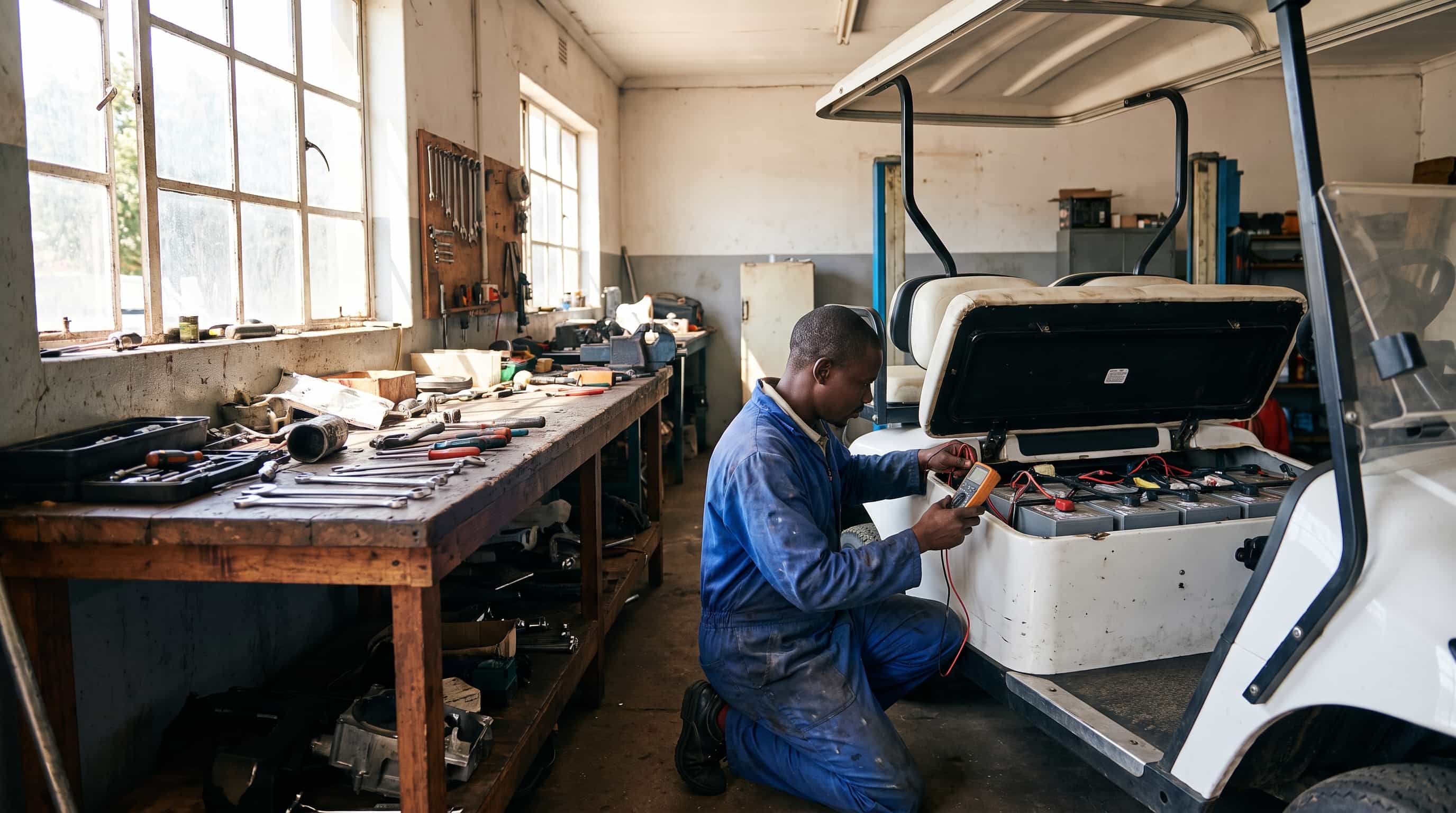
Not every battery complaint means a new set. A set that is merely flat recharges. A set failing to charge because of a corroded terminal, a bad connection, or a charger fault is a repair, not a replacement, and it would be an expensive mistake to buy batteries for what was a loose lug. And a lead-acid set that is low on water but caught before the plates were damaged can recover with proper watering. So before condemning a set, the connections, the charger and, on lead-acid, the water level all deserve checking, because those are cheap fixes that can look exactly like a dead set.
The decision comes down to one honest question: does the set still hold a useful charge once everything around it is known good. If it does, keep it and maintain it. If it does not, replace it as a whole set and start the maintenance right this time.
Common questions
- Can I just replace the one bad battery
- You can, but it is a false economy. A single new battery among old ones is dragged down to their condition, so you spend money for little gain and are soon back to the same problem. Batteries work as a matched set and should be replaced together to actually restore performance and last.
- How do I know it is the batteries and not the charger
- Check the cheap causes first. A corroded terminal, a bad connection or a charger fault can stop a set charging and look exactly like a dead set, and buying batteries for those would be a costly mistake. On lead-acid, check the water too. Only condemn the set once the connections, charger and water are known good and it still will not hold charge.
- Is it worth nursing an old set through one more season
- Rarely. A worn set costs you range and reliability all season and tends to fail at the least convenient moment, in front of guests or mid-event. If the set no longer holds useful charge, a fresh set bought before the season usually pays for itself in avoided breakdowns and lost use.
Still not right
We diagnose and repair golf buggies, service them on a plan, and send an engineer out to where the buggy is. Tell us the symptom and we will say what it usually means.