Golf buggy jerks or surges
By James Brown · Updated 21 July 2026 · 5 minute read

Jerking or surging is uneven power delivery, and it usually starts at the throttle: a worn or dirty throttle sensor, or a poor connection to it, sends the controller an unsteady signal. A tired battery sagging under load, or a controller fault, can also cause it. Check the throttle and its connection first, because that is where most uneven-power faults live.
Key takeaways
- Jerking and surging are uneven power delivery, most often traced to the throttle signal.
- A worn or dirty throttle sensor sends a jumpy signal that the controller turns into surging.
- A poor connection at the throttle or in the wiring does the same as a worn sensor.
- A tired battery can sag under load and cause a lurching, uneven feel.
- Persistent surging with a good throttle and battery points at the controller, which needs an engineer.
What surging actually is
Smooth driving depends on a smooth, steady signal from the throttle to the controller, which the controller turns into steady power. Jerking and surging mean that chain has become unsteady somewhere: the power is arriving in lumps rather than a smooth flow. So the diagnosis is really a hunt for where the steadiness is being lost, and the throttle end of the chain is where it is lost most often.
The throttle sensor and its wiring
The throttle sensor, a potentiometer or a Hall-effect device depending on the buggy, tells the controller how far you have pressed the pedal. As it wears, or as dirt and damp get into it, it can send a signal that jumps around instead of rising smoothly, and the controller faithfully turns that jumpy signal into surging power. A poor connection at the throttle plug, or corrosion in its wiring, produces the same effect, because the controller sees an unsteady voltage either way.
This is why the throttle and its connector are the first place to look. Checking the connection is simple and cheap; the sensor itself can be tested and, if worn, replaced. The throttle guide covers this in more detail.
The battery and the load
A tired battery set adds its own version. Under the load of pulling away or climbing, a weak set sags in voltage, then partly recovers, and that sag and recovery can feel like lurching or hesitation, especially from a standstill or on a hill. If the surging is worse as the charge drops through the day, or only under heavy load, suspect the battery alongside the throttle, and check its health and charge.
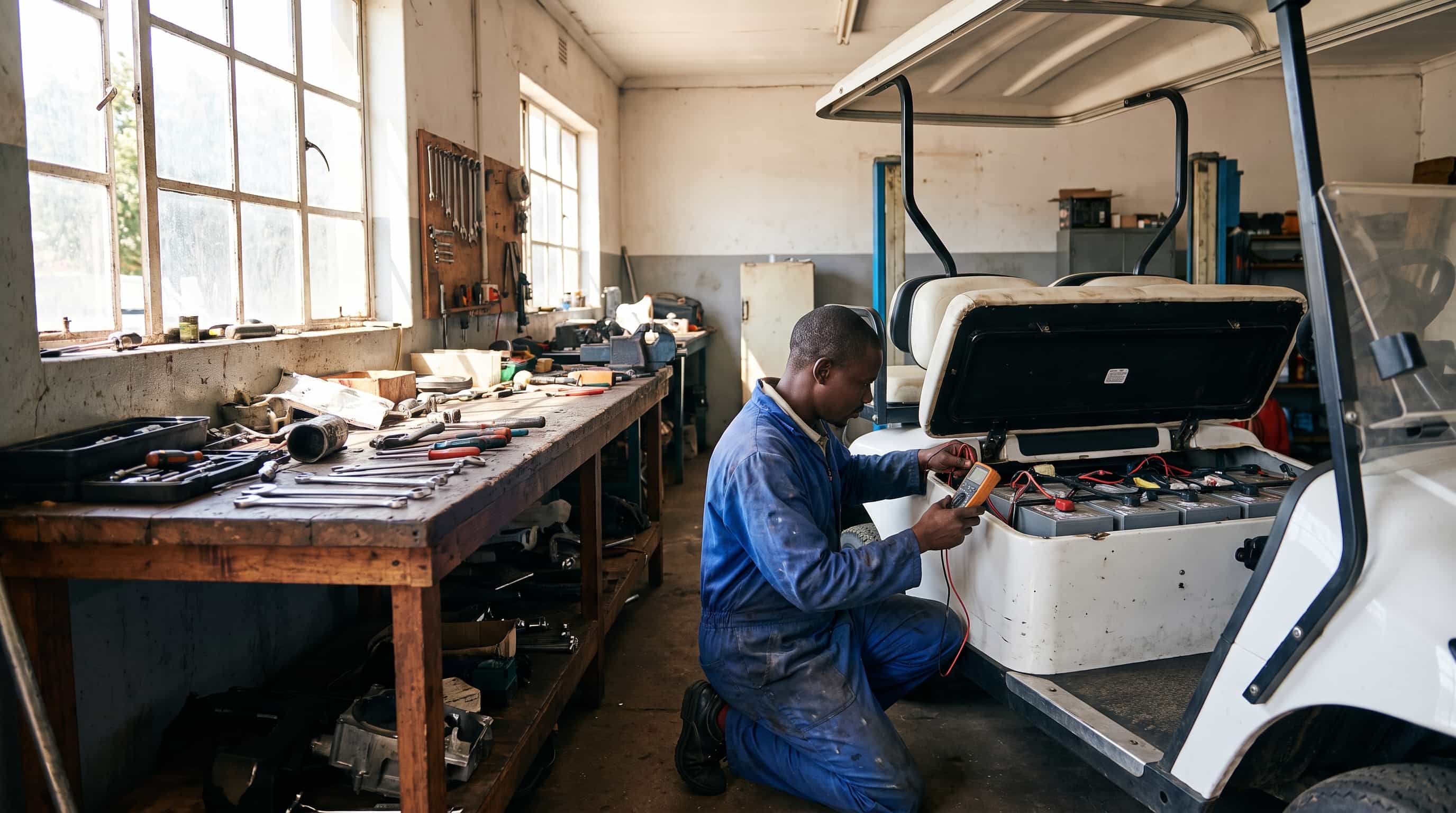
If yours is doing this and the checks here have not settled it, we diagnose and repair buggies, including a callout to wherever it is.
When it is the controller
If the throttle signal is clean, the connections are good, and the battery is healthy and charged, but the buggy still surges, the controller becomes the suspect, since it is what shapes the power. A controller fault causing uneven delivery is not a guessing matter, because controllers are expensive and often programmed to the buggy. That is the point to have it diagnosed properly with the right reader rather than replace it on a hunch. As with all uneven-power faults, note exactly when the surging happens, from rest, under load, when warm, at low charge, because that pattern guides the diagnosis.
Common questions
- It surges when I pull away
- Surging from rest points first at the throttle sensor and its connection sending an unsteady signal, and second at a tired battery sagging under the load of moving off. Check the throttle plug and test the sensor, and check the battery health, before looking deeper, since those two cover most cases.
- It only jerks when the battery is low
- That pattern fits a tired battery set. Under load a weak set sags in voltage and then recovers, which feels like lurching, and it gets worse as the charge drops. Charge the set fully and assess its condition; if a full, healthy set drives smoothly, the battery was the cause.
- The throttle seems fine but it still surges
- If the throttle signal and connections are good and the battery is healthy, the controller is the likely source, since it shapes the power delivery. That is a diagnosis-and-test job rather than a swap-and-hope one, because controllers are costly and often matched to the buggy, so involve an engineer with the right reader.
Still not right
We diagnose and repair golf buggies, service them on a plan, and send an engineer out to where the buggy is. Tell us the symptom and we will say what it usually means.
Related pages
Related guides
 Golf buggy troubleshooting, a complete guide9 minute read
 Golf buggy transaxle and differential basics5 minute read
 How to check golf buggy tyre pressures, step by step4 minute read
- Golf buggy throttle and potentiometer faults5 minute read
- Controller faults and error behaviour6 minute read
 Buggy cuts out while driving6 minute read