Star EV buggies explained
By James Brown · Updated 29 August 2026 · 10 minute read

Star EV is a marque of small electric vehicles aimed more at moving people around a site than at carrying golfers round a course. Multi-passenger shuttles, enclosed cabins and models presented abroad as street-capable are the recognisable shape of the range. For a British buyer the road-legal question decides everything, because road equipment fitted for another country's rules confers nothing here. On private land the position is simple. On a public road it depends on approval, registration, tax and insurance.
Key takeaways
- The range leans towards multi-passenger and enclosed vehicles rather than plain course machines.
- Lights, mirrors, belts and a windscreen are what confuse British buyers, because they look like proof of road legality and are not.
- Britain has no category a small vehicle simply falls into; road use turns on approval, registration, tax and insurance.
- Most owners never need the road at all, and on private land there is no registration or licence requirement.
- A private site split by a public road puts that short stretch straight back into the road question.
- A heavier multi-passenger machine changes gradients, gateways, turning circles and what happens to soft ground.
- Imported machines carry specification differences in the charger, the lighting and the instruments that are worth checking before purchase.
What the marque is aimed at
Star EV is a marque of small electric vehicles, and the range is pitched more at moving people around a place than at carrying a pair of golfers round a course. Multi-passenger shuttles, enclosed cabins, load-carrying variants and models presented abroad as street-capable are the recognisable shape of it. Golf-style machines exist within the range, but they are not what the marque is known for and not usually the reason a British buyer is looking at one.
That aim shapes the machines. A vehicle designed to carry a group along a resort road is heavier, longer and differently braked from a course buggy, and it is fitted with the equipment a road-going vehicle needs in the market it was designed for: lights, indicators, mirrors, a windscreen and seat belts. Those fittings are the source of nearly all the confusion British buyers run into, because they look like the answer to a question they do not actually settle.
The low speed vehicle category and why it does not travel
In the United States there is a recognised class of small, slow road vehicle with its own equipment requirements, and machines built to it can be used on certain public roads as a matter of routine. A great deal of the marketing for vehicles of this type, and most of the writing about them online, comes from inside that system. It is accurate where it was written and it does not transfer to Britain.
There is no equivalent classification here that a machine simply falls into by being built a certain way. What a vehicle may do on a British public road is decided by whether it has been approved, registered, taxed and insured, and by whether it meets construction and lighting requirements. A machine can carry every fitting the American category demands and still have no standing on a road here, because the fittings were never the thing that granted it standing in the first place.
That is why the road question comes first with this marque specifically. Nobody is under any illusion about a plain course buggy. Faced with a vehicle that has indicators, mirrors, belts and a windscreen, it is very easy for a buyer, and sometimes for a seller repeating what they were told, to assume the matter has already been dealt with by somebody else.
What British road use actually involves
The route to using any small vehicle on a public road in Britain runs through vehicle approval and then registration. Approval is the evidence that the vehicle meets the requirements applying to it. Registration is what puts it on the record and gives it a number plate. After that come tax, insurance, and the ordinary requirements around lighting, brakes, mirrors and driver licensing. Each is a separate hurdle, and clearing one does not clear the others.
The authoritative answers belong to DVLA and to DVSA, not to a supplier and not to us. For a specific machine the questions are whether it holds approval valid here, whether it has ever been registered in Britain, and what an approval test would involve if it has not. Ask to see documents. A verbal assurance that a vehicle is road legal is not evidence, and the cost of discovering otherwise falls on whoever owns it at the time.
- Approval evidence for the specific vehicle in writing, not a general claim about the model.
- A registration document if it has been registered here, and a plain explanation if it has not.
- Insurance confirmed for the intended use by your own insurer before you buy.
- Confirmation of what licence, if any, your intended drivers need for that class of vehicle.
Private land, where most of these vehicles live
Most buyers of this kind of machine never need it on a public road, and on private land the position is far simpler. There is no registration requirement and no driving licence requirement. The rules that apply are the landowner's own, plus the ordinary duty of care towards anybody on the site. Holiday parks, resorts, estates, campuses and event grounds run vehicles like this constantly without ever touching the road question.
The catch is the crossing. A private site divided by a public road, or a route that uses a short stretch of highway between two gates, puts you straight back into the road question for that stretch, however brief it is. Sites deal with it through a gated crossing, an agreed crossing arrangement, an alternative internal route, or a properly registered vehicle. What they should not do is treat a short hop across as though it somehow does not count.
What a multi-passenger machine changes
A shuttle carrying several people is a different vehicle from a small course buggy in every way that matters on site. It is heavier, so it needs more stopping distance and presses harder on soft ground. It is longer, so turning circles and gateway widths become real constraints rather than details. And it carries passengers who are not driving, which changes the seating, the handholds and the way it has to be driven when it is full.
Test the actual route before you commit rather than afterwards. The gradients on a resort path, the camber of a car park, the width of a bridge, the height of a barrier and the state of the surface after rain all decide whether a longer, heavier machine works there. A vehicle that is entirely comfortable on a flat resort road abroad can be marginal on a British site with a hill, a gravel bend and a wet October.
- Gradients on the real route, loaded, in both directions.
- Gateway widths, turning circles and any height barrier on the way in or out.
- Ground conditions after rain rather than on the day of the demonstration.
- Passenger access: the step, the handholds, and where people put their feet.
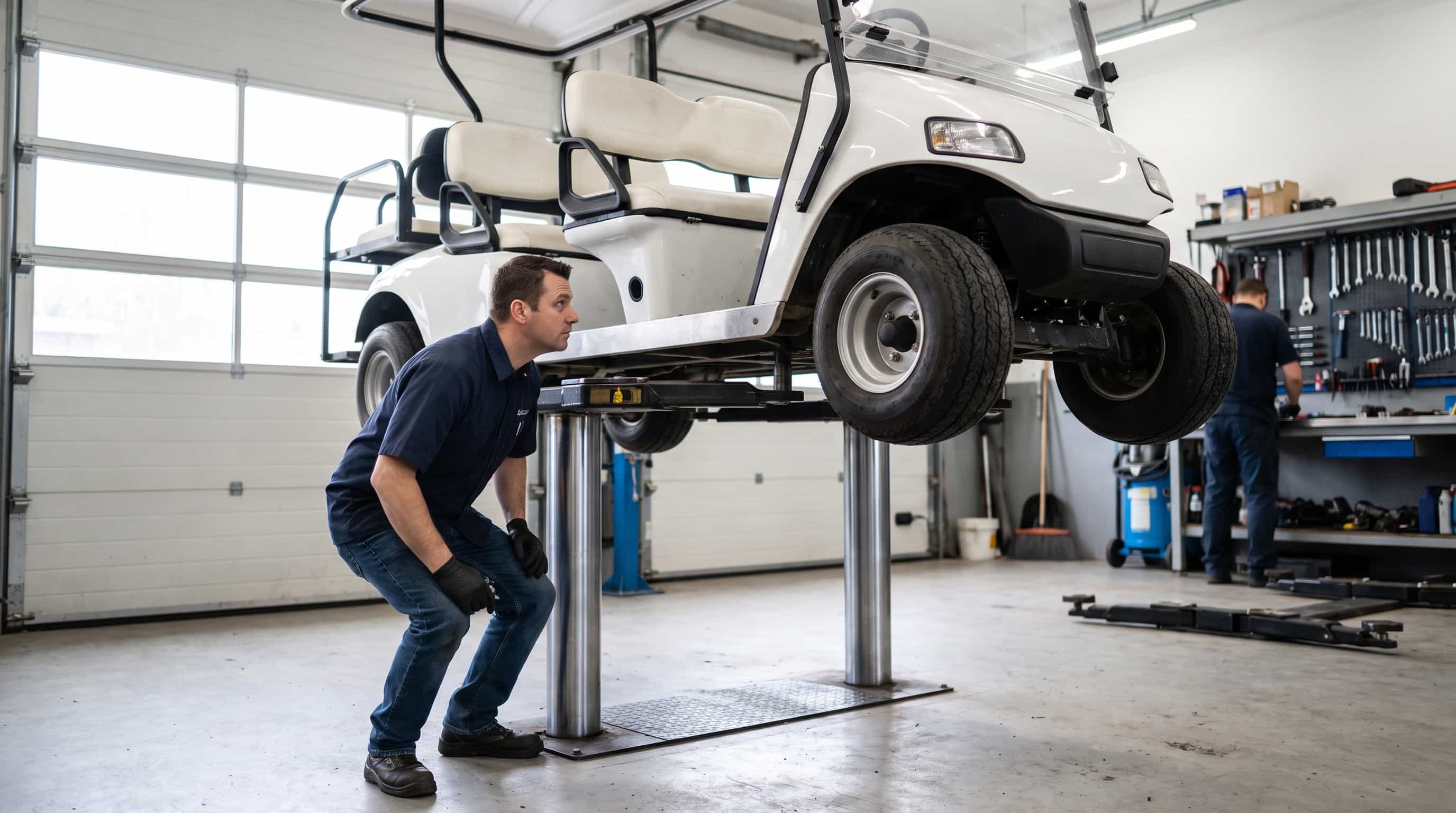
If yours is doing this and the checks here have not settled it, we diagnose and repair buggies, including a callout to wherever it is.
Support, parts and specification differences
Anything arriving in Britain through a small importer or a private sale carries the same set of questions. Which market was the machine specified for, and does that affect the charger, the plug, the lighting colours or the instruments? Who holds parts here, and what has to be ordered from abroad? Who honours any warranty, and does it survive a change of ownership? None of those has a general answer, and every one of them has a specific answer for the vehicle in front of you.
Ask an independent engineer as well. Common fleet makes get serviced by anybody, because the parts are on a shelf and the layout is familiar. A marque that arrives here in small numbers depends on somebody being willing to work on it and able to obtain parts for it. If the nearest person who will touch it is a long way off, that is not necessarily a reason to walk away, but it is a cost and a delay you should know about first.
Going over a machine before you commit
Treat the paperwork as part of the vehicle. Approval and registration documents, the battery specification and its warranty terms, the charger and its supply requirements, the service history and the identity of the importer are all things to see rather than to be told about. Photograph the vehicle identification number and check that it appears consistently on every document you are handed, because a mismatch there is worth stopping for.
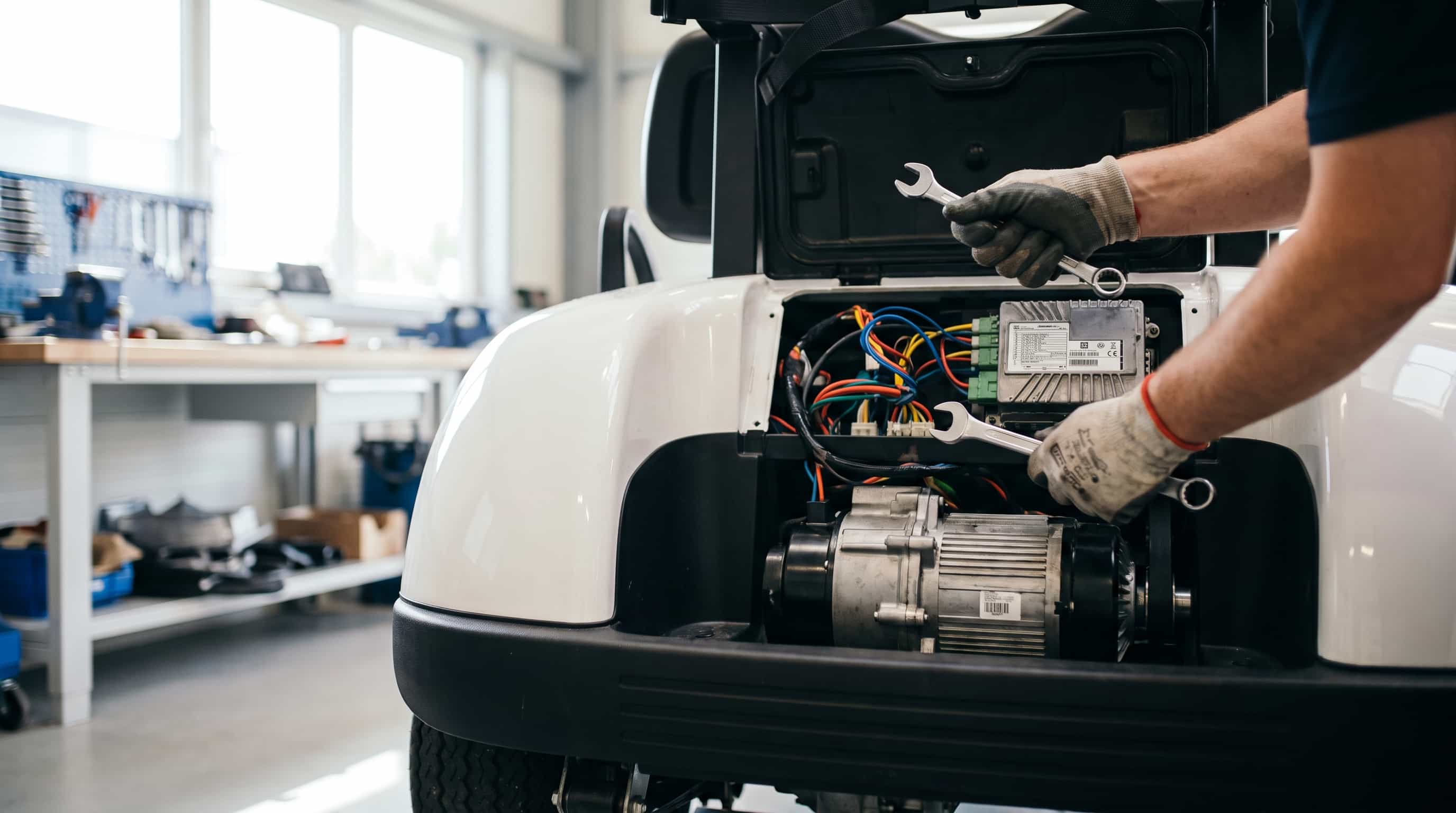
Physically, the priorities are the pack, the brakes and the structure. Establish the battery chemistry, its age and how it has been charged, since it is the largest hidden cost in any used electric vehicle. Test the brakes loaded and on a slope. Look for corrosion in the places a road-equipped machine collects salt and water, and check that fitted lighting and belts are complete and working rather than partly removed by a previous owner.
- Vehicle identification number matched across every document you are shown.
- Battery chemistry, age, charging history and the correct charger present with the machine.
- Brakes tested loaded and on a gradient, not empty on the flat.
- Lights, indicators, mirrors and belts complete and working if the machine carries them.
Where the marque fits and the honest limits
For moving groups of people around a private site with made-up surfaces, machines of this type do a job that a plain golf buggy does badly. Resorts, holiday parks, campuses, large venues and event sites are the natural fit, and the enclosed and multi-passenger variants are genuinely useful where people need shelter from British weather and the route is a road rather than a fairway.
The limits are turf and the highway. On soft ground a heavier vehicle needs the right tyres and a careful eye on the forecast, and it will mark a lawn that a light buggy crosses without trace. On a public road, nothing about the machine settles the question by itself. If road use is part of why you want one, treat it as the first thing to prove, take the answer from DVLA and your insurer, and choose the vehicle afterwards.
Common questions
- Is a Star EV road legal in the UK?
- Not automatically, and not because of the equipment fitted to it. Road use in Britain depends on the vehicle holding appropriate approval, being registered and taxed, being insured for the use and meeting construction and lighting requirements. Some individual machines have been through that process and many have not. Ask for the documents, and confirm the position with DVLA rather than with a seller.
- What is a low speed vehicle?
- It is an American road category for small, slow vehicles with defined equipment requirements, and vehicles built to it can be used on certain public roads there. Britain does not use that classification. Here the question is settled by approval, registration, tax and insurance for the individual vehicle, so a machine described as a low speed vehicle has been described in another country's terms.
- Do I need a licence to drive one on private land?
- No driving licence is required on private land. What applies instead are the landowner's own rules, which commonly include a minimum age, a briefing and restrictions on where the vehicle may go, plus the ordinary duty of care towards other people on the site. Check the site's insurance position too, since cover often carries its own conditions about drivers.
- Can one be registered with DVLA?
- That depends on the individual vehicle and what approval it can demonstrate or obtain. Registration follows approval rather than replacing it, and the process differs for a vehicle already approved for use here and one that has never been. DVLA and DVSA hold the authoritative answer for a specific machine, and it is worth getting it before purchase rather than after.
- Where can I get one serviced in Britain?
- Start with whoever imported or supplied it, then ask an independent buggy engineer near you. The mechanical and battery side is usually familiar work. Marque-specific electronics, body parts and glazing are the areas where availability decides how long a repair takes. Establish that support route before you buy, because it is the difference between a short delay and a vehicle standing for weeks.
- Is this the right choice for a golf course fleet?
- Usually not. Course fleets want light machines on turf tyres, cheap common parts and repairs that fit between tee times. Multi-passenger and road-equipped vehicles are heavier, harder on the ground and slower to get parts for in Britain. They earn their place moving guests and staff along paths and roadways rather than working the fairways.
Still not right
We diagnose and repair golf buggies, service them on a plan, and send an engineer out to where the buggy is. Tell us the symptom and we will say what it usually means.