Single-rider buggies at a golf club
By James Brown · Updated 29 August 2026 · 9 minute read
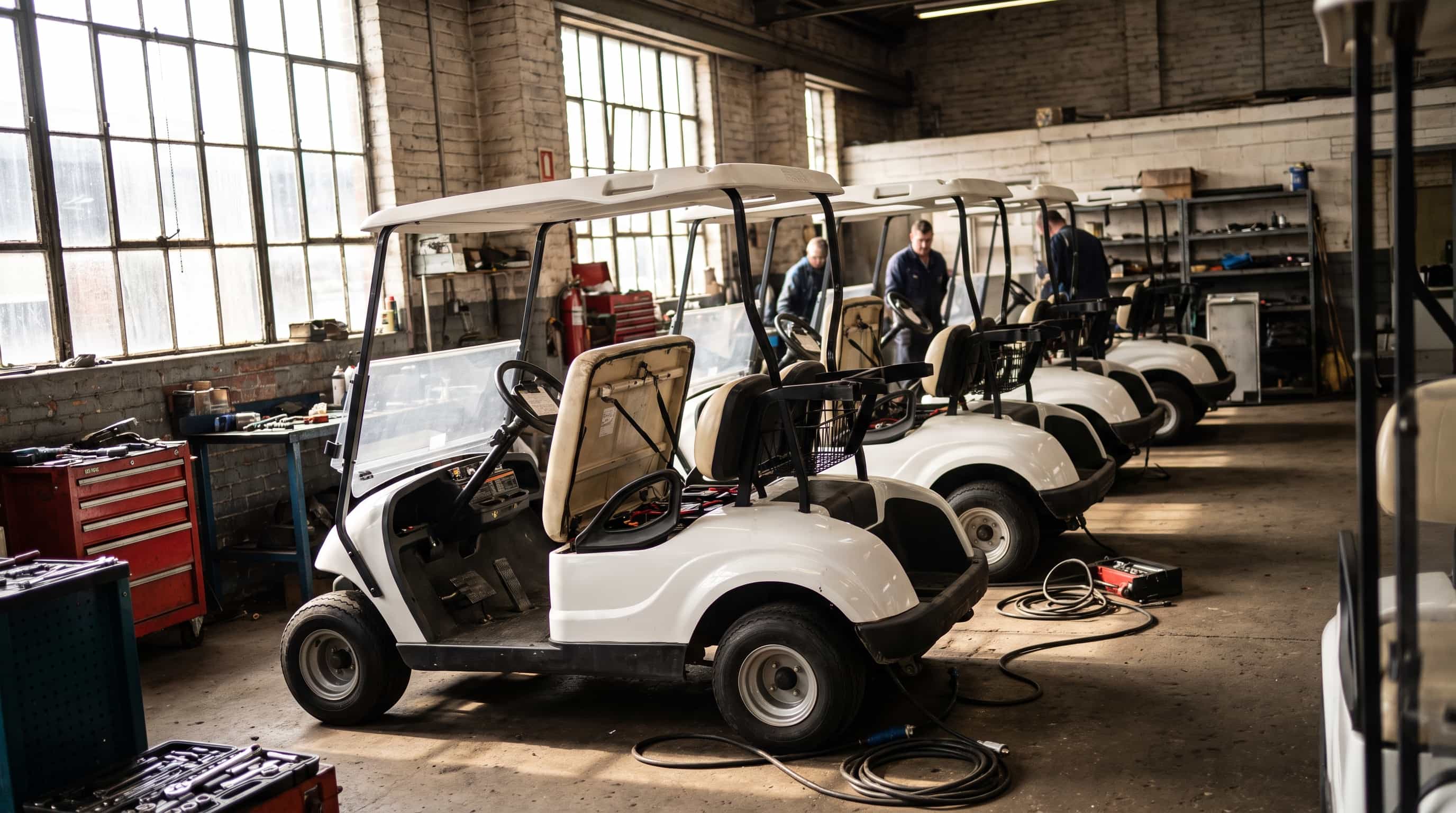
One golfer, one bag, and a machine that goes wherever that player's ball goes. Single riders come seated or as a stand-on platform, and on a course that limits full buggies for reasons of width, turning room or concentrated wear, a single often passes where a two-seater cannot. It is not exempt from a wet weather closure and it is not automatically gentler on turf. Trial one on your own ground, and settle driver rules, storage and charging at the same time.
Key takeaways
- A single rider carries one golfer and one bag, so it travels to that player's own ball rather than a compromise between two.
- Two singles disperse their wear across a hole, while one shared buggy concentrates it on a single line driven twice.
- Lighter does not automatically mean gentler, because a narrow tyre puts its load through a smaller patch of ground.
- Where a course restricts buggies on width, camber or turning room, a single machine may pass where a two-seater will not.
- Course-condition closures apply to singles as well, because the ground does not care how many seats a machine has.
- Permitting riding transport in a competition is a decision for the committee running it, written into the conditions of competition.
- Storage space, a charging point and a driver rule all need settling before the first machine arrives rather than after.
What a single rider machine is
A single rider is what the name says: a machine built to carry one golfer and one bag. Two broad shapes exist. One is a small seated buggy, essentially a conventional buggy narrowed to a single seat with a bag carrier behind. The other is a stand-on machine, where the rider stands on a platform between the wheels with the bag carried upright alongside, steering from a handlebar or a post.
The seated type behaves like a small buggy and needs no explaining to anyone who has driven one. The stand-on type behaves differently. It is narrower, it turns tighter, and it asks the rider to balance, which suits some golfers very well and rules out others immediately. Neither is a novelty, and both appear at British clubs, usually alongside a conventional fleet rather than instead of one.
The distinction that matters on a golf course is not the shape but the seat count. One rider means one destination. The machine follows the player to their own ball, waits, and moves on, and it never has to compromise between two people who have hit in different directions. Everything that follows in this guide, the wear pattern, the pace argument, the access case and the storage question, comes back to that one fact.
How the ground argument changes
The usual claim is that a single rider is kinder to the course because it is lighter. That is half true, and it is not the half that matters. The important difference is dispersal. A shared buggy carrying two players drives to one ball, then across to the other, so the pair's traffic runs as one heavier line crossing both sides of the hole. Two singles go their own ways, and neither drives the other's route.
Weight is a weaker argument than it sounds. A lighter machine on narrow tyres can press as hard into the soil as a heavier one on wide turf tyres, because what damages soil is pressure and repetition rather than total mass. Stand-on machines in particular can run narrow wheels. The contact patch, the pressure the maker specifies, and how many times the same line gets driven decide the outcome, not a weight figure in a brochure.
So the honest position is that a single rider changes where the wear goes rather than removing it. On a course with a problem at the entry and exit points, spreading that traffic is a genuine gain. On soft ground in winter a single still cuts a rut, and the course manager still has grounds to close the course to it.
Courses where a single fits and a two-seater does not
Some buggy restrictions are policy and some are geometry, and only the second kind bends for a single rider. If the committee has decided buggies are not part of the club's character, a narrower machine does not answer that. If the reason is that the gap between two bunkers will not take a buggy, or the bridge over the burn was built for a person with a trolley, then width and turning circle are the whole question, and a single may pass where a two-seater will not.
The way to find out is to walk the course looking for specific blocks rather than to debate it in the committee room. In practice a small number of points on any restricted course carry the whole restriction, and they are usually identifiable in one circuit with the course manager. Write each one down with the reason beside it, because width, camber, a step and soft ground are four different problems and only some of them are answered by a narrower machine.
- Gaps between bunkers, mounds or dune faces that a two-seater cannot line up for.
- Bridges and boardwalks built for foot traffic, where the width and the load both need checking.
- Steps, revetted banks and short steep climbs between a green and the next tee.
- Path networks that stop well short of the green, leaving a long walk back for the rider.
- Cross-slopes, where the issue is the camber a machine sits on rather than the gradient it climbs.
The pace of play case, honestly put
A single rider goes straight to its own ball, which removes the most reliable way a shared buggy loses time: one player walking across the hole to their ball while the other sits waiting in the vehicle. On that count singles are quicker, and where buggies are allowed to disperse rather than being held to a path, the gain is real and it turns up on every hole rather than occasionally.
It is worth not overselling it. A round takes as long as the slowest group ahead, and a fast pair in singles behind a walking fourball gains nothing at all. Singles help most where the field is largely riding, where the course is long between holes, or where a paths-only rule is forcing riders into long walks out and back. On a busy tee sheet, the interval between groups sets the pace far more than the transport does.
Working out what this costs for your own event? Tell us the venue and dates and you will have an itemised written quote within one working hour.
Who they suit, and who they do not
The access case is often the strongest reason a club buys one, and it is more specific than it looks. A golfer who cannot walk the course but can sit, steer and get in and out unaided is well served by a seated single. A golfer who stands and balances comfortably but finds distance the problem may prefer a stand-on machine, which is easier to step on and off than a buggy is to climb into.
Neither suits everyone. Standing machines ask for balance on moving ground and are not the answer for somebody unsteady on their feet. Some golfers need a machine that supports them in a standing position so they can play a shot without transferring, and those exist as a separate category of adaptive equipment. Fitting one to a person is not a job to do from a brochure: involve the supplier and the golfer's own physiotherapist or clinician.
A club that buys a single rider for accessibility reasons should also decide how it is booked. A machine kept for golfers who need it, and quietly used by anyone who fancies a ride on a wet Sunday, is not available at the moment it is needed. Say in the policy what the machine is for and who has priority.
What a club needs to settle before adding one
The machine is the easy part. The decisions around it take longer, and they decide whether the thing actually gets used. Charging comes first: a single rider needs a point in the store like every other machine, and adding one to a compound already at capacity is a building question rather than a purchase question. Work out where it will stand, how it gets plugged in without a lead trailing across a walkway, and who is responsible for putting it on charge once play has finished.
The rest is policy, and most of it can be lifted from what the club already does for its buggies, with the differences written in. The differences are usually the driver briefing, because a stand-on machine handles unlike anything a member has driven before, and the competition position, because riding transport in a competition is a matter for the committee running it and needs saying in the conditions of competition rather than being left to custom.
- A charging point, storage space, and somewhere the machine lives in the wet.
- Who may drive it, at what age, and what briefing they are given first.
- Whether it falls inside the same course-condition closures as the rest of the fleet.
- How it is booked, and who has priority if it was bought for access.
- Insurance, since a different type of machine is something the insurer should be told about.
- The competition position, written into the conditions of competition.
- Recovery: how the machine comes home if it stops at the far end of the course.
Running a trial that tells you something
Suppliers will put a machine on your ground for a period, and a trial is worth more than any specification sheet. Set it up to answer questions rather than to enjoy it. Run it through a wet week as well as a dry one, because the wet week is where the argument will actually be had, and agree beforehand what you are measuring: the ground, the pace, the demand from members, or all three.
Walk behind it with the course manager on your softest hole and your steepest, and look at the ground the following morning rather than at the time. Put it in the hands of the members it was bought for, not only the committee. Then ask the starter what happened on the busiest morning, because the practical objections to a mixed fleet, booking, briefing and charging turnaround, surface at the first tee before they surface anywhere else.
Common questions
- Is a single rider buggy allowed when the course is closed to buggies?
- Normally no. Course-condition closures are about the ground rather than the vehicle, and most clubs apply them to every powered machine on the property. Some make a narrow exception for a golfer with an exemption, or allow paths only, but that is a decision for the club and its course manager. Ask what the written policy says before relying on it.
- Do single rider buggies cause less damage to the course?
- They spread wear rather than remove it. Two singles take two different lines instead of one shared buggy driving both sides of a hole, which helps where wear concentrates. Weight alone proves little, since a narrow tyre can press harder on the soil than a wide one. On soft ground a single still ruts, which is why closures apply to them too.
- Can you use a single rider buggy in a club competition?
- That depends on the committee running the competition. Riding transport is permitted or prohibited in the conditions of competition, and a club can allow it generally, allow it only for golfers with an exemption, or prohibit it. Check the conditions for the specific competition rather than the club's general buggy policy, because the two are set separately.
- Do you need a licence to drive a single rider machine?
- Not on private land. No driving licence is required to drive a buggy on a golf course, and the same applies to a single rider. What governs is the club's own rule: a minimum age, a briefing, and any condition the club's insurer has attached. Public roads are a separate question with separate requirements of their own.
- Are single riders suitable for a golfer who cannot walk far?
- Often, and a seated single is usually the easier starting point because it asks nothing of the rider's balance. Stand-on machines need the rider to stand steadily on a moving platform. If a golfer needs support to play a shot from a standing position, that is a different category of adaptive machine and should be specified with the supplier and the golfer's own clinician.
- How many single riders does a club need?
- There is no standard number, and the useful limit is usually physical: charging points and floor space in the store. Start with what the compound can genuinely take, watch how the booking diary fills over a season, and add capacity when the diary shows the demand. A machine that is never free stops serving the purpose it was bought for.
Ready to get a price
Tell us about your event and we will send an itemised written quote within one working hour.


