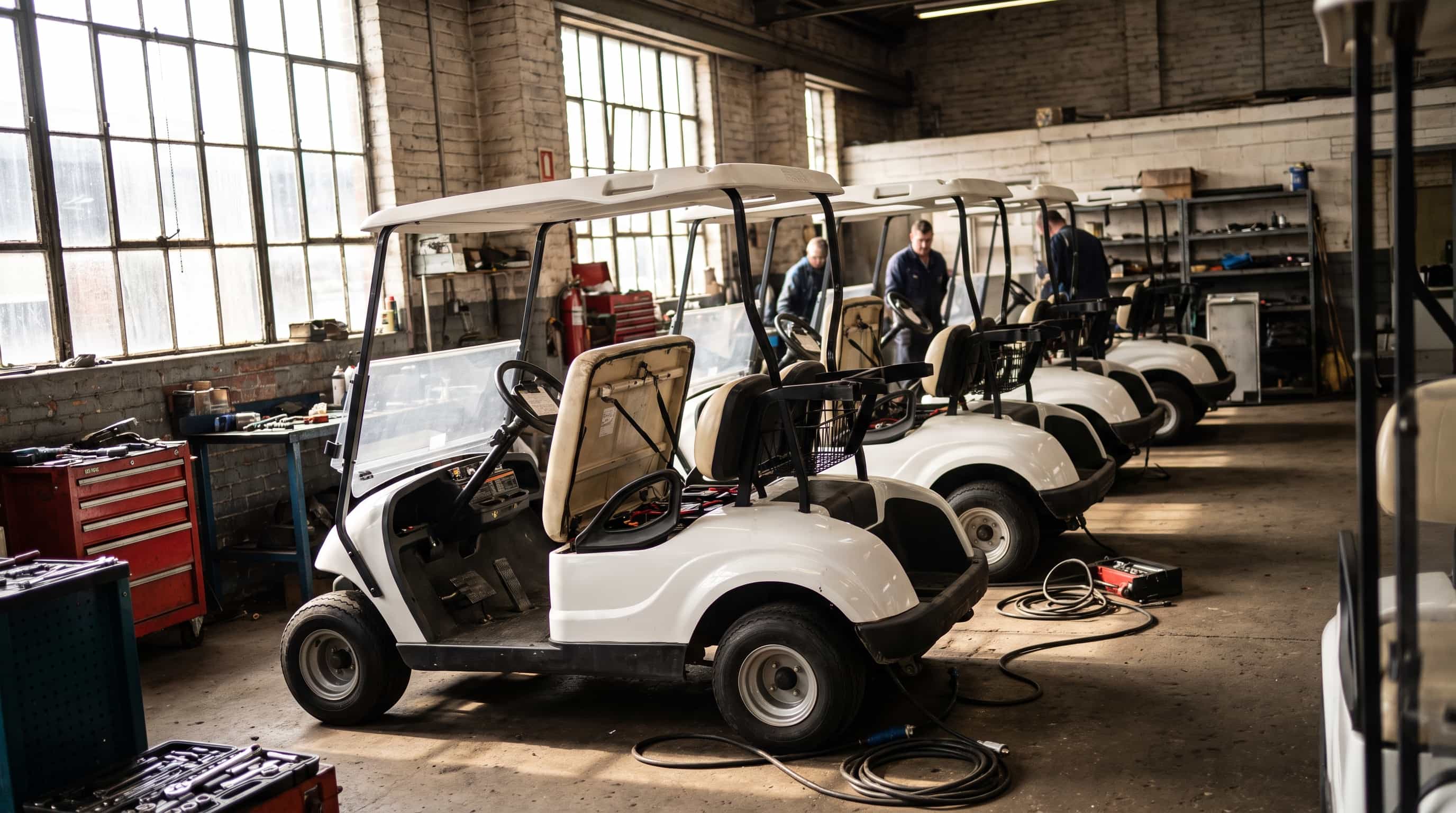
Buggies and pace of play
By James Brown · Updated 29 August 2026 · 9 minute read

Buggies do not reliably make a round quicker. A round is governed by waiting rather than walking speed, so a buggy saves time only where it removes a wait or shortens a long link between holes. A shared buggy carrying two players whose balls are apart usually loses time against a walking pair. Paths-only rules cost more time again, because the rider walks to and from the machine at every shot. The course, the rule in force and the driving habits decide the answer.
Key takeaways
- Walking speed is rarely what makes a round slow; waiting on the group ahead and searching for balls is.
- A shared buggy ties two players to one vehicle, which is the most common way riding loses time.
- Paths-only rules protect turf and cost pace, because every shot becomes a walk out and a walk back.
- Buggies gain time on courses with long green-to-tee links and on ground that tires walkers late in the round.
- A rider who takes two or three clubs to the ball and lets the buggy go ahead removes most of the loss.
- Where a path ends far from the green, the club has built the pace problem rather than the buggy causing it.
- Tee interval, course setup and marshalling move pace more than transport does, so check those before writing a buggy rule.
Walking speed is not what makes a round slow
Start with what actually consumes time on a golf course. A round is not slow because golfers walk at walking pace. It is slow because groups wait: on the tee for the fairway to clear, on the fairway for the green, and behind somebody looking for a ball in the rough. Walking between shots happens inside that waiting rather than adding to it, which is why riding does not automatically buy anything back.
That gives a simple test for any course. A buggy saves time only where it removes a wait or shortens a walk that was holding somebody up. On a compact course with tees beside the previous green there is very little of either, and the group in a buggy spends the round looking at the backs of the group in front. On a spread-out course with long walks between holes there is a good deal of both.
The corollary is uncomfortable for anyone arguing either side. On most courses buggies are neither the cause of slow play nor the cure for it. They are one variable among several, and the ones that matter more, the tee interval, the rough height, the pin positions, the pace policy and whether anybody enforces it, sit with the club rather than with the golfer.
What a paths-only rule costs
Paths only is the rule clubs reach for when the ground will not take traffic, and it works, because the wheels never touch turf. The pace cost is real and it is often understated. The rider parks on the path, walks out to the ball, plays and walks back, at every shot, usually further than a walking golfer goes because the path is not where the ball is.
It gets worse when the rider guesses the club wrong. A walker carries the whole bag and changes their mind at the ball. A rider on a paths-only day has to decide from the path and walk back if the decision was wrong. That is where the minutes actually go, and it is why paths-only mornings feel slow to everybody on the course rather than only to the riders.
None of this is an argument against the rule. Protecting the course in the wet is the right call, and a slow round is a smaller loss than a scarred fairway. It is an argument for saying so plainly on the day, for expecting the tee sheet to run behind, and for looking at where the paths actually end, since a path that stops well short of a green turns a sensible rule into an unnecessary walk.
Where buggies genuinely gain time
The gains are real on particular kinds of course. Where holes sit far apart, where the walk from a green to the next tee climbs, or where the routing loops away from the clubhouse, a buggy removes dead distance nobody was enjoying. On hilly ground the gain often shows up late: a walking group is fine for a dozen holes and tired for the rest, while a riding group plays the closing holes at the pace of the opening ones.
Buggies also keep mixed groups together. A fourball of very different fitness walks at the pace of its slowest member and stops being a fourball by the turn. Give the players who need one a buggy and the group stays intact and keeps moving. On society and corporate days, where the field is large and the standard is mixed, that effect is usually worth more than any saving on an individual shot.
Working out what this costs for your own event? Tell us the venue and dates and you will have an itemised written quote within one working hour.
Driving habits that recover most of the loss
Almost everything above comes down to what riders do rather than what machines are. A short briefing at the first tee changes more than any policy document, and clubs that give one, at the starter's hut or printed on the back of the scorecard, notice the difference on the tee sheet. Visitors take it particularly well, because most of them have never been told any of this and are not deliberately holding anybody up.
The habits themselves are ordinary and easy to state. Where a club prints them, print them as instructions rather than as suggestions, and keep them short enough to be read while somebody is putting a glove on. A handful of lines on a scorecard gets read; a page of guidance pinned to a noticeboard does not, and the difference shows in how the field moves before the turn.
- Take two or three clubs to the ball rather than driving the buggy to it and back.
- Drop your partner first, then drive on to your own ball, instead of carrying both players to every shot.
- Park behind or to the side of the green, on the line to the next tee, never in front of it.
- Leave the bags on the machine while putting, and walk off towards it rather than back to it.
- Play ready golf, which matters more in a buggy than on foot because getting out and in costs time.
- Keep to the course-condition rule in force that morning, even where the ground looks fine to you.
What the club controls
Most of the buggy pace problems a club complains about are things the club built. The commonest is a path that ends a long way from the green, which forces every rider into a walk out and a walk back on the one part of the hole where groups already bunch. Extending the path, or moving the point where riders are asked to leave it, changes the pace of the whole hole.
Signage is next. A dispersal rule nobody understands gets ignored or over-obeyed, and both cost time. If the rule is that buggies stay on the path until level with the ball and then turn straight out to it, say that in those words on a sign where it applies, not in a notice pinned up in the locker room in March. If certain holes are paths only, mark those holes rather than declaring it course-wide out of caution.
The last one is the tee sheet. If riders and walkers are mixed at short intervals on a busy morning, the field bunches whatever the transport rules say. Clubs that look hard at pace usually find the interval, first-tee discipline and marshalling matter more than the buggies, and that finding is worth having before a policy goes out that annoys the members who need transport most.
Checking it on your own course rather than arguing about it
Pace arguments run on impressions, and impressions are unreliable, because everyone remembers the group that held them up and nobody remembers the ones that did not. If the committee is going to change a buggy rule, gather some evidence first, and it does not have to be elaborate. What you want is enough to separate a transport problem from a course setup problem and a tee sheet problem, because the remedy for each is different.
Time a sample of groups from the first tee to the ninth and to the eighteenth across a few different mornings, note which were riding and which walking, and record the course-condition rule in force each day. Ask the starter and the marshal what they see, since they see it daily. Watch one hole where bunching happens and find out what causes it. In most cases the answer is not the transport, and where it is, you will know which rule to change instead of guessing.
Common questions
- Do golf buggies speed up a round of golf?
- Not by themselves. A round runs at the speed of the group in front, so a buggy saves time only where it removes a wait or shortens a long walk between holes. On spread-out or hilly courses the gain is real, particularly late in the round. On compact courses riders spend the day waiting on the group ahead exactly as walkers do.
- Why does a shared buggy slow us down?
- Because two players are tied to one vehicle. If the balls finish apart, the buggy goes to one, the other player walks across and back, and both are held to a single route. Walking pairs split and go straight to their own balls. Dropping your partner at their ball with a couple of clubs removes most of the difference.
- Is a paths-only rule bad for pace of play?
- It costs time, and clubs do better to say so than to pretend otherwise. Riders walk out to the ball and back at every shot, then walk again when they took the wrong club. It is still the right call when the ground will not carry traffic. Where the path ends far from the green, the cost is larger than it needs to be.
- Should buggy riders play ready golf?
- Yes, and it matters more in a buggy than on foot. Getting out, choosing a club and getting back in adds time at every shot, so playing when ready rather than strictly in order recovers it. Agree it on the first tee. It only works if all four players are doing the same thing, which is why the agreement matters.
- Can a club ban buggies to improve pace of play?
- A club can set its own transport policy, but it should test the assumption first, because most pace problems trace back to tee intervals, course setup or marshalling. A club also has duties towards disabled golfers under the Equality Act 2010, so any restriction needs an exemption route. Look at your own timings before writing the rule.
- Do single rider buggies help pace of play?
- They remove the shared buggy problem, because each golfer travels to their own ball with their own clubs. That is a genuine gain where the field is largely riding and machines are allowed off the paths. Behind a slow walking group it makes no difference at all, since the group in front sets the pace for everybody behind it.
Ready to get a price
Tell us about your event and we will send an itemised written quote within one working hour.