Recovering a broken-down golf buggy on site
By James Brown · Updated 21 July 2026 · 4 minute read
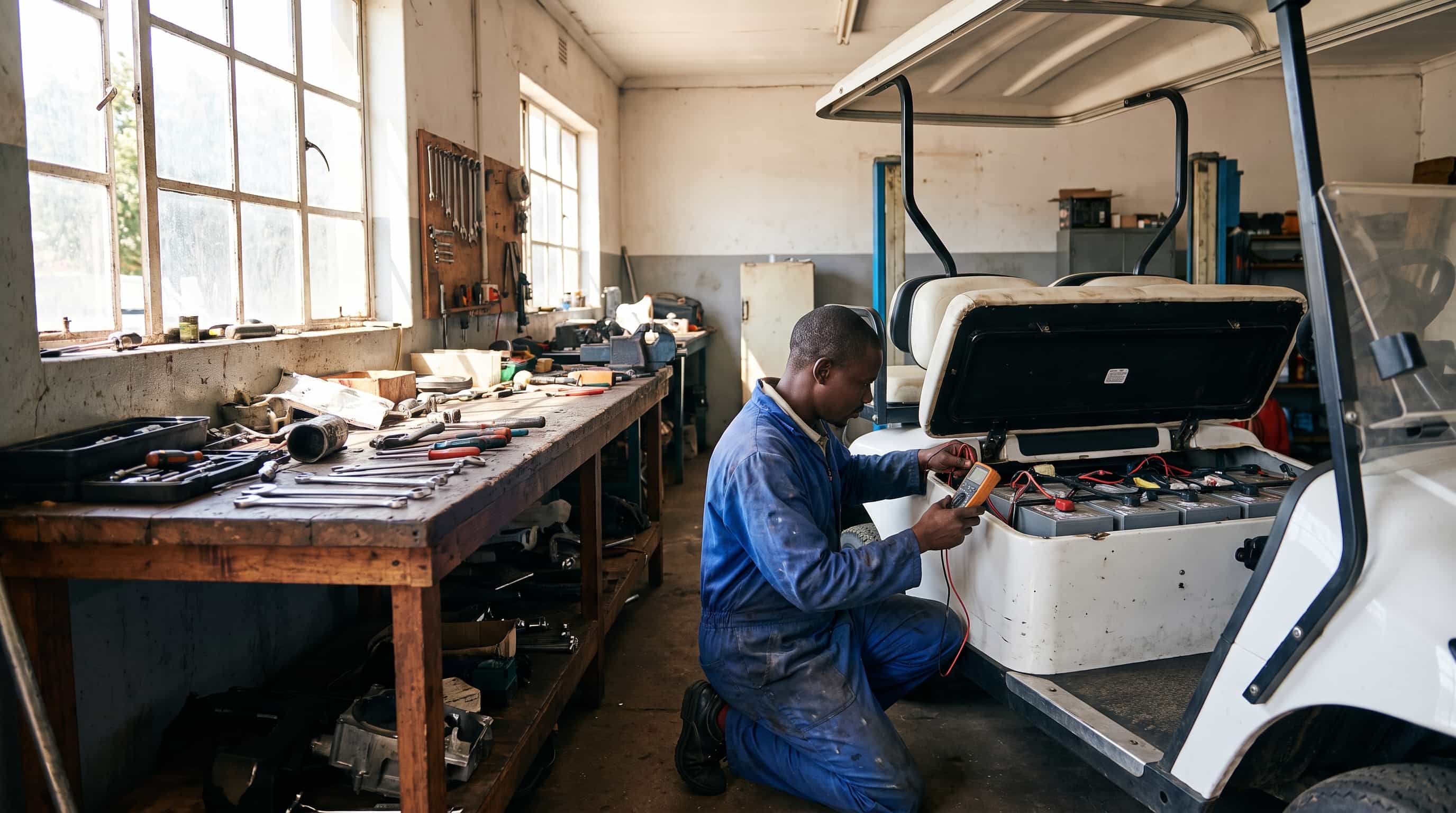
If a buggy breaks down at an event or on a site, make it safe first: stop it somewhere it will not block or roll, switch it off, and get any passengers clear. To move it, use any tow or freewheel setting that disengages the drive so it can be pushed, and steer it aside. If it cannot be safely moved or the fault is serious, keep clear and call for help.
Key takeaways
- Make the buggy safe first: stop it clear of the way, switch off, get passengers clear.
- Use any tow or freewheel setting to disengage the drive so it can be pushed.
- Steer it aside to a safe spot rather than leaving it blocking or on a slope.
- Do not force or improvise with a serious fault such as a burning smell or damaged battery.
- If it cannot be safely moved, keep clear and call for help.
First, make it safe
A buggy that stops working in the middle of an event is an inconvenience, and the temptation is to fuss over why before dealing with where, which is the wrong order. The first job is to make the situation safe. Bring the buggy to a stop somewhere it will not block a route, an entrance or a path, and where it will not roll, avoiding a slope if you can. Switch it off. Get any passengers off and clear, particularly if there is any smell, heat or other sign of a serious fault. Only once the buggy and the people are safe is it worth thinking about moving it or diagnosing it. At a busy event, a broken-down buggy left in the wrong place is a hazard and an obstruction, so clearing it safely comes first.
Moving it out of the way
Often the practical need is simply to get the buggy out of the way until it can be dealt with, and this is where the freewheel setting matters. As the rolls-when-parked guide explains, many buggies have a tow or freewheel lever that disengages the drive so the buggy can be pushed or towed freely. Engaging that setting lets you push a dead buggy aside by hand, steering it to a safe, level spot off the route, which is far better than leaving it where it stopped. If the buggy has no such setting, or you cannot move it safely, do not force it or push it up or across a slope where it could get away from you; a buggy is heavier than it looks, and moving it wrongly is how injuries and rolls happen. Move it only where it is safe to do so, and get help if it is not.
When not to improvise
Some breakdowns are not for pushing aside and carrying on; they are for stopping and getting help. If the buggy stopped with a burning smell, smoke, or overheating, that is the serious-fault situation the burning-smell and smoking guides cover: make it safe, keep clear, and do not try to restart or move it casually, since those faults can worsen. If a battery is involved, swollen, hot or smelling, keep clear and treat it as a hazard. And if the fault is a mystery and the buggy is in a safe spot, resist the urge to keep trying to restart it in front of guests; note what happened and get it looked at. Knowing the difference between a simple dead buggy to move aside and a serious fault to keep clear of is the important judgement here.
If yours is doing this and the checks here have not settled it, we diagnose and repair buggies, including a callout to wherever it is.
Getting it dealt with
Once the buggy is safe and out of the way, the rest is about getting it recovered and repaired without disrupting the event further. A buggy that has simply stopped, a flat battery, a cut-out, can often wait quietly out of the way until after the event to diagnose, using the relevant fault guides, or be swapped for another if you have one. A buggy hired from us that breaks down at your event is our concern to sort, and the on-hire support in the booking, a report-a-problem route and the breakdown cover promise, is exactly for this situation, so the practical step is to use that rather than struggle alone. For your own buggy, once it is safe and clear, the fault-finding guides help you work out what happened calmly afterwards, and transporting it for repair, if needed, follows the transporting guide. The priority on the day is safety and clearing the way; the diagnosis can wait for calm.
Common questions
- What do I do if a buggy breaks down at my event
- Make it safe first: stop it clear of routes and slopes, switch it off, and get passengers clear, especially if there is any smell or heat. Then, if it is a simple breakdown, use any freewheel setting to push it aside to a safe spot. If it cannot be safely moved or the fault is serious, keep clear and call for help rather than forcing it.
- How do I move a dead buggy out of the way
- Use any tow or freewheel setting, a lever that disengages the drive so the buggy can be pushed, then steer it aside by hand to a safe, level spot. Do not push it up or across a slope where it could get away from you, since a buggy is heavy. If it has no freewheel setting or cannot be moved safely, get help rather than forcing it.
- What if there is a smell or the battery looks damaged
- Then it is a serious fault, not one to push aside and carry on. Make the buggy safe, get everyone clear, and do not try to restart or move it casually, since a burning smell, smoke or a damaged battery can worsen. Keep clear and get help. A hired buggy is ours to sort through the breakdown support; for your own, the serious-fault guides apply.
Still not right
We diagnose and repair golf buggies, service them on a plan, and send an engineer out to where the buggy is. Tell us the symptom and we will say what it usually means.
Related pages
Related guides
- Golf buggy troubleshooting, a complete guide9 minute read
 How to top up lead-acid battery water, step by step5 minute read
 Golf buggy brakes squeak or drag4 minute read
- Golf buggy free-wheels or rolls when parked4 minute read
 Transporting a golf buggy safely5 minute read
- Golf buggy won't start: causes and fixes6 minute read