Insuring a golf club buggy fleet
By James Brown · Updated 29 August 2026 · 11 minute read

A club fleet usually needs three things settled rather than one: cover for the machines themselves, cover for injury or damage they cause, and the insurer's agreement to what the club actually does with them. Hiring buggies to members and visitors is a different activity from running them for greenkeeping, and it has to be declared. Driver eligibility, use off the course and storage conditions are all written into the policy schedule, so the binding answer comes from your broker and the wording, not from general guidance.
Key takeaways
- A buggy fleet raises three separate insurance questions: the machines, the harm they can do, and the club's position as the party letting them out.
- Hiring buggies to members and visitors is a commercial activity your insurer needs to know about, and non-disclosure is what most often breaks a claim.
- Compulsory motor insurance attaches to roads and other public places, so a club car park open to the public may not be the private ground people assume.
- Security wording is frequently a condition of cover rather than advice, so a locked compound and separated keys can decide whether a theft claim pays.
- The records that support a claim are the hire log, the pre-use check, the briefing note and the incident report written on the day.
- A fleet run by an outside operator on your ground moves some of the risk and none of the club's own duties as occupier.
- Only the policy schedule and its endorsements bind, so ask your broker to confirm each point in writing.
The three questions a fleet actually raises
Insurance talk about buggies usually collapses into a single question, are they covered, and that is why clubs end up surprised. A fleet raises three separate questions, and they are often answered by different sections of different policies. The first is the machines: theft, accidental damage, fire, and what happens while they are charging or being moved. The second is harm the buggy does to a person or to property. The third is the club's own position as the organisation that hands over the keys, which is not the same as the driver's position.
Keeping them apart matters, because a club can be well covered on one and bare on another. Property cover on the machines says nothing about a rider driving into a member. Public liability written for a clubhouse and a course may or may not reach a vehicle being hired out. A policy that responds when a greenkeeper drives to the far end of the property may not respond when a visitor drives the same machine on a society day.
The practical move is to write the three down and put them to your broker as three questions, naming the activity in each. Vague enquiries get vague answers. A question that sets out that the club hires electric buggies to members and green fee visitors, stores them in the greenkeeping compound overnight and crosses a public road between two parts of the course will get an answer you can rely on.
Declaring what you actually do with them
The most common way a buggy claim fails is not an exclusion buried in the wording. It is that the insurer was told something different from what the club does. Hiring buggies out for a fee is a commercial activity. Running them as greenkeeping transport is not. Lending them free to members is different again, and so is allowing a visiting society to bring drivers who have never set foot on the property.
Set out the whole picture at renewal rather than at the point of a claim. That means how many machines there are, though the count matters less than the pattern of use: who drives them, on what basis, at what times of year, and how the club takes payment. A club that has grown from a couple of spare buggies for members who cannot walk into a hire operation running right through the summer has changed its activity, not just its scale.
Open events, corporate days and charity days deserve a specific mention, because they bring drivers nobody knows and often more buggies than the club owns. Machines brought in for the day by an outside supplier are normally insured by that supplier for that supplier's own use, which is not the same as being insured for your visitors to drive. Settle who carries what before the day rather than after it.
Who is covered to drive
Policies define an insured driver, and the definition is where club practice and cover most often part company. Some wordings name individuals. Some cover any person driving with the club's permission. Some add conditions on top: a minimum age, a full driving licence, or a briefing recorded before the keys change hands. None of that is standard, so it has to be read rather than assumed.
The age point catches clubs regularly. A club may be content for a competent teenager to drive on its own ground, and no national licensing requirement stops it on private land, but the insurer may set a minimum age of its own or require a licence the young driver does not hold. Where the two do not match, it is the club's rule that has to move.
Visitors are the other pinch point. A member who hires a buggy every week has been briefed, has signed the club's terms and is known to the shop. A green fee visitor on a society morning has done none of that unless the club makes it happen at the first tee. If the policy requires a briefing or a signed hire agreement, and the starter is under pressure, that condition quietly fails on the busiest days of the year.
- Ask the insurer for the exact definition of an insured driver, in writing.
- Check any minimum age and any licence requirement, then set the club's rule to the stricter of the two.
- Confirm whether contractors, casual staff and juniors sit inside or outside the definition.
- Agree in advance who may drive on a society or corporate day, and who briefs them.
- Check whether a member's guest counts as an authorised driver, since most people assume they do.
Where the cover stops applying
Every policy has a geographic limit, and buggies wander further than the limit assumes. A machine that never leaves the course is a straightforward proposition. A machine that crosses a public road between two parts of the property, tracks along the edge of the car park to reach the first tee, or goes to another club for an away fixture, is not. The wording will describe the insured location in a line or two, and it is worth reading that line against what actually happens on a Saturday.
The general legal position is that compulsory motor insurance attaches to use on a road and in other public places, so private land removes the requirement rather than the risk. The complication for clubs is that a car park the public can enter may be a public place even though the club owns it, and a road crossing is a road crossing however short. Neither point is one to settle by reasoning it out at committee. Put your specific crossing and your specific car park to the insurer and get the answer back in writing.
Movement off the property needs its own line in the conversation. Buggies going out on a trailer to a club open day, going away for servicing, or being lent to a neighbouring club are usually outside standard course-based cover unless transit is added. The same goes for a machine kept at a member's house over the winter, which sounds harmless and is a change of risk address.
Working out what this costs for your own event? Tell us the venue and dates and you will have an itemised written quote within one working hour.
Theft, storage and the conditions attached to cover
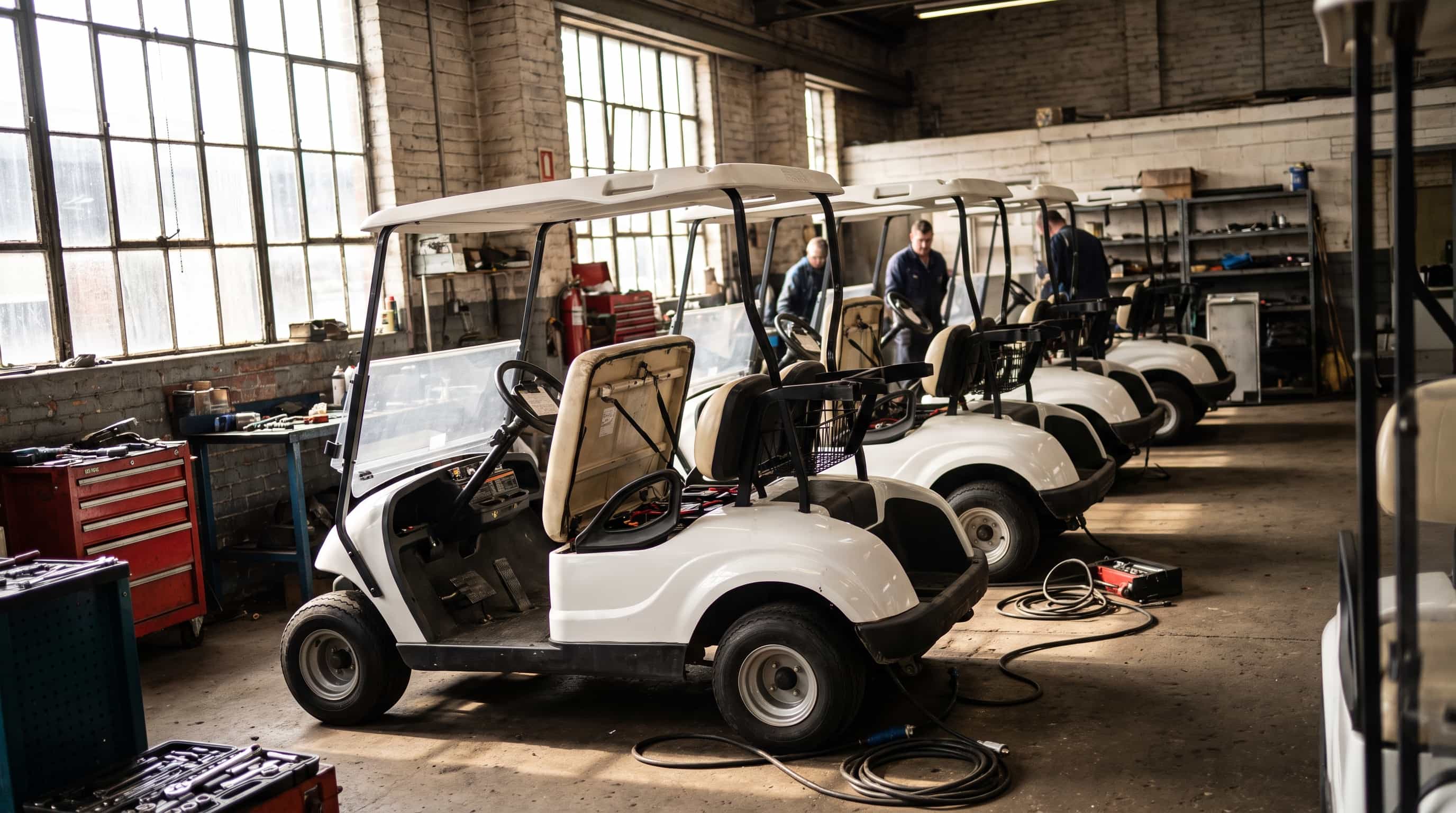
Buggy theft tends to be organised rather than opportunist, and insurers price it that way. Cover for the machines almost always arrives with conditions about how they are kept: a locked building or compound, keys removed and held away from the vehicles, and sometimes immobilisers, trackers or an alarm on the store itself. Expect questions about the construction of the building, the locks fitted to it, and whether anything identifies the machines as yours, since marking and recorded serial numbers make recovery more likely and a claim easier to settle.
Read those as requirements rather than suggestions. Where a security measure is written in as a condition, a claim can be reduced or refused because it was not in place, even where it had nothing to do with how the thieves got in. Clubs come unstuck on small habits: keys in a drawer in the same shed, a compound gate propped open through the season because it is quicker, a side door with a lock nobody has tested since it was fitted.
Charging belongs in the same conversation. Insurers take an interest in where batteries are charged, what the building is made of, and what else is stored alongside. Lead-acid charging gives off hydrogen and needs ventilation. Lithium packs behave differently again in a fire, and your insurer may have requirements of its own. Ask what the insurer wants and what the battery maker's manual says, then work to the stricter of the two.
The records that decide a claim
After an incident the insurer's questions are always the same. Who was driving, what were they told, what condition was the machine in, and what did the club do at the time. A club that can answer all four from its own paperwork within the hour is in a very different position from one reconstructing it from memory a month later.
None of this needs a system. A clipboard in the professional's shop and a folder in the office covers most of it, provided somebody actually fills them in. The value only appears once something has gone wrong, which is exactly the moment nobody feels like starting a record, so the habit has to exist beforehand. Decide who owns each record, where it lives and how long it is kept, then tell the shop staff and the greenkeeping team, because a record nobody has been asked to keep is one that stops in the first busy week.
- An asset list carrying each machine's serial number, with photographs kept off site.
- A hire log naming the driver, the machine, the date and the times out and back.
- The signed hire terms, plus a note that the briefing was given.
- A short pre-use check covering brakes, tyres and the seat belt or hip restraint where one is fitted.
- Servicing and battery maintenance records, from your own staff or your service provider.
- An incident report written on the day, with the names of anyone who saw it.
When the fleet is not the club's
Plenty of clubs run buggies they do not own, either on contract hire or through an operator taking a share of the income. That arrangement moves some risk and none of the club's duties as occupier. The operator insures its own fleet for its own use, and the contract decides the rest: damage caused by a rider, damage to the course, and injury to a third party.
Ask for the operator's certificate, read what activity it describes, and check the indemnity in the contract runs the way you think it does. The same applies to privately owned buggies belonging to members, which many clubs permit. A club is entitled to ask for proof of liability cover before a private machine goes on the course, and to say what it requires on storage, charging, driver and the conditions under which buggies come off the course. Whatever the arrangement, the schedule and its endorsements are what bind, so review them with your broker each year as the fleet and the activity change.
Common questions
- Does our public liability policy already cover the buggies?
- Not necessarily, and it is not safe to assume. Many liability wordings exclude mechanically propelled vehicles, or reach them only in limited circumstances. Some clubs find the buggies sit under a motor or plant section instead, and some find nothing at all responds to hire use. Ask your broker to point at the section and the wording that answers it.
- Do we need motor insurance for buggies that never leave the course?
- The compulsory requirement attaches to roads and other public places, so machines kept to genuinely private ground are not caught by it. That removes the legal duty and not the exposure, and it depends on your ground being private in fact. A car park the public can drive into, or a crossing over a public road, changes the analysis, so put your own layout to the insurer.
- Do members need their own insurance to drive a club buggy?
- Usually not, since they are driving the club's machine under the club's arrangements, but that depends on how the policy defines an insured driver. Some clubs also ask members to accept a damage excess in the hire terms, which is a contractual matter rather than an insurance one. Say which applies in your written terms so nobody discovers it afterwards.
- Are we covered when a visiting society drives our buggies?
- Only if the policy's driver definition reaches them and any conditions attached to it are actually met on the day. That is where briefings and signed hire terms matter, because a condition the starter skips on a busy morning is a condition that failed. Agree the process for society days before the season and give the starter something short to follow.
- What happens if buggies are stolen from the compound overnight?
- It depends far more on the security conditions in your policy than on the theft itself. Where the wording requires a locked store, keys held separately or an alarm, the insurer will ask whether those were in place. Report it to the police, get a crime reference, and use your asset list and photographs to identify the machines by serial number.
- Should we insist on liability cover for members' own buggies?
- Many clubs do, and it is a reasonable condition of allowing a private machine on the course. Ask for the certificate rather than a verbal assurance, note the renewal date, and set out in the club's policy what else you require: storage, charging, who may drive, and the conditions under which buggies come off the course.
Ready to get a price
Tell us about your event and we will send an itemised written quote within one working hour.
Related pages
Related guides
 Golf buggies at a golf club: the complete guide11 minute read
 Single-rider buggies at a golf club9 minute read
 Buggies and pace of play9 minute read
 Golf buggy insurance and liability explained5 minute read
 Insurance checks before you hire golf buggies6 minute read
- Managing a buggy fleet at a golf club11 minute read