How much do golf buggy repairs cost
By James Brown · Updated 21 July 2026 · 6 minute read
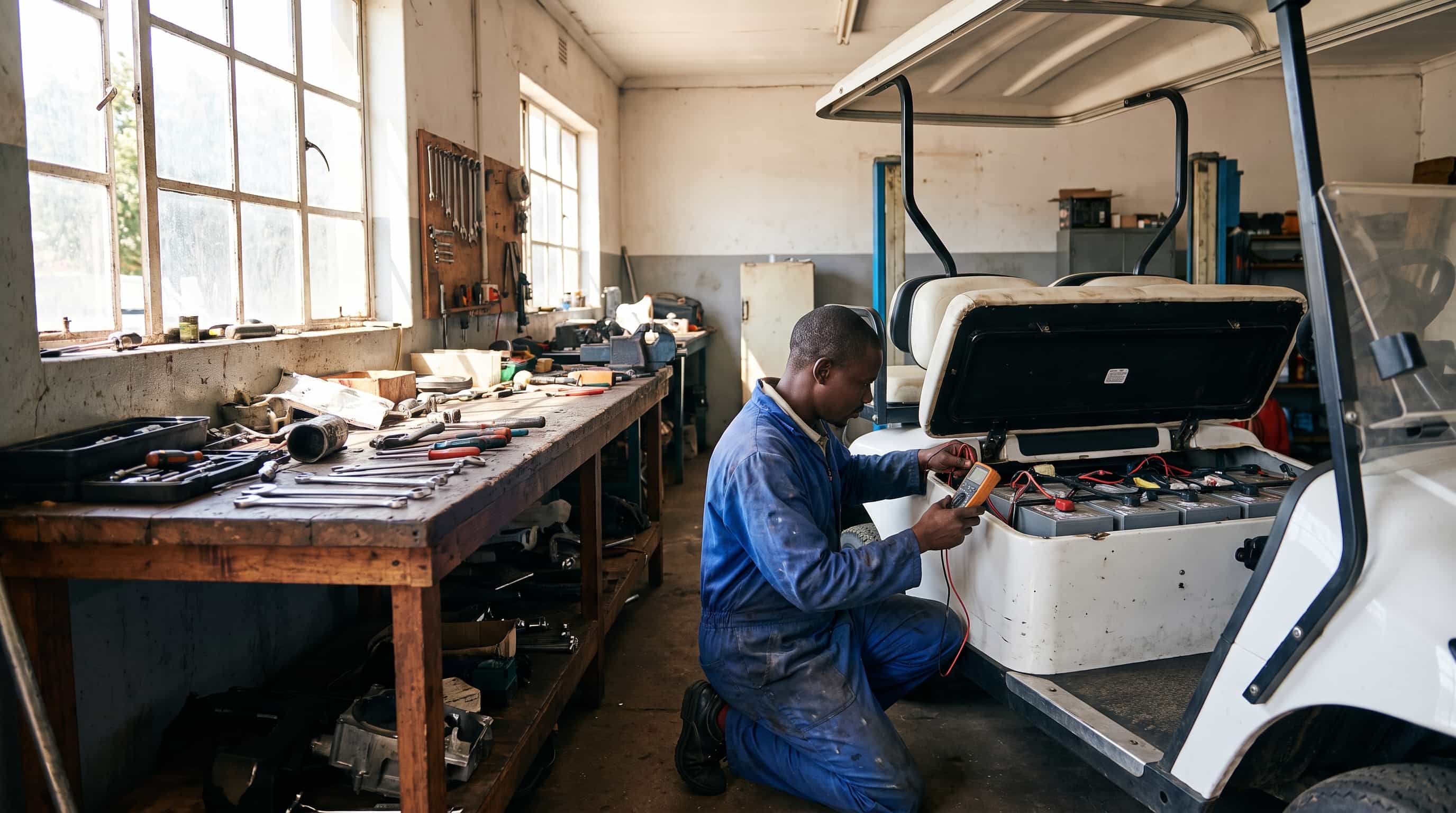
A repair's cost is labour plus parts plus travel. The labour depends on how long the fault takes to diagnose and fix, the parts vary from a cheap fuse to a full battery set, and travel reflects the distance to you. Our engineer work is charged on a clear basis, a published hourly rate on site, plus mileage from the depot, with parts at cost, so the estimate is transparent before we start.
Key takeaways
- A repair cost is three things: labour time, parts, and travel to you.
- Batteries are the big-ticket item, since a set is replaced together, not one at a time.
- Small electrical faults, a fuse, a bulb, a connection, are often cheap once diagnosed.
- Our basis is a published hourly rate on site, plus mileage from the depot, and parts at cost.
- We give the pricing basis before starting, and no specific part price is quoted here because parts vary.
The three parts of any repair bill
Every repair bill is built from the same three things, and understanding them makes any quote easier to read. There is labour, the engineer's time to diagnose and carry out the fix. There are parts, whatever the buggy needs, which ranges enormously. And there is travel, the cost of getting an engineer to you, which depends on distance. A quick, cheap-part fix nearby and a long-diagnosis, big-part fix far away sit at opposite ends of the same simple formula, which is why a repair cannot be given a single headline price without knowing the fault and the place.
Why batteries dominate
The largest single cost most owners meet is a battery set, and it is worth being straight about why. Batteries are replaced as a matched set rather than one at a time, because a new battery among old ones is dragged down and the money is wasted, as the battery guides explain. So a battery replacement is a whole-set cost at once, which makes it the big-ticket repair, well above most other jobs. That is not a markup, it is the nature of how a set has to be replaced to actually restore the buggy. Against that, many faults are far cheaper: a blown fuse, a bulb, a corroded connection cleaned up, a worn switch, are modest once diagnosed.
What we will and will not quote here
We will be clear about our charging basis, because that is a real figure we can stand behind. Engineer work is a published hourly rate on site, plus mileage from the depot to cover travel, and parts are charged at cost, stated plainly. That basis is shown before any work starts, so you see the shape of the cost rather than getting a surprise. What we will not do is print a price for each part or each job in this guide, because parts prices vary by buggy, make and what the market is doing, and inventing a figure that turns out wrong helps nobody. For a specific fault on your specific buggy, a request through the Repair Centre gets you a real estimate rather than a guess.
If yours is doing this and the checks here have not settled it, we diagnose and repair buggies, including a callout to wherever it is.
Keeping repair costs down
Some of what drives a bill is within your control. Maintenance is the biggest lever: a watered, charged, clean buggy avoids the battery deaths and corrosion faults that make up a large share of call-outs, so the cheapest repair is the one the maintenance prevented. Catching a fault early helps too, since a click attended to is cheaper than the clunk and failure it becomes. And for owners who would rather spread and manage the cost, the service plans put maintenance and callouts on a monthly footing, which suits a buggy in regular use or a fleet more than paying reactively each time something breaks.
Common questions
- How much will my repair cost
- It depends on the fault, because a bill is labour plus parts plus travel, and those vary hugely between a fuse and a battery set. Our basis is a published hourly rate on site, plus mileage from the depot, and parts at cost, shown before we start. For a real figure on your buggy, a request through the Repair Centre gets an estimate rather than a guess.
- Why is a new battery set so expensive
- Because a set is replaced together, not one battery at a time. A single new battery among old ones is dragged down to their condition and the money is wasted, so replacement is a whole-set cost at once, which makes it the big-ticket repair. It is the nature of how batteries work as a set, not a markup, and it is what actually restores the buggy.
- How can I keep repair costs down
- Maintenance is the biggest lever, since a watered, charged, clean buggy avoids the battery and corrosion faults behind many call-outs. Catching faults early keeps a cheap fix from becoming an expensive one. For a buggy in regular use or a fleet, a service plan puts maintenance and callouts on a predictable monthly footing rather than reactive one-off bills.
Still not right
We diagnose and repair golf buggies, service them on a plan, and send an engineer out to where the buggy is. Tell us the symptom and we will say what it usually means.
Related pages
Related guides
- Golf buggy troubleshooting, a complete guide9 minute read
 Golf buggy canopy, windscreen and weather protection4 minute read
- Golf buggy battery cables, corrosion and damage4 minute read
 Is my golf buggy worth repairing5 minute read
 When to repair versus replace a battery set5 minute read
 Golf buggy service plans explained5 minute read