Golf buggy battery cables, corrosion and damage
By James Brown · Updated 21 July 2026 · 4 minute read
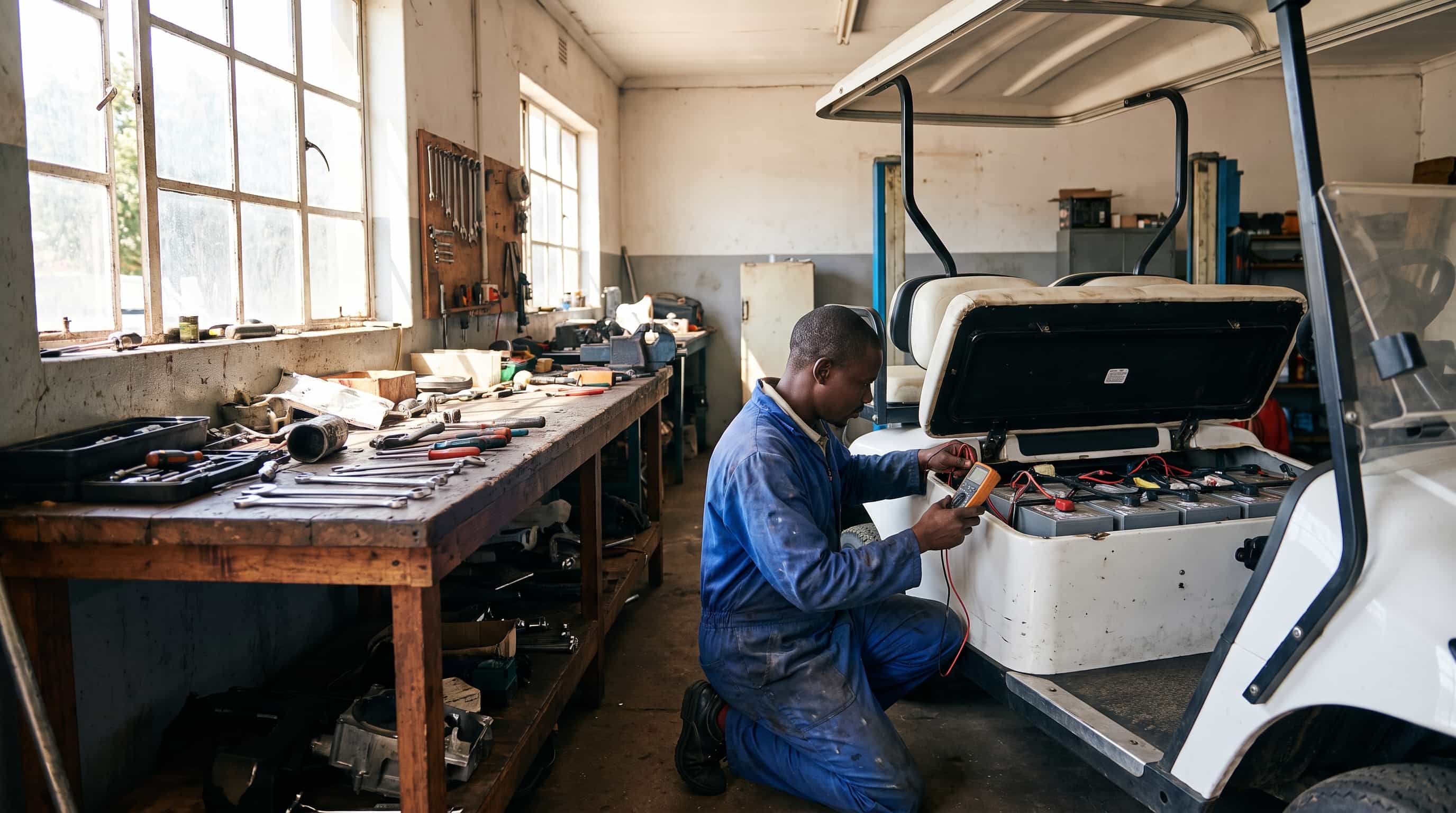
The heavy cables that link the batteries and carry current to the buggy can corrode or be damaged, and because they carry the full current, a bad cable causes weak power, cutting out, heat, and dead symptoms. Corrosion often hides inside the lug where you cannot see it. Cable work is high-current, so heavy corrosion or damage is a job to do carefully or hand over.
Key takeaways
- The battery interconnect cables carry the full current between batteries and to the buggy.
- Corrosion or damage in a cable causes weak power, cutting out, heat, or a dead buggy.
- Corrosion can hide inside the lug or under the insulation where it is not visible.
- A cable or lug that runs hot under load has a poor connection and is a warning.
- Cable work involves high current, so heavy corrosion or damage needs care or an engineer.
The cables that do the heavy lifting
Behind the terminals, the batteries are linked to each other and to the buggy by heavy cables, and these carry the full current the buggy draws. They are sized for that current, and they rely on clean metal contact at each lug where they bolt to a terminal. When a cable or its lug corrodes, or the cable is damaged, that heavy current is forced through a compromised connection, and the symptoms are the same family as a bad terminal but sometimes harder to find: weak power, cutting out especially under load or over bumps, heat at the connection, and, if bad enough, a dead buggy.
Checking within reason
An owner can do useful checks. Inspect the cables and lugs for visible corrosion, damage to the insulation, and lugs that look tired or discoloured. Feel, carefully and with the safety precautions, for a cable or connection that runs hotter than the others under load, which points at a poor connection there. Wiggling a suspect connection, with the buggy off, to see whether it is loose adds information. What you often cannot do by eye is confirm corrosion hidden inside a lug, which is where measurement, or an engineer's inspection, comes in.
If yours is doing this and the checks here have not settled it, we diagnose and repair buggies, including a callout to wherever it is.
Why care matters here
This is high-current territory, next to the batteries, so the battery safety rules apply in full and the work deserves respect. A short across battery cables produces a dangerous spark and heat, the connections carry serious current, and replacing or remaking a heavy cable and lug properly, so the new connection is sound and safe, is more than a casual job. Cleaning an accessible lug and tightening a connection is fair owner work with the right precautions. Replacing a corroded or damaged cable, or dealing with corrosion hidden inside a lug, is better done carefully by someone competent or handed to an engineer, because a poorly remade high-current connection runs hot and can become a hazard. And the usual firm stop applies for any battery that is damaged.
Common questions
- Could a battery cable cause my power problem
- Yes. The cables carry the full current, so a corroded or damaged cable causes weak power, cutting out under load or over bumps, heat, or a dead buggy, just like a bad terminal. If cleaning the visible terminals does not fix a power fault, suspect corrosion hidden inside a cable lug or damage to a cable, which is harder to see.
- How can corrosion hide if the terminals look clean
- Corrosion can creep up inside the crimped lug where the cable meets the terminal, or track under the insulation, so the outside looks fine while the connection inside is failing. A telltale is a cable or lug that runs hot under load, which shows a poor connection resisting the current there. Confirming hidden corrosion usually needs measurement or an engineer's inspection.
- Can I replace a battery cable myself
- Cleaning an accessible lug and tightening a connection is fair owner work with the battery safety precautions. Replacing a heavy cable or remaking a lug properly is high-current work where a poor connection runs hot and can become a hazard, so it is better done carefully by someone competent or handed to an engineer. Never work on a damaged battery.
Still not right
We diagnose and repair golf buggies, service them on a plan, and send an engineer out to where the buggy is. Tell us the symptom and we will say what it usually means.