Replacing a golf club buggy fleet: timing the cycle
By James Brown · Updated 29 August 2026 · 10 minute read

A fleet has reached the end when spending stops being concentrated in one system and starts appearing everywhere at once: steering, brakes, bodywork, wiring and batteries in the same season, on the same machines. Before accepting that, rule out the cheaper explanation, because a fleet that has all gone soft together is usually a set of packs that aged together or a charging regime that shortened them. Then choose between replacing everything in one go and replacing in batches.
Key takeaways
- End of life is a pattern in the repair book, not a birthday on a spreadsheet.
- A whole fleet losing range in the same season is a battery story until somebody proves otherwise.
- Machines bought together and worked identically wear out together, which is why the bill arrives as a cliff.
- Whole fleet replacement buys uniformity and recreates the cliff; batches smooth the spend and split the parts stock.
- Old machines have several destinations, and the batteries have a separate one with its own duty of care.
- The finance route usually decides the replacement cycle at the moment of signing, not at the end of the term.
- Lead times mean a fleet is ordered out of season, not requested once the current one has failed.
End of life shows up as a pattern in the repair book
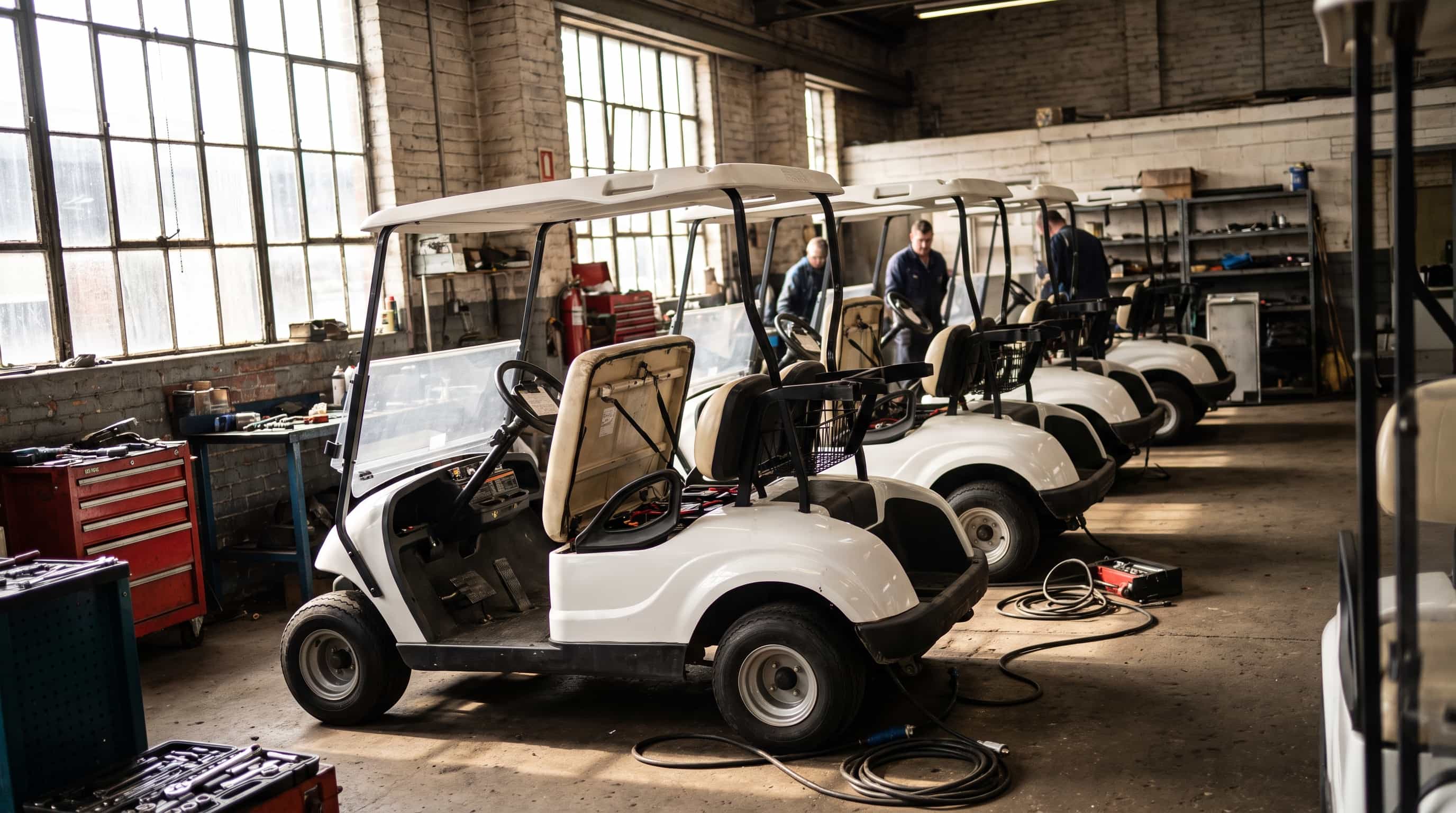
There is no age at which a buggy stops being worth keeping, and a club that sets one will either scrap sound machines or run tired ones past the point of sense. What there is instead is a change in the shape of the spending. For most of a machine's working life the money goes into consumables and one or two known items: tyres, brake shoes, a charger, a set of batteries. None of that is a signal to replace anything.
The signal is when the spending spreads. In one season a machine takes steering work, brake work, a body repair, a wiring fault chased through a loom that has been apart before, and a new pack. Each job on its own is reasonable; together they say the vehicle has passed the point where fixing one thing keeps it running. So look at your records rather than at the fleet, and if you do not hold per machine costs going back a couple of seasons, start now.
Ruling out the battery explanation first
The most common reason a club believes its fleet is finished is that the machines will no longer get round comfortably. That is a battery symptom before it is a fleet symptom, and the two cost very different amounts to put right. Test before concluding, and test across the fleet rather than on the one machine that prompted the complaint, because a comparison tells you far more than any single reading will.
The distinction that matters is between a pack that has worn out and one that has been shortened. A worn pack has done its cycles. A shortened pack has been run flat and left, charged on equipment that never completes a cycle, watered erratically, or stored discharged over winter. If the cause is the regime rather than the age, a new fleet inherits the same problem within a couple of seasons and the club has bought nothing but a delay.
- Test a rested, fully charged pack under load with proper equipment, and compare results across the fleet rather than judging one machine alone.
- Check the charger before condemning the pack, because one that never completes a cycle will flatten a good set of batteries across a season.
- On flooded lead acid, take readings cell by cell: one weak cell drags a whole pack, while weakness throughout is age.
- Separate a range complaint from a power complaint. Fading over the closing holes points at capacity; slow from the first tee more often points at dragging brakes, soft tyres, the motor or the controller.
- Read the watering and charging records if they exist, and start keeping them if they do not.
Why a fleet bought together fails together
Clubs buy fleets in one go because it is simpler to negotiate, simpler to train staff on and simpler to stock parts for. The consequence arrives years later. The machines were built to the same specification, delivered on the same day, charged on the same schedule and worked a similar number of rounds, so they wear at very similar rates and reach the end within a season or two of each other. Nothing has gone wrong: identical assets under identical use behave identically.
That is why the replacement bill turns up as a cliff rather than a slope, and why recognising it early separates a club that plans a changeover from one that discovers it in the middle of a season. The uneven cases are worth noticing too. Machines kept for the hilliest loop, or the ones staff always take because they are nearest the door, age faster than their neighbours. If two machines carry most of the cost, that is a rotation problem and it is cheap to fix.
Replacing the whole fleet in one go
A single changeover has real advantages. One negotiation, one specification, one set of chargers, one parts list, one briefing for the staff who issue the machines, and a fleet that looks consistent to a visitor. It also lets the club treat the batteries, the chargers and the shed as a single project rather than as a run of small surprises spread across several years, which is usually the cheaper way to get the electrical work done properly.
The costs are equally plain. The capital lands in one year, which at a members club means it competes with the course, the clubhouse and the machinery fund in the same committee meeting. And the cliff repeats: replace everything at once and you have created another fleet that will need replacing at once. That is manageable if it is deliberate, and some clubs choose it and run a sinking fund against it, provided the fund survives the years when something else is more urgent.
Replacing in batches
Staggering the fleet spreads the spend and breaks the cycle. A club that renews a portion each year moves from an occasional large decision to a small annual one, which is easier to budget for and much easier to defend to a membership. It also means there are always newer machines to put in front of visitors and older ones for quieter days, and it keeps the relationship with a supplier warm rather than reopening it once a decade.
The price is variety. Two or three specifications in one shed means more than one parts list, possibly more than one type of charger, and staff who have to remember which machine does what. Packs at different ages across the fleet make the charging routine less uniform. None of that is fatal, and all of it is easier if you stay with one make and one broad model family rather than buying whatever happened to be available in a given year.
Working out what this costs for your own event? Tell us the venue and dates and you will have an itemised written quote within one working hour.
Where the old machines go
There are fewer destinations than clubs expect, and it is worth settling them before the new fleet is ordered rather than after the old one has been parked behind the greenkeeping shed for a winter. Part exchange against the new machines is the simplest route and often recovers the most, because a supplier can move a set of working machines in a way a club cannot, and it clears the storage problem on the day the new fleet arrives.
Selling individually recovers more per machine and costs staff time and attention through a season. A club selling used vehicles to members or to the public takes on obligations as a seller, so take your own advice on where you stand before advertising anything. Keeping one or two back as donors for spares is sensible where the new fleet is the same family and the parts still fit, and a poor idea where nothing carries across.
- Part exchange against the new fleet, usually the cleanest route for a whole set of working machines.
- Individual sale, which recovers more per machine and costs staff time and seller obligations.
- One or two retained as donors, but only where the parts genuinely fit the incoming fleet.
- Scrap through a licensed route where a machine is beyond economic repair.
- Batteries handled separately: they are not general waste, the club is the producer, and the supplier's take back arrangement or a licensed carrier is the practical answer. Ask what paperwork you should receive and keep it.
The finance route sets the cycle before the machines do
How a fleet is paid for usually decides when it is replaced, and that decision is taken at signing rather than at the end. Buy outright and the club owns machines that stay until somebody decides they should go, which in practice tends to mean longer than intended. Take them on hire purchase and the same is true once the term finishes, with ownership arriving at the point the machines are at their oldest and least wanted.
A rental, lease or contract hire arrangement builds the changeover into the agreement. The fleet goes back at the end of the term and a new one arrives, which removes the disposal problem and the cliff together, and also removes the option of running on for another season when funds are short. Some clubs run buggies on an arrangement where a supplier provides and maintains the fleet against a share of the hire, and there the cycle belongs to the contract.
The tax and accounting treatment differs between those routes, and it also depends on the club's own status and on how the buggy operation is run. That is a question for the club's accountant, and it is far better asked before the paperwork is signed than after the first year end, because the route chosen is difficult to unwind once machines are on site.
Planning the changeover around the playing season
A fleet is usually built to order rather than lifted off a shelf, so the date the club wants the machines and the date a supplier can deliver them are two different things. Ask for the lead time in writing early, work backwards from the first competition you cannot afford to disrupt, and confirm it again before you dispose of anything, because a delivery date is a plan rather than a promise until the machines are on the ground.
The changeover has more moving parts than the purchase. Chargers may not carry over. The shed may need circuits altered. Staff who issue machines need briefing on anything that behaves differently, and the old fleet has to keep working until the new one has been inspected and accepted. Clubs that treat the arrival as the end of the job rather than the middle of it spend the first fortnight of the season apologising at the counter.
- Agree a delivery window that sits outside the competition calendar and outside your peak weeks.
- Confirm lead times in writing, and confirm again before disposing of anything.
- Settle charger compatibility and any electrical work before the machines arrive.
- Keep enough of the old fleet running until the new one has been inspected and accepted.
- Brief the counter staff who issue the machines, not only the professional and the workshop.
Common questions
- How long does a golf club buggy fleet last?
- There is no fixed answer, and any figure quoted without knowing your course would be a guess. What decides it is how many rounds each machine does, the terrain, the charging discipline and how well the fleet has been maintained. The practical test is your own repair book: when spending spreads across several systems on several machines in one season, the fleet is telling you.
- How do you tell if it is the batteries or the buggies?
- Test rather than assume. A pack that starts strongly and fades over the closing holes is a capacity problem. A machine that feels slow from the first tee with a healthy pack points somewhere else, often at dragging brakes, soft tyres, the motor or the controller. Check the charger too, because one that never completes a cycle will ruin good batteries across a season.
- Is it better to replace a buggy fleet all at once or a few at a time?
- All at once gives you one negotiation, one specification and one parts list, and it recreates the same cliff for your successors. A few at a time smooths the spend and keeps newer machines in front of visitors, at the price of running more than one specification. If the fleet is on a lease or contract hire, the agreement has usually decided this already.
- What happens to the old golf buggies when a club replaces them?
- Part exchange against the new fleet is usually simplest and often recovers the most, because a supplier can move a set of working machines. Individual sale takes staff time and brings obligations on the seller, so take advice first. Batteries are handled separately: they are not general waste, and the supplier's take back route or a licensed carrier is the practical answer.
- When should a club start planning a fleet replacement?
- As soon as the repair book shows spending spreading across systems on more than one machine, which is usually at least a season before anybody wants to act. Fleets are built to order, so lead times matter, and the changeover involves chargers, electrical work and staff briefing as well as vehicles. Plan for delivery outside your competition calendar.
- Does the finance route change when a fleet gets replaced?
- It usually decides it. Outright purchase and hire purchase leave the club owning machines and choosing when they go, which in practice tends to mean later. A lease or contract hire builds the changeover into the term, so the cycle is fixed at signing. The tax and accounting treatment differs between them, and that is a conversation for your accountant.
Ready to get a price
Tell us about your event and we will send an itemised written quote within one working hour.
Related pages
Related guides
- Golf buggies at a golf club: the complete guide11 minute read
 Charging and storing a club buggy fleet10 minute read
 Buggy safety induction for club members and visitors10 minute read
 Buying golf buggies for a golf club6 minute read
 Hire purchase, lease or contract hire for a buggy10 minute read
- When to repair versus replace a battery set5 minute read