Common electric golf buggy faults across brands
By James Brown · Updated 21 July 2026 · 5 minute read
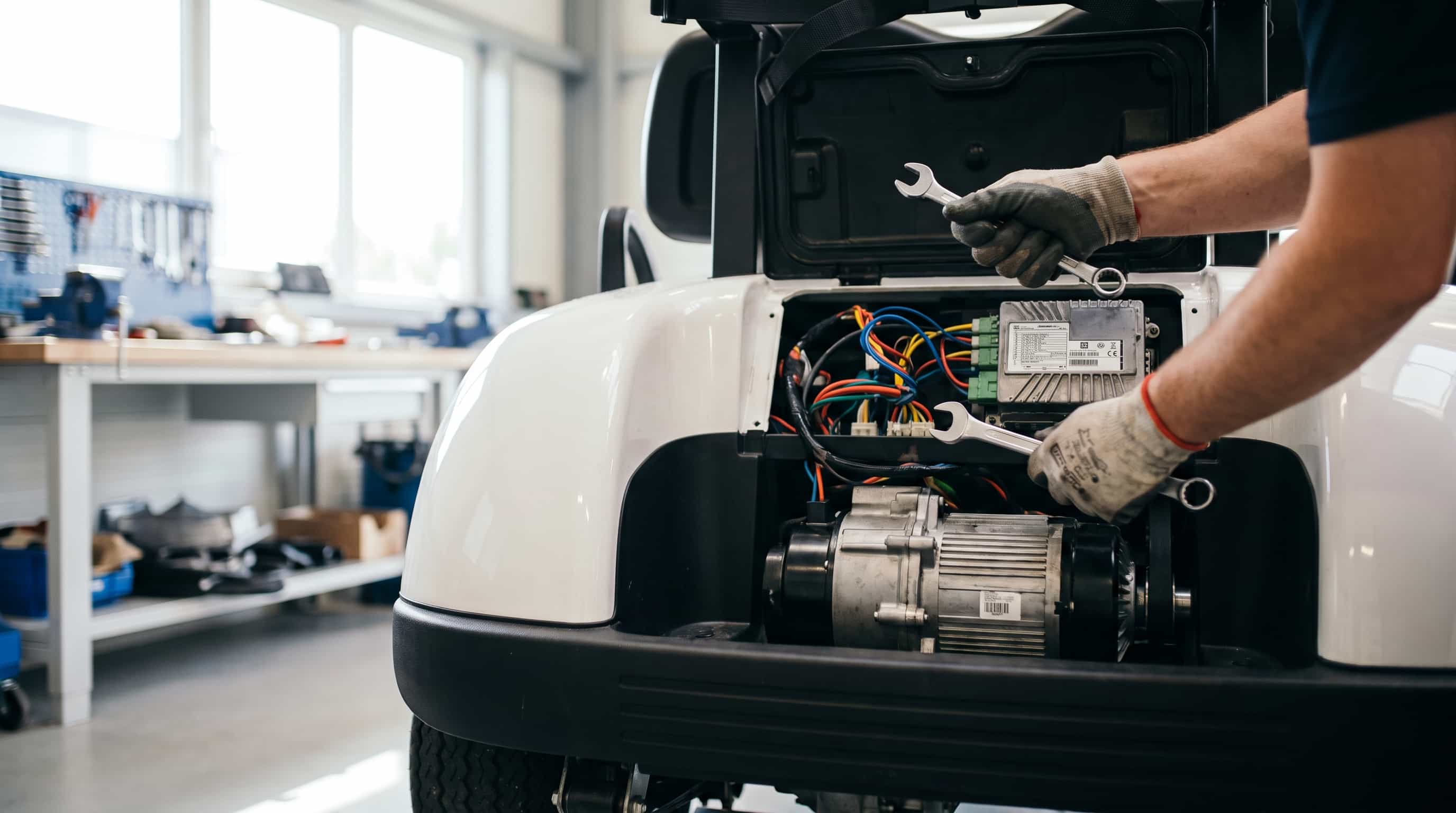
Electric golf buggies of any make share the same faults, because they share the same systems: batteries and connections, the solenoid, the controller, the throttle, and wear in the brakes, steering and drivetrain. The make changes the specific parts and the error-code list, not the categories, which is why the general symptom guides apply across brands.
Key takeaways
- Electric buggies share the same systems, so they share the same fault categories.
- Batteries and connections cause the most faults on any make.
- The solenoid, controller and throttle produce the same symptoms across brands.
- The make changes the specific parts and codes, not the fault categories.
- The general symptom guides here apply whatever badge your buggy carries.
Same systems, same faults
It is easy to assume that a fault on one make is unrelated to the same symptom on another, but the physics says otherwise. An electric golf buggy, whatever the badge, is built from the same handful of systems: a battery set delivering power through heavy cables and connections, a solenoid to connect the pack to the controller, a controller to manage the drive, a throttle to tell it what you want, a motor and transaxle to move the buggy, and mechanical brakes, steering and suspension. Because the systems are common, so are the faults, and a dead buggy, a surge, a whine or a soft pedal means much the same thing across brands. This is why the symptom guides in this knowledge base are written by symptom rather than by make: the diagnosis travels.
The order holds everywhere
The order of suspects is the same on any make too. Batteries and their connections cause the most faults, so a dead, weak or fading buggy of any brand starts there, with the terminals and cables among the first things to check. The solenoid gives its click, no-click and chatter symptoms identically across makes. The controller protects itself more often than it fails, and reports through error behaviour, on any brand. The throttle sensor sits behind surging and hesitation everywhere. And the brakes, steering, tyres, bearings and drivetrain wear with use regardless of the badge. So the first-principles method, observe, split the fault, check cheap and common first, applies whatever make you have in front of you.
What the make actually changes
If the categories are shared, what does the make change. The detail. The specific controller fitted and its error-code list differ, so you read the codes against your controller's list, not a generic one. The exact parts, their positions, the fuse locations and the service specifics vary by make, model and generation, so the maker's documentation for your exact buggy is the reference for those. And there are genuine differences in layout and design between makes that matter when you get down to the specific repair. But none of that changes what a symptom means or where to start looking; it changes which exact part and which exact figure once you are there. So the make-specific guides here name their brands to be found by owners searching, then send them to the same symptom guides, because that is honestly where the diagnosis lives.
If yours is doing this and the checks here have not settled it, we diagnose and repair buggies, including a callout to wherever it is.
Using this across brands
The practical upshot is freeing: you do not need a different mental model for every make. Learn the systems and the symptoms once, use the general guides to diagnose the category, and reach for the maker's documentation only for the specific detail, the code, the part number, the fuse position. That is how an experienced person approaches an unfamiliar buggy: not by knowing every make intimately, but by knowing the common systems and letting the symptom and the make's documentation fill in the rest. And the safety line is identical on every make, brakes, steering, burning smells and damaged batteries to an engineer, so the one thing that never varies by badge is where to stop.
Common questions
- Do different makes of buggy have different faults
- Not really, in category. Electric buggies share the same systems, batteries, solenoid, controller, throttle, motor, brakes and steering, so they share the same fault categories and symptoms. The make changes the specific parts, layout and error-code list, not what a symptom means or where to start looking, which is why the general symptom guides apply across brands.
- Can I use the symptom guides for any make
- Yes. The symptom guides here are written by symptom rather than by make precisely because the diagnosis travels across brands. Use them to diagnose the category, no start, power loss, a noise, a charging fault, and then turn to the maker's documentation for your exact model for the specific detail, such as the error-code list or a fuse position.
- What do I need the make-specific information for
- For the detail once you have diagnosed the category: the exact controller and its codes, the specific parts and their positions, the fuse locations, and the service specifics, all of which vary by make, model and generation. The maker's documentation for your exact buggy is the reliable source for those, while the general guides handle the diagnosis that is common across brands.
Still not right
We diagnose and repair golf buggies, service them on a plan, and send an engineer out to where the buggy is. Tell us the symptom and we will say what it usually means.
Related pages
Related guides
 Golf buggy troubleshooting, a complete guide9 minute read
 Golf buggy smoking or overheating4 minute read
 How to read your golf buggy charger lights, step by step4 minute read
- Common Club Car faults and fixes6 minute read
 Common EZGO faults and fixes6 minute read
 Common Yamaha buggy faults and fixes6 minute read