Club Car Onward: what it is and who it suits
By James Brown · Updated 29 August 2026 · 8 minute read
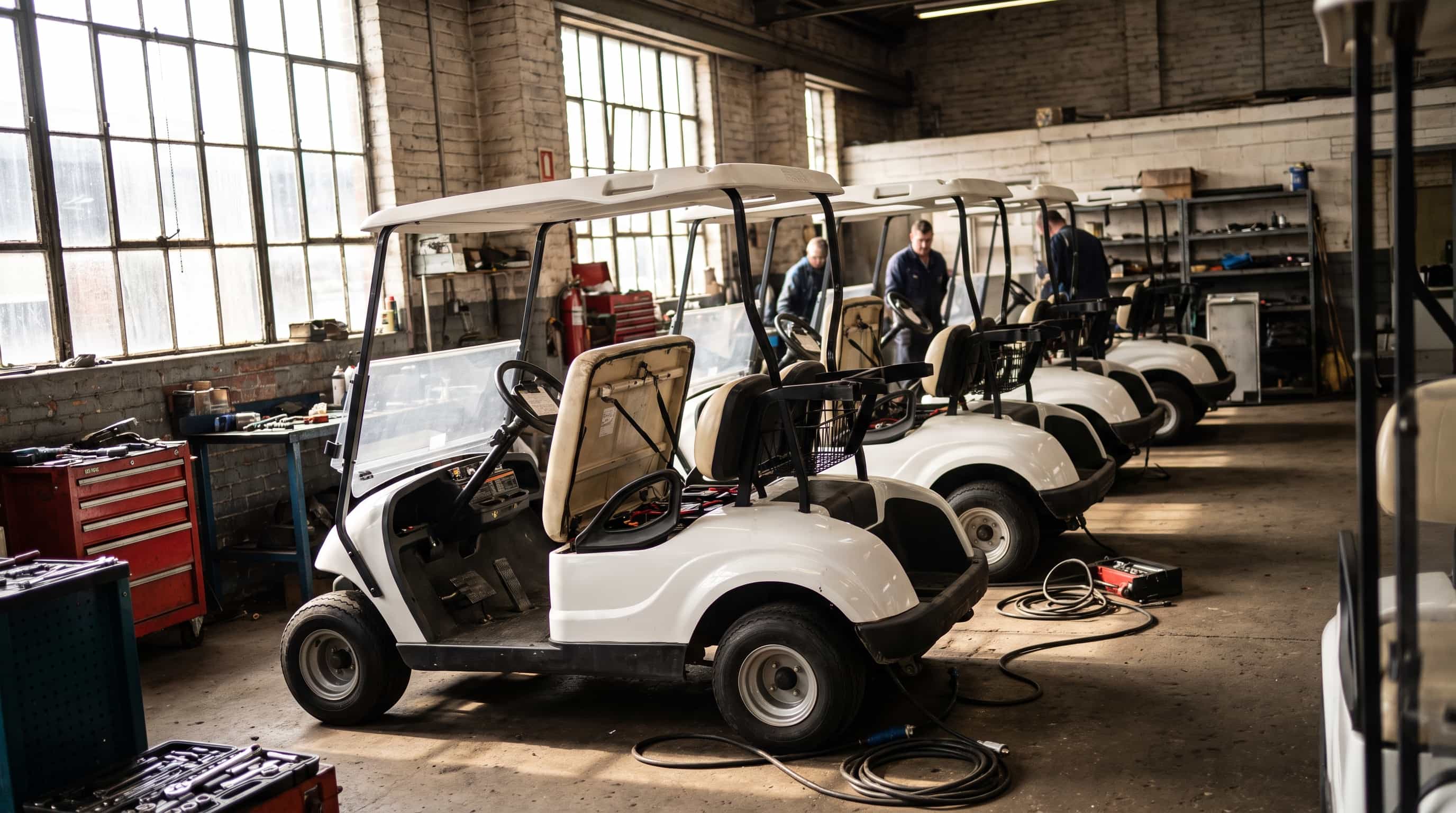
The Onward is Club Car's personal line: a vehicle specified around an owner, an estate or a hospitality site rather than around a course fleet. That is the whole of the difference in practice. A fleet car arrives as a fleet car, while an Onward is built to an order with seating, trim, weather protection, lighting, wheels and battery type all chosen. Buying one well is therefore a specifying exercise, so start from the journeys you actually make and the ground you make them on.
Key takeaways
- It is a personal specification rather than a fleet car with different trim, and it is ordered rather than picked.
- The current option list belongs to Club Car and its UK dealers, changes over time, and varies by market.
- Specify from the journeys, the ground and the passengers, and most of the option list answers itself.
- Rear space is the real trade: a rear bench and a load bed compete for the same part of the vehicle.
- Lifted builds and larger tyres improve clearance, raise the step and raise the centre of gravity.
- Measure the gate, the doorway and the store before specifying, because a longer build can stop fitting.
- Fitting lights and mirrors does not make a vehicle road legal, and that question sits with DVLA.
A personal line rather than a fleet line
A fleet car is designed around a club's problems: identical vehicles, quick servicing, hard repetitive duty, a wash-down when the day ends, and a decent appearance on the first tee. A personal vehicle is designed around one owner's use, which is a different set of problems: how it looks parked outside a house, seating that suits a family or guests, storage for what is actually carried, and enough weather protection to be worth using in a British winter.
The buying experience follows from that. Personal-line vehicles are built to an order from an option list, through a dealer, which makes the process closer to specifying a machine than to choosing one off a row. That is an advantage if you know what you need and a trap if you do not, because it is entirely possible to specify a vehicle that suits the brochure rather than the property.
We do not print the option list here. It changes, it varies between markets, and the current version sits with Club Car and its UK dealers, which is where it should come from. What is stable, and worth writing down, is how to think your way through it, because the questions a specification has to answer do not change even when the tick boxes do.
Who buys one in the UK
The pattern is fairly consistent: houses with long drives, farms and smallholdings, equestrian yards, gardens and estates, holiday parks, hotels and country houses moving guests and luggage, coastal properties where walking the site is a chore, and shoots. What those have in common is short repeated journeys on private ground, mixed passengers who are not all young and agile, some load to carry, and a vehicle that visitors see.
That last point is not vanity. On a property where guests are being moved, the vehicle is part of the impression the place makes, and it is one of the reasons a personal specification exists at all. It is also why the accessory list is long: the things people add are mostly about comfort, weather and appearance rather than capability.
Start from the journeys, not the option list
The specifying mistake is starting from the brochure and working backwards. Start instead from what actually happens on the property, written down honestly rather than optimistically. Most of the specification then answers itself, and the questions that remain are the ones worth taking to a dealer. It is worth doing this on paper before anybody shows you a vehicle, because a well-presented demonstrator is very good at making its own specification look inevitable.
Answering those properly usually removes half the option list immediately, and it tends to change the seat count people arrive with. Almost everybody overestimates how often they carry the largest group they can picture, and a longer vehicle turns wider, parks bigger and asks more of its brakes on a slope for the rest of its life. The rarer journey is generally better solved with a second trip than with a permanently bigger machine.
- The longest single journey you make in a day, and how many times a day you make it.
- The most people you genuinely need to carry at once, and how often that actually happens.
- What travels with them: bags, feed, tools, shopping, a dog, a wheelchair.
- The worst ground on the route: wet grass, gravel, a slope, a kerb, a cattle grid.
- Where it lives and charges, and how far that is from a socket you can use safely.
Seating, load and the trade you cannot avoid
The back of the vehicle is the contested space, and every specification argument ends up there. A rear bench and a load bed want the same real estate. Some builds convert between the two, which sounds like it settles the argument and in practice means somebody converting it every time the use changes, which they will do twice and then stop.
Think about who sits in the back and how they get there. A rear-facing bench is fine for short hops with people who can climb aboard easily. It is much less suitable for anyone unsteady on their feet, and for them the getting on and off matters far more than the seat itself. If older guests are part of the reason for buying, that consideration should outrank almost everything else on the list.
If yours is doing this and the checks here have not settled it, we diagnose and repair buggies, including a callout to wherever it is.
Lifted builds, tyres and the ground you have
Lift kits and larger tyres are among the options people choose most readily, and they change the vehicle more than the photographs suggest. Ground clearance improves, which is the point on rough or wet ground. The step up gets higher, which matters to anyone with a stiff hip. The centre of gravity rises, which matters on a side slope, and a side slope is exactly where a garden vehicle spends its awkward moments.
Tyres deserve their own thought. Turf tyres are gentle on grass and lose grip on a wet bank. A more aggressive tread grips and marks a lawn. Choose for the surface you cross most days rather than for the worst day of the year, and accept that a buggy has limits on genuinely rough ground whatever is fitted. Where the ground is that bad, a utility vehicle is a different class of machine and the honest answer.
Weather protection, lighting and what does not follow
A canopy and a screen change how often a vehicle gets used in this country, and they are usually the options that earn their place first. Fuller enclosures and doors exist and involve a trade: better weather protection, worse ventilation, and slower getting in and out, which is a real cost on a vehicle used for short hops all day.
Lighting, indicators, mirrors, a horn and a plate holder can all be specified, and none of them makes a vehicle road legal. Road use turns on construction standards, lighting requirements, registration and insurance, and the authority on what is required is DVLA rather than an options page. Most owners keep to private land and handle any road crossing as its own question, which is the sensible order to deal with it in.
Batteries, charging and living with it afterwards
Battery choice has the longest tail of any decision on the order form. A lead-acid set needs topping up with distilled water and disciplined charging, and it does not enjoy standing discharged over a winter. A lithium pack needs no watering and behaves differently when stood, but it brings its own charger and its own support arrangements, and replacement is a different conversation entirely. Ask the dealer what each option means for charging, for winter storage and for what happens years later.
Settle the charging location at the same time. That means a socket in the right place, a lead route nobody trips over, and somewhere the vehicle can live out of the weather. It is a dull part of the specification and it is the part owners most often leave until the vehicle arrives, at which point it becomes an extension lead across a yard.
The last question is who looks after it. A personal-line vehicle is bought through a dealer and the parts route runs the same way, so the honest thing to establish before ordering is who services it, how far away they are, and what the arrangement looks like once any warranty has run out. Ask that while you are still a prospective customer, because it is a far easier question to get answered then.
Common questions
- What is the difference between a Club Car Onward and a Precedent?
- They are built for different jobs. A Precedent is a course fleet car, drawn around identical duty and fast servicing. The Onward is a personal specification, built to an order with seating, trim and accessories chosen. A fleet car can be used privately and often is, but it was never specified for a driveway, guests or a load bed.
- How many seats can a Club Car Onward have?
- More than one seating arrangement is offered, and the current choice belongs to Club Car and its UK dealers rather than to an article that will date. Decide from the passengers you carry regularly rather than the largest group you can imagine, because a longer vehicle turns wider, parks bigger and is harder to store.
- Is a lifted Onward better for a garden or an estate?
- Better on rough, wet or uneven ground, which is what a lift is for. It also raises the step for anyone getting in and raises the centre of gravity, which is worth thinking about on a side slope. If your ground is mostly firm and level, a standard build usually rides better and is easier to board.
- Can a Club Car Onward be driven on the road in the UK?
- Not simply because lights have been fitted. Road use depends on construction standards, lighting, registration and insurance, and DVLA is the authority on what is required rather than the seller or the options list. Most owners stay on private land and deal with any crossing separately, with the landowner's agreement.
- Should I choose lithium or lead-acid?
- Lithium avoids watering and tends to suit a vehicle used in short bursts and stood over winter. Lead-acid is familiar and well understood, and it needs topping up and disciplined charging to reach a decent age. Ask the dealer what charger comes with each, how each behaves when stored, and what replacement involves later.
- Where do I get the current option list?
- From Club Car's own literature and its UK dealers. Options change and vary by market, so any list printed in an article goes stale quickly and is a poor basis for spending money. Take the specification from the dealer, then check it line by line against the journeys and the ground you wrote down first.
Still not right
We diagnose and repair golf buggies, service them on a plan, and send an engineer out to where the buggy is. Tell us the symptom and we will say what it usually means.
Related pages
Related guides
 Golf buggy makes explained: who builds what10 minute read
 E-Z-GO RXV or TXT: which is which9 minute read
- E-Z-GO Freedom and Express: the passenger lines10 minute read
 Club Car buggies: the model lines explained10 minute read
 A golf buggy for a private garden or estate5 minute read
- What to specify when you order a new buggy10 minute read