Club Car DS: what to know about the older platform
By James Brown · Updated 29 August 2026 · 8 minute read

The DS is the older Club Car platform that a great many surviving used buggies still sit on, and it lasted because the design was simple and the frame was aluminium rather than steel. That combination keeps old cars alive: the structure outlives nearly everything bolted to it. So the question is never the platform, it is the individual car. A straight frame, a documented battery set, honest history and brakes that hold on a slope make a sensible buy. Without those it is a restoration.
Key takeaways
- The platform ran long enough that a large share of used buggies offered in the UK are built on it.
- The aluminium frame is the main reason so many survive: the structure outlasts what is bolted to it.
- A long production run means parts, and body panels that unbolt one at a time without bodywork skills.
- Age shows in everything that is not aluminium: brakes, bushes, cables, seat frames, loom and receptacle.
- Standing still damages an old car faster than gentle use does, which changes what you look for.
- Simplicity suits an owner who does their own work and frustrates one who expects a dealer fix.
- Buying a project believing it is a runner is the expensive mistake, and it is avoidable at the viewing.
Why the platform lasted
Two things kept these cars going. The frame is aluminium, so the structural part of the vehicle does not quietly rot away underneath while the paint still looks acceptable. And the design is straightforward: bolt-together body panels, mechanical parts that are recognisable to anyone who has worked on a small vehicle, and an electrical system a careful person can follow with a meter and a wiring diagram.
A long production run compounds both. High numbers mean a trade that knows the car, an aftermarket that finds it worth supplying, and enough donor vehicles that awkward parts turn up. Individual panels unbolt and replace, so a car that looks tired can be tidied without a bodyshop. None of that makes any particular DS a good buy, but it explains why so many are still working.
What a long-lived design means for parts
For the common wear items the position is comfortable. Brake shoes and cables, bushes, tie rod ends, bearings, solenoids, switches, charging receptacles, seat covers, panels and roof hardware are all obtainable, from the maker's channel or from an aftermarket that grew up around the platform. That is a genuine reason to consider an older car rather than a rarer newer one.
The comfort thins at the edges. Availability is not uniform across the platform's whole life, and the earliest cars use arrangements that a modern engineer meets rarely, with some parts for them now genuinely hard to find. Petrol variants bring their own supply questions again, and a maintenance routine an owner used to electric buggies will not expect. So the age of the specific car matters much more than the platform's general reputation for parts.
The practical move is boring and it works: before you buy, ring a parts supplier with the serial from the identification plate and ask whether they can supply the three things you already expect to need. Do it before, not after. A supplier who can answer in a minute has told you what owning that car will feel like, and one who has to go away and think about it has told you something as well.
What actually wears on a car of this age
The battery set comes first and dominates everything else, as it does on any electric buggy. After that the list is predictable and mostly mechanical: brakes that have seized rather than worn, cables stretched or corroded inside their outers, play in the steering, tired springs and bushes, and tyres with perfectly good tread on sidewalls that have perished. None of those is difficult in itself. Together, on a car nobody has touched for years, they add up to a long afternoon and a parts list.
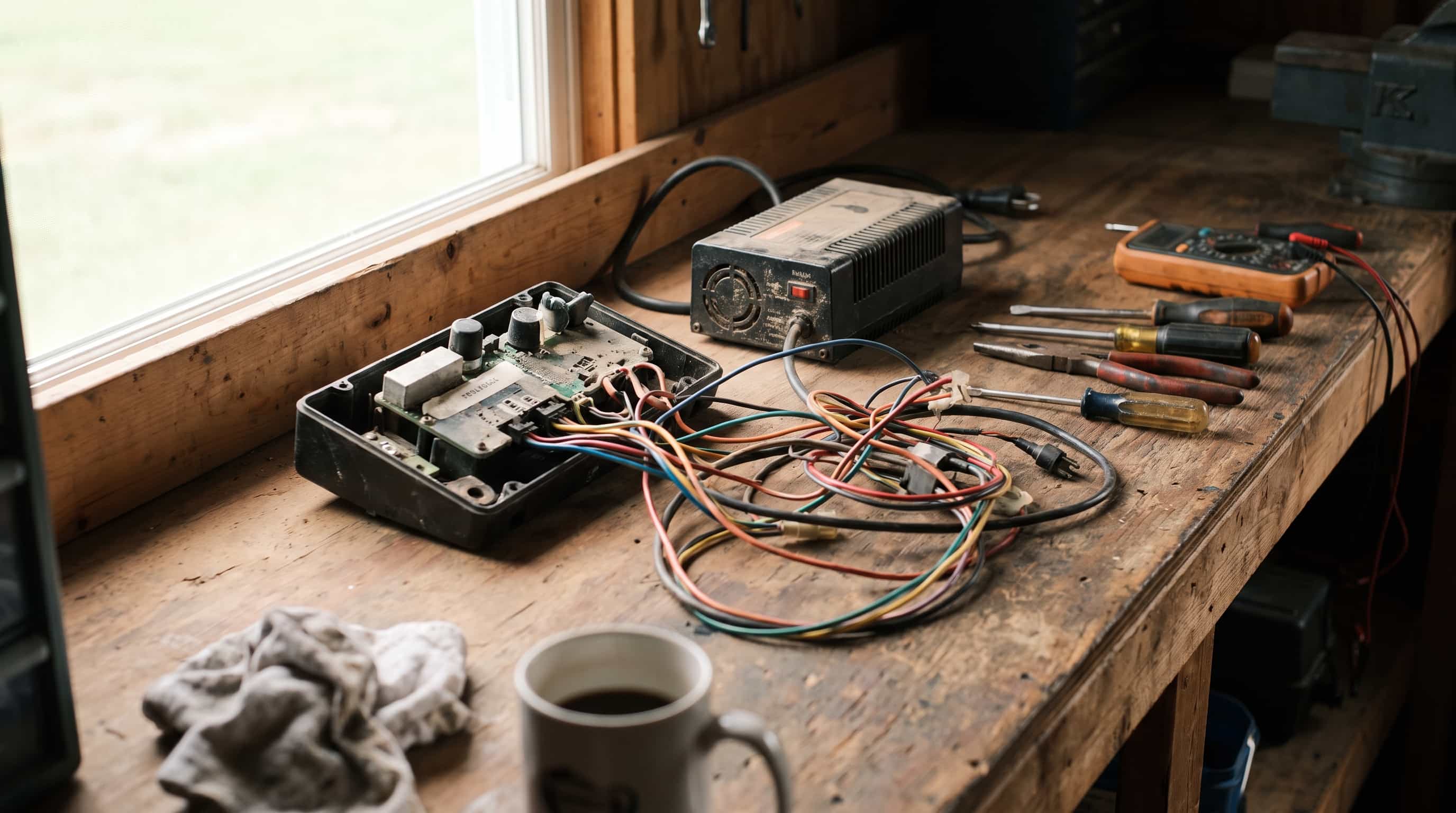
The electrical faults are the ones that reward a torch. Corroded terminals, brittle insulation where a loom has rubbed, and heat damage at the charging receptacle or at a battery post. That last one matters more than it looks: heat marking at a connection is the visible end of a bad joint that has been getting worse for a long time, and it will keep getting worse until somebody addresses the joint rather than the symptom.
It is also worth knowing which way the damage runs. On a car of this age, standing does more harm than driving. A vehicle used and charged weekly is usually healthier than one that sat in a barn across two winters with the batteries slowly going flat, however few hours it shows. So the question to put to a seller is not only how much the car has done, but how long it has been since it last did anything.
The aluminium frame is not a free pass
Because the frame cannot rust the way a steel chassis does, buyers assume the car underneath is sound. Steel is still there: fixings, brackets, spring hangers, seat frames and assorted hardware. Where the two metals meet and water gets in, the joint corrodes at the contact face, showing as white powdery deposits and fixings that shear rather than undo. A seized fixing on a cheap part is how a small job turns into a long one.
The frame can also be bent, and it can have been repaired badly. Look along it for ripples, kinks and mismatched fasteners, and be suspicious of welds and of paint in places that should not be painted. Then look where water sits: the battery tray, the floorboard edges, under the seat, and anywhere a bolt passes through from above. A straight frame is the one thing on an old car you cannot put right cheaply.
If yours is doing this and the checks here have not settled it, we diagnose and repair buggies, including a callout to wherever it is.
Where simplicity helps and where it stops helping
For an owner willing to do their own work, an older car is approachable in a way a modern one is not. The brakes are mechanical and visible. The wiring can be followed. Most jobs need ordinary tools and patience rather than a subscription and a laptop. That is a real reason to choose one, and plenty of owners do exactly that and keep a car going happily for years.
The limit arrives from the same direction. With little to plug into, diagnosis is by measurement and elimination, which suits some people and exhausts others. The earliest cars use arrangements that are now unfamiliar even to engineers who see buggies weekly. If your expectation is to ring a dealer and have the problem taken away, the older platform is the wrong end of the market and no amount of charm in the vehicle will change that.
Telling a sensible buy from a project
The distinction is not about how the car looks. Tired paint and a scuffed panel cost very little to live with, and a car that presents badly can be a perfectly good buy. The distinction is about what has been allowed to happen to the systems that are expensive or awkward to put right, and about whether anybody can still tell you the history of the machine.
A project is a perfectly legitimate purchase if that is what you want, and some owners enjoy the work more than the driving. The mistake worth avoiding is buying a project while believing it is a runner, and that mistake is almost always made by not checking the brakes and the battery set at the viewing. Both checks are quick, neither needs tools, and between them they separate most of the cars in this market.
- Sensible: straight unrepaired frame, brakes that hold on a slope, steering without slop.
- Sensible: a battery set of known age, replaced together, with a matching charger present.
- Sensible: a seller who can say what has been done and roughly when.
- Project: seized brakes after long standing, no charger, or a generic one substituted.
- Project: unknown battery age, a flat set, or cells that have obviously been left discharged.
- Project: broken panel mounts, previous repairs, and no history anybody can describe.
Where a DS makes sense today
Light private use suits it well: a garden, a paddock, a run down a long drive to the gate, a yard, or a small site with somebody handy on it. It is a simple machine doing simple work, the parts are there, and it does not owe anybody anything. For that kind of duty an older car with a recent battery set is often the sensible purchase rather than the compromise.
It suits a business less well. Where a stopped vehicle costs money every hour, the case moves towards something newer with a warranty and a dealer who answers the phone. That is a judgement about downtime rather than about the car. And whatever the platform, none of this makes a buggy road legal: that question belongs to DVLA and to the standards a road vehicle has to meet, not to the age or the badge of the machine.
Common questions
- How old is a Club Car DS?
- It varies enormously, because the platform ran for a long time and the model name alone will not date a car. The identification plate on the vehicle, read against the maker's documentation for that serial, is what dates it. Ask the seller for a clear photograph of the plate before you travel to view anything.
- Are Club Car DS parts still available?
- Broadly yes for the common wear items and body panels, from both the maker's channel and a long-established aftermarket. It thins out for the earliest cars and for specific electrical items. Check with a parts supplier against your serial before committing, naming the parts you already expect to need rather than asking in general terms.
- Does a Club Car DS frame rust?
- The aluminium frame does not rust the way a steel chassis does, which is the main reason so many survive. The steel around it does: fixings, brackets, spring hangers and seat frames, plus the joints where the two metals meet and trap water. Inspect from underneath with a torch rather than judging by the bodywork.
- Is a Club Car DS worth buying?
- It can be, for light private use where simplicity and easy parts matter more than a warranty. The platform is not really the question, the individual car is. A straight frame, a battery set of known age, working brakes and a seller who can describe the history make a sensible purchase. Missing any of those, treat it as a project.
- What is the difference between a DS and a Precedent?
- The Precedent is the later fleet platform that followed the DS, with different bodywork and revised arrangements. Both were built for the same job. In the used market the DS is the older and simpler machine, which suits an owner who does their own work, while a Precedent is generally the easier car to have serviced by somebody else.
- Can I fit lithium batteries to an old DS?
- Sometimes, and it is a conversion rather than a swap. The charger, the battery tray, the cabling and the vehicle's own electrics all have to suit, and the answer depends on the specific car. Talk to an installer who has done it on that platform, and settle the charger question first because it decides much of the rest.
Still not right
We diagnose and repair golf buggies, service them on a plan, and send an engineer out to where the buggy is. Tell us the symptom and we will say what it usually means.
Related pages
Related guides
 Golf buggy makes explained: who builds what10 minute read
 Club Car Onward: what it is and who it suits8 minute read
 E-Z-GO RXV or TXT: which is which9 minute read
 Club Car buggies: the model lines explained10 minute read
- How old is too old for a used golf buggy5 minute read
 Golf buggy chassis and frame corrosion4 minute read