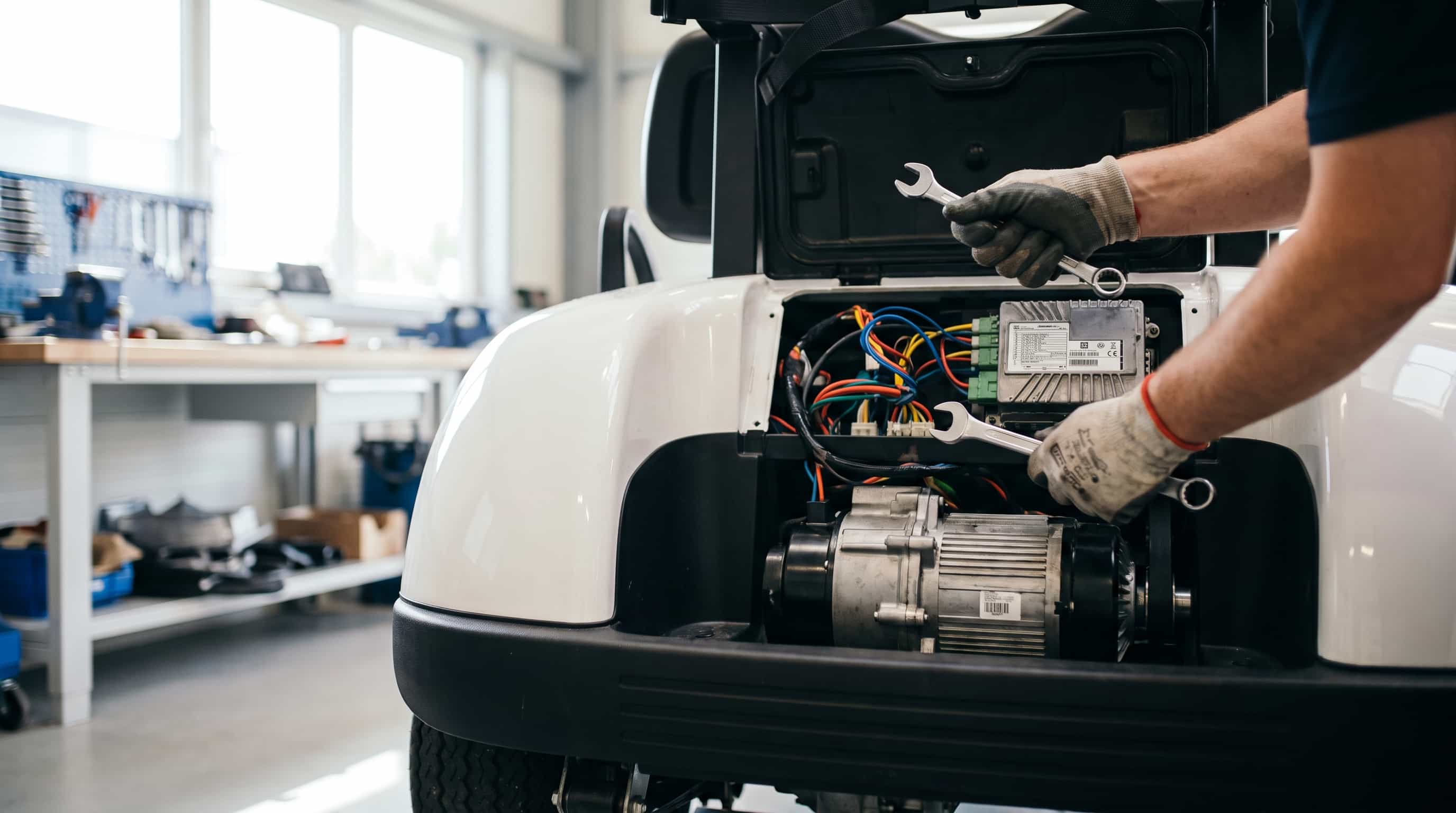
Bradshaw electric vehicles explained
By James Brown · Updated 29 August 2026 · 9 minute read

Bradshaw is a British brand of industrial electric vehicles: tow tractors, load carriers and personnel carriers built for working sites rather than for golf. They turn up at airports, hospitals, factories, distribution centres, universities and large estates because the work is repetitive internal movement over distance, and electric drive suits that indoors. Choosing one is closer to choosing a forklift than a buggy, because the specification follows the load, the gradient, the surface and the duty cycle rather than the seat count.
Key takeaways
- These are industrial machines, not golf machines, and a few of them only look like a buggy from a distance.
- The work is repetitive internal movement, which is why electric drive took it long before the environmental argument arrived.
- Getting the shape right matters most: a tow tractor pulls, a load carrier carries, a personnel carrier moves people.
- Specification follows total rolling load, the steepest ramp, the surface and the hours worked, not the number of seats.
- Hard industrial tyres and wet British turf are a poor combination, and the ground pays for it.
- Size the battery around the heaviest realistic shift rather than the average day, or the vehicle will run short when it matters.
- No driving licence is needed on private land, but an employer still owes duties around training, maintenance and competence.
What the brand builds
Bradshaw is a British brand of industrial electric vehicles, and the first thing to say is that it is not a golf marque. The machines are tow tractors, load carriers and personnel carriers, built for moving goods and people around working sites: warehouses, factories, hospitals, airports, distribution centres, universities and large estates. A few of them look superficially like a buggy from across a yard. None of them is designed for the job a golf buggy does on turf.
That distinction matters because plenty of buyers arrive here from the golf side, having decided that a buggy is not quite enough for what they need. It is usually not the same decision at all. An industrial electric vehicle is specified around a load, a duty cycle and a surface, and it is bought much the way a forklift is bought. For current models and any published capacities, the maker's own documentation is the source, and we do not repeat figures we cannot stand behind.
Why they end up on airports, hospitals and factory sites
The common thread is repetitive internal movement over distance. Airports move baggage and equipment. Hospitals move laundry, waste, catering, stores and post between departments and often between buildings. Factories and distribution centres shift components and cages. Universities and large estates move maintenance teams and their kit around a site that is too spread out to walk and too tight for a van. All of it is short-range, high-frequency work.
Electric drive suits that exactly. There is no exhaust, so the vehicle can work inside a building and go into a lift. The noise is low, which matters on a ward corridor at night and in an office block. And the duty is predictable enough that a battery can be sized around the shift rather than guessed at. Those three practical points, rather than any environmental argument, are why this work went electric early and has stayed there.
Tow tractor, load carrier or personnel carrier
Almost everything in this class is one of those things, and getting the shape right matters more than any other decision you will make. A tow tractor pulls: it has little or no load area of its own and its job is to move trailers, cages or trolleys behind it. A load carrier carries, with a flat or box body on the vehicle itself, sized around what will go on it. A personnel carrier moves people, with proper seating, handholds and a step.
Sites regularly buy the wrong one. A tow tractor bought because it looks capable is useless if there are no trailers to put behind it. A load carrier bought for a job that is really towing means somebody making repeated trips all day. And a load carrier pressed into service as a personnel carrier is how people end up riding on a deck they should not be on, which is a safety failure rather than a comfort complaint.
- Things move behind the vehicle in trailers, cages or trolleys: a tow tractor.
- Things ride on the vehicle: a load carrier, sized around the heaviest regular load.
- People move between buildings: a personnel carrier with real seats and handholds.
- The ground is turf and the passengers are guests: that is buggy territory, not industrial.
How choosing one differs from choosing a buggy
A golf buggy is chosen by seat count and terrain. An industrial electric vehicle is chosen by load, gradient, surface and duty cycle, and the seat count is nearly an afterthought. Before anybody can specify one properly you need the total rolling weight it will move including trailers, the steepest ramp on the route, the surface it runs on, and how many hours a day it will genuinely be working. Those answers determine the machine.
Nobody can pick a model from a description of the job alone, and a supplier who does so without asking about ramps and rolling loads is guessing. Makers publish capacities for a reason, and they are stated under defined conditions rather than as a promise about your site. Give a supplier the real measurements from your own premises, get the recommendation in writing, and keep it. That document is what matters if the vehicle turns out to be undersized in service.
Tyres, surfaces and ground damage
Industrial vehicles run on hard tyres because they work on concrete, tarmac and warehouse floors, where a hard tyre gives low rolling resistance, precise steering and long life. Put the same tyre on wet grass and two things happen at once: traction disappears, and the ground takes a beating, because the weight is carried on a small contact patch. A turf tyre exists precisely to spread that load across a wider footprint.
So a machine specified for a factory floor is often the wrong choice for an estate, and the reverse holds too, since a turf tyre on a loading dock wears quickly and steers vaguely. Where a route mixes both surfaces, say so early in the conversation. It usually changes the tyre choice, sometimes the vehicle, and occasionally the route itself. Kerbs, ramp gradients, drainage channels and door thresholds all belong in the same discussion.
If yours is doing this and the checks here have not settled it, we diagnose and repair buggies, including a callout to wherever it is.
Batteries, charging and the shift pattern
The mistake that causes most disappointment is sizing the battery around distance covered rather than work done. Towing a loaded train up a ramp takes far more out of a pack than the same distance running empty on the flat, and a vehicle that comfortably covers a quiet day can run short on a busy one. Specify around the heaviest realistic shift, then check what happens on the day everything goes wrong at once.
Then look at where charging will happen. An industrial vehicle needs a designated charging point with the right electrical supply, ventilation appropriate to the battery type, and a position that does not block a fire route or a doorway. On a site running more than one shift, the real question becomes whether the vehicle can be charged during breaks or whether you need a second pack or a second machine. That decision is far cheaper made at purchase than a year later.
Operator safety and what a site needs in place
No driving licence is required to use one of these vehicles on private land, and that is where the simplicity ends. An employer providing work equipment owes duties around its suitability, its maintenance and the competence of the people using it, and an electric tow tractor in a hospital corridor is work equipment in exactly that sense. Training, written authorisation, pre-use checks and a risk assessment are the normal expectations rather than the cautious ones.
The specifics belong to your own competent person and to HSE guidance rather than to a supplier or to us. What is worth saying is which risk actually bites: pedestrian interaction. These vehicles are quiet, they spend a good deal of time reversing, and they operate where people are walking and not looking up. Speed limiting, visibility, an audible warning, route planning and segregation are the controls that make the practical difference.
- Written authorisation for named operators, with training recorded rather than assumed.
- A pre-use check the operator actually performs, and a working way to report defects.
- Route planning that separates vehicles from pedestrians wherever the layout allows it.
- Speed limiting and visibility aids set for your site rather than left as delivered.
Where a golf buggy is still the right answer
If the job is moving guests, members or visitors short distances over turf and gravel, a buggy remains the right tool. An industrial machine will be heavier, harsher and considerably less welcome on the grass. Appearance counts as well, and it is not a vain point: a personnel carrier in works colours is entirely correct on an industrial estate and entirely wrong at a wedding or alongside a fairway on a competition day.
The honest dividing line is load and duty. Once the work involves towing, heavy or repetitive load carrying, indoor use, or a shift pattern that runs all day every day, you are in industrial territory and a buggy will be worked past its design. Below that line a buggy is cheaper to buy, cheaper to keep and kinder to the ground. Sites that get this wrong usually do so by buying up rather than down.
Common questions
- Is a Bradshaw the same as a golf buggy?
- No. These are industrial vehicles for towing, load carrying and moving staff around working sites, and they are specified around loads, gradients and shift patterns rather than seats and turf. Some personnel carriers resemble a buggy in outline, but the chassis, tyres, duty rating and intended surface are all different, and so is the buying process.
- Can an industrial electric vehicle be used on grass?
- Sometimes, and it depends on tyres, weight and the state of the ground. Hard industrial tyres on wet British turf lose traction and mark the surface, because the weight sits on a small contact patch. If the route mixes hard standing and grass, raise it at the specification stage, because it can change the tyre choice or the vehicle entirely.
- How do I work out what size tow tractor I need?
- Measure the job rather than guess it. You need the total rolling weight being moved including trailers and load, the steepest gradient on the route, the surface, and the hours the vehicle will actually work. Give those to a supplier, ask for the recommendation in writing, and check it against the maker's published capacities, which are stated under defined conditions.
- Do operators need a licence to drive one?
- Not a driving licence, on private land. What is needed is competence: training on the specific vehicle, written authorisation from the employer, a pre-use check routine and a risk assessment covering pedestrians and the route. Those duties sit with the employer and their competent person, and HSE guidance is the place to take the detail from rather than a supplier's brochure.
- Are these vehicles road legal in the UK?
- Treat them as site vehicles unless proven otherwise. Using any small vehicle on a public road here depends on appropriate approval, registration, tax, insurance and compliance with construction and lighting requirements. Some sites need a short public crossing between two gates, and that stretch counts. Ask DVLA about the specific machine and your insurer about the cover before relying on it.
- Should I hire a personnel carrier or buy one?
- Duration and utilisation decide it. Short projects, seasonal peaks and one-off events suit hire, because you avoid charging infrastructure, maintenance and the vehicle standing idle for months. Continuous daily use across a site usually favours ownership, provided somebody is responsible for servicing and there is a proper charging point. Mixed patterns often end up as a small owned fleet topped up with hire.
Still not right
We diagnose and repair golf buggies, service them on a plan, and send an engineer out to where the buggy is. Tell us the symptom and we will say what it usually means.