Petrol golf buggy engines explained
By James Brown · Updated 29 August 2026 · 10 minute read

A petrol buggy carries a small engine, usually a single-cylinder four-stroke, driving through a belt-and-pulley variable transmission to a rear axle, with a fuel tank, exhaust, air filter and a small starting battery around it. It asks for the maintenance any small engine asks for: oil, filters, plug, belt and clean fuel. It earns its place where a working day runs long and far from power, and it loses its place wherever noise, fumes or a venue's own rules settle the matter first.
Key takeaways
- A petrol buggy drives through a belt-and-pulley variable transmission rather than a gearbox, which is why take-up feels delayed.
- Service intervals are set in running hours by the maker's own manual, so a working hour meter matters more than a calendar.
- Stale fuel after a winter layup is the most common reason a petrol buggy will not start in spring.
- Petrol keeps a genuine advantage where the working day is long and the site has no power at the far end of it.
- Venue rules, not emissions law, are what usually stop a petrol buggy being used in the UK.
- On a used machine the engine replaces the battery set as the item that decides the purchase.
- Fuel storage is a fire risk with rules attached, so ask your insurer and, on a site, your fire risk assessor.
What is actually under the seat
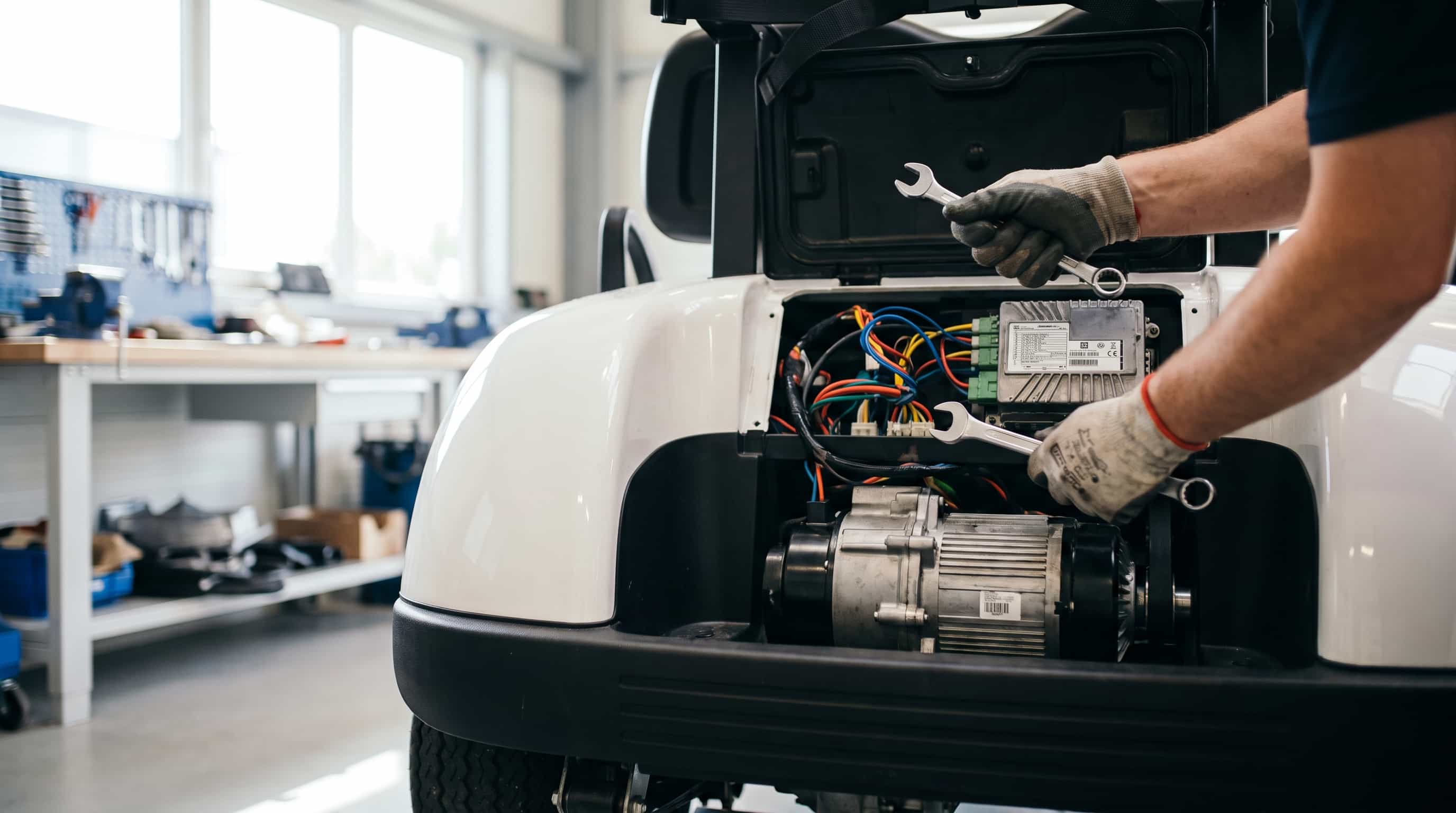
The layout is simpler than a car and quite different from an electric buggy. A small engine, usually a single-cylinder four-stroke, sits behind or beneath the seat. Its drive goes through a variable belt transmission rather than a gearbox: two pulleys, one on the engine and one feeding the rear axle, joined by a wide belt that changes ratio as engine speed rises. There is no clutch pedal and no gear lever, only forward, neutral and reverse.
Around that sit the parts an electric machine simply does not have. A fuel tank and lines. An exhaust and silencer. An air filter, an oil supply, and a small battery whose job is starting and lights rather than propulsion. Older machines may use a two-stroke engine, and some use a combined starter and generator unit rather than a separate starter motor. Establish which arrangement you have before buying parts or following any procedure, because the servicing differs across all of them.
How it drives, and why it feels different
Press the pedal and the engine either starts from rest or lifts from an idle, depending on the machine, and the belt takes up drive with a short delay that electric drivers find odd at first. Once moving, the note rises and falls with the load rather than sitting at a constant hum. On a descent the engine and transmission provide some braking of their own, which changes how you drive downhill compared with a freewheeling electric machine on the same slope.
The differences that matter socially are noise, vibration and heat. A petrol buggy is audible across a fairway and unmissable beside a marquee. It vibrates at idle in a way that tires passengers over a long day. And it carries a hot exhaust close to knees, luggage and dry grass. None of that is a fault in the machine. It is what an engine does, and it is why so many venue decisions get made before any technical comparison has even started.
What it asks for that an electric does not
Every service item on a petrol buggy is one an electric machine does not have at all. Engine oil and its filter. An air filter that fills quickly on dusty ground. A spark plug. A fuel filter. Valve clearances at whatever interval the maker sets. And a drive belt that wears, glazes and eventually slips. Intervals are usually stated in running hours rather than in distance, which is why the hour meter matters more than the calendar on the wall.
The manual for your exact machine is the authority on all of it, and there is no safe general figure to work from. Intervals, oil grades, plug types and clearances differ between engines that look much the same from a metre away. If a machine arrives without documentation, getting hold of the right manual is the first service job rather than an optional extra, and an engineer who knows the engine is the next call after that.
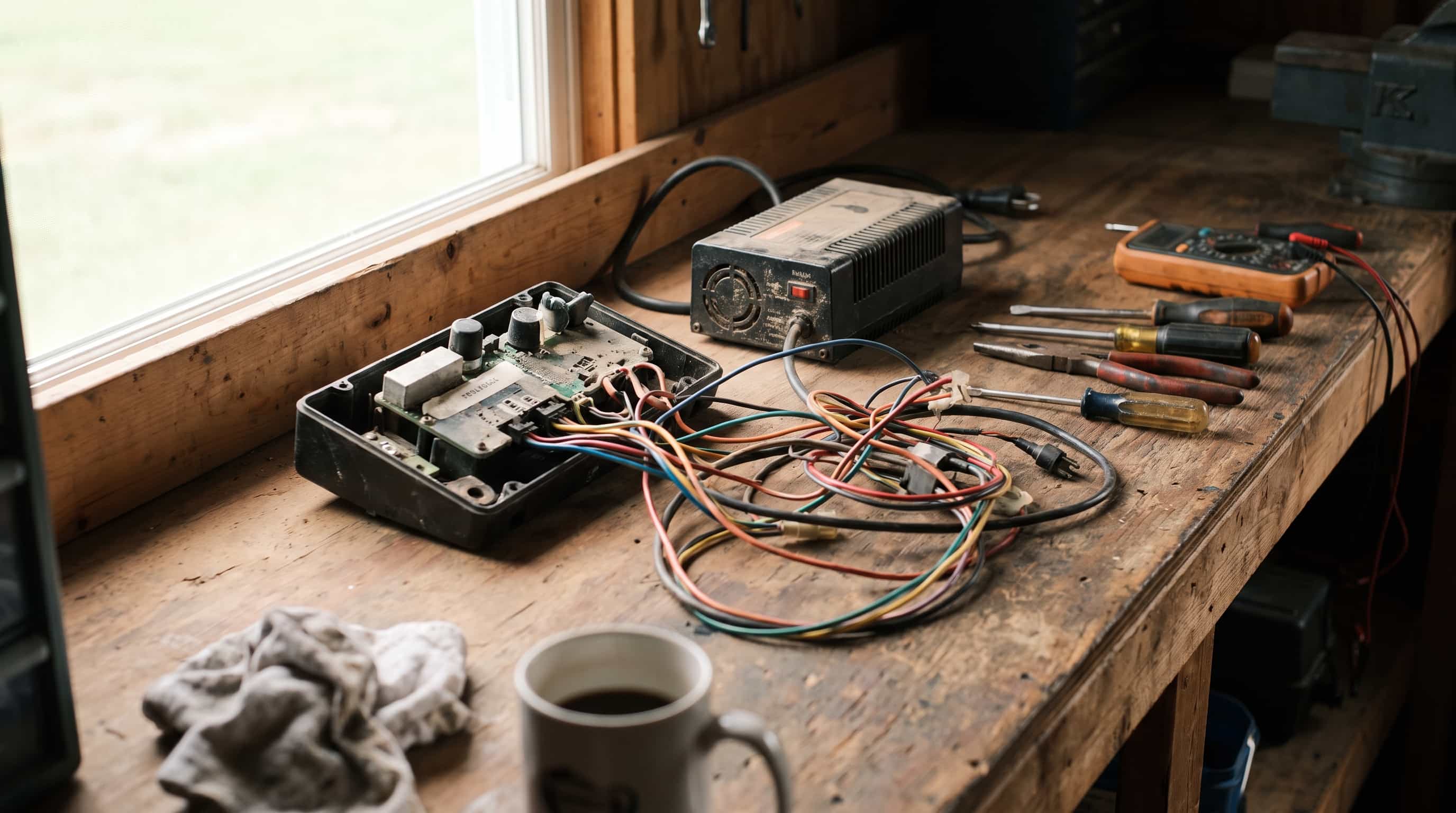
Fuel is the item people underestimate. Modern petrol degrades in storage, and stale fuel gumming a carburettor is by a distance the most common reason a machine that worked in September will not start in April. It is also among the cheapest problems on the vehicle to prevent, and one of the more tedious to put right once it has happened.
Storage, winter and the spring start
A petrol buggy that works all year round rarely gives fuel trouble. One that stands from autumn to spring frequently does, and the routine that avoids it is short enough to write on a card and leave in the store. The point of the routine is that the machine goes to sleep in a known state, so that whoever wakes it in March is not diagnosing a mystery on the morning of the first society day.
Fuel storage itself deserves a moment's thought too. Petrol kept in a domestic garage or a club store is a real fire risk and is subject to rules on containers and quantities, and your insurer very likely has terms about it in the policy. Ask the insurer, and for a club or venue ask your fire risk assessor, what is actually permitted on your site rather than working from what feels reasonable to the person carrying the can.
- Decide before the layup whether to store it near empty or full with a stabiliser added, following the maker's advice for your engine.
- Run the engine after adding stabiliser so treated fuel reaches the carburettor and not only the tank.
- Take the starting battery off the machine or keep it on a suitable maintenance charger.
- Store under cover with ventilation, off wet ground, with the fuel tap closed if the machine has one.
- In spring, fresh fuel first, then oil and air filter, then a look at the belt for flat spots before anyone drives it.
Where petrol still makes sense in the UK
The honest case for petrol is geographic rather than sentimental. A machine that works all day at the far end of an estate, tows loads that run consumption up, or lives in a building with no power has a genuine problem that a charging lead does not solve. Refuelling takes a minute and a charge does not, so a vehicle that must keep working continuously through a long day still holds a real and practical advantage.
There is a used-market case as well. Demand has moved firmly towards electric, which leaves petrol machines changing hands among buyers who want a working vehicle rather than a quiet one. If you have somewhere sensible to keep fuel, someone locally who will service a small engine, and ground that is genuinely remote from power, that is a rational purchase rather than a compromise you have talked yourself into.
Set against that, the servicing burden is continuous rather than occasional, and it is the burden most private owners quietly stop keeping up with after the second year. The vehicle that suffers for it is usually the one whose oil was last changed by somebody else, and the bill arrives later as an engine problem rather than as a service you skipped.
If yours is doing this and the checks here have not settled it, we diagnose and repair buggies, including a callout to wherever it is.
The venue, noise and emissions questions
Most refusals have nothing to do with the law. Golf clubs increasingly specify electric for noise near greens and around the clubhouse, and some have moved their fleets over entirely and apply the same rule to anything brought in. Wedding and hotel venues, indoor halls, food areas, care settings and anywhere with a marquee usually rule out engines outright, and a machine that arrives without that being checked is a machine that turns round in the car park.
Ask the venue before anything else is decided. The question to put is direct: do you allow petrol vehicles on site, and if so, where may they be refuelled and where may they be left running. Answers are often more restrictive than a general policy suggests, particularly around early morning and late evening work, and the person who knows is usually the operations or grounds manager rather than the events desk.
On emissions, low emission and clean air schemes are aimed at road vehicles, and a buggy used on private land is generally outside them. That is not the same as being welcome. The rules that actually bite on a buggy are the site's own, together with the ordinary duty not to expose people to exhaust in enclosed spaces. Carbon monoxide indoors and in closed garages is a serious risk rather than a nuisance, and it deserves treating as one.
Buying a used petrol machine
The engine takes the place of the battery set as the item that decides the purchase. Start it from cold in front of you, and refuse a machine that has been thoughtfully warmed up before you arrived, because a cold start is where the truth about an engine lives. Watch what comes out of the exhaust once it has settled, listen for a rattle that does not clear, and look at the oil on the dipstick for both level and condition.
Then work round the things that are cheap to check and expensive to ignore. Fuel lines for perishing, and the smell of fuel anywhere it should not be. Exhaust mountings and silencer security. The drive belt for cracking and glazing. The air filter's condition, which is a fair proxy for how the machine was looked after generally. And the brakes, which on a petrol machine work harder than most buyers expect. Ask for the service history and an hour reading, and ask who has been servicing it.
The last question is the one that catches people out. Find out before you buy who will service that engine near you, and whether its parts are still available. Ask who has been maintaining it and ring that person before you commit, because two minutes on the telephone tells you more about a machine than an hour spent looking at it. A petrol platform with no local support is a project rather than a vehicle, and projects become expensive very quietly.
Running one responsibly
Refuel with the engine off, away from people and away from any ignition source, and never inside a building. Keep a suitable extinguisher where the machine is stored and where it is refuelled, and make sure the people using the vehicle know where it is. Do not run an engine in a closed garage or under a marquee, and treat any smell of exhaust in an enclosed space as a reason to stop rather than as a reason to open a door and carry on.
Waste has its own rules. Used oil, oil filters and old fuel are not household waste and go to a local recycling centre or a licensed collector. On a site with staff, the vehicle is work equipment, which means the people driving it need training and the machine needs maintaining in a way you can evidence afterwards. None of this is onerous, and all of it is the part that gets skipped on the machine that eventually causes the incident.
Common questions
- Are petrol golf buggies still available in the UK?
- New sales here have moved heavily towards electric, and most petrol buggies now change hands second hand. Petrol utility models remain part of the picture on farms, estates and large working sites where charging is impractical. If you want one, expect the used market rather than a showroom, and check parts and servicing support in your area before committing to a machine.
- Do golf clubs allow petrol buggies?
- Many do not, and it is the club's decision rather than a legal restriction. Noise near greens and around the clubhouse is the usual reason, and clubs that have moved their own fleet to electric generally apply the same rule to anything brought in. Ask the club directly before arriving with one, including for society days and charity events.
- How often does a petrol buggy need servicing?
- By running hours rather than by date, and the intervals come from the manual for your exact engine. Machines that sit unused still need attention, because oil ages and fuel degrades whether the vehicle moves or not. If the hour meter has stopped working, that is worth fixing, since without it the whole servicing schedule becomes guesswork.
- Why will my petrol buggy not start after the winter?
- Stale fuel is the first suspect, followed by a flat starting battery and a plug that has been sitting damp. Fuel left through a long layup gums the carburettor, and the machine turns over without firing. Fresh fuel, a charged battery and a clean plug solve most cases. A carburettor that has already varnished usually needs stripping and cleaning properly.
- Does a petrol buggy need an MOT?
- Not for use on private land, where no test, registration or road tax applies. Those obligations belong to vehicles used on public roads, and putting any buggy on a road brings requirements around construction, lighting, registration and insurance that DVLA is the authority on. Settle that with DVLA before assuming a particular machine can be used on a road at all.
- Is converting a petrol buggy to electric worth it?
- Rarely, on cost. A conversion means a motor, a controller, a battery set, a charger and the work to make them all fit and behave together, and the result usually lands above what a used electric machine of similar age would have cost. Where a specific vehicle has to stay in service for other reasons it can be justified. As a saving, it is not.
Still not right
We diagnose and repair golf buggies, service them on a plan, and send an engineer out to where the buggy is. Tell us the symptom and we will say what it usually means.