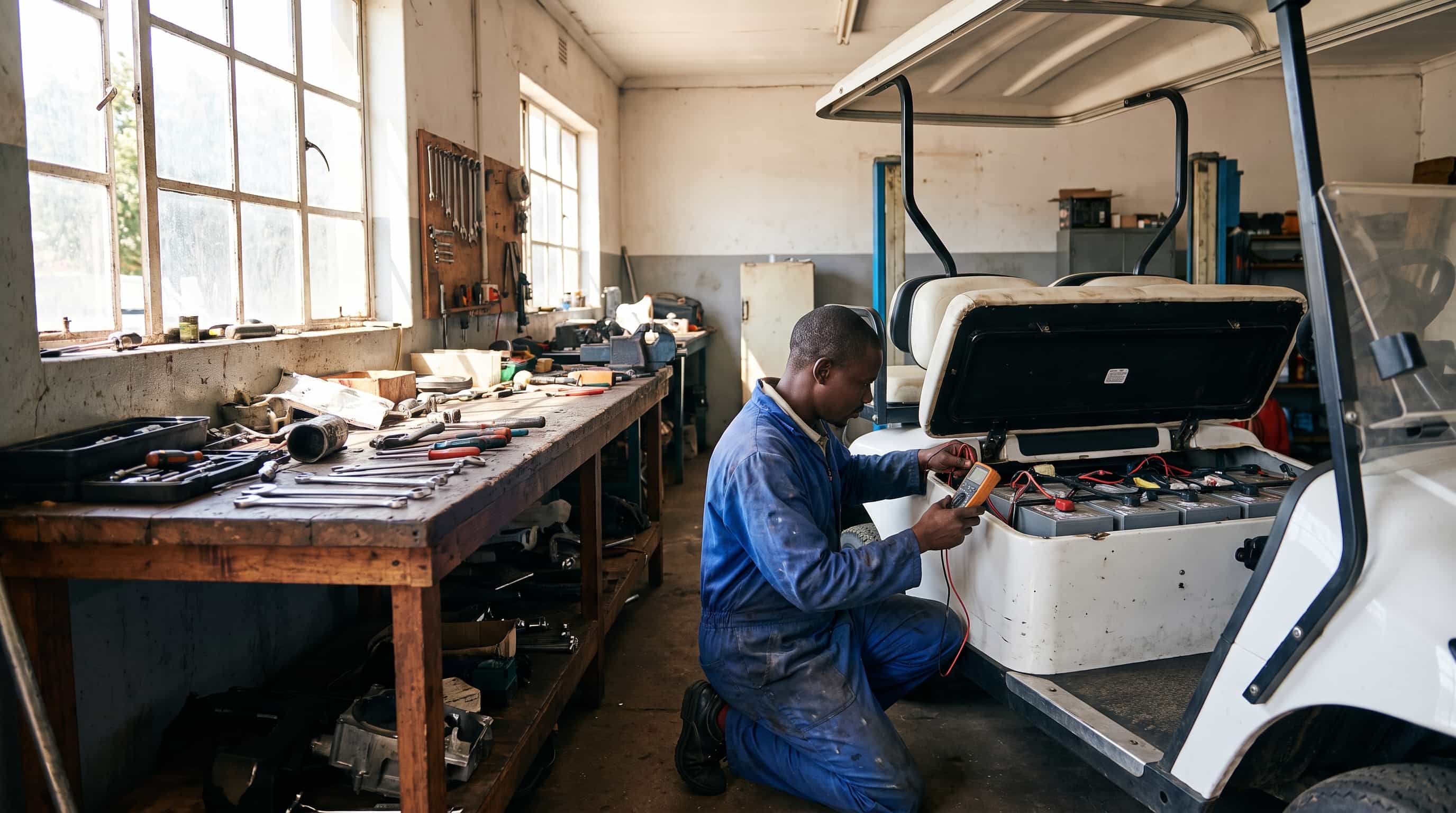
Winter buggy policy at a golf club
By James Brown · Updated 29 August 2026 · 10 minute read

A winter buggy policy has four parts, and clubs get into trouble when they publish only the first. Set the ground condition test that takes the fleet off, decide whether anything keeps running for members who cannot walk the course, settle where the machines are stored and how they are charged through the closed months, and name who makes the daily call and where members read it. Ground condition drives the decision. The calendar only frames it.
Key takeaways
- Ground condition decides whether buggies run; a published season only tells members what to expect.
- One named person should make the daily call, and members should find it without ringing the shop.
- A blanket suspension lands hardest on members who cannot walk the course, which is a question for the club's own legal advice rather than a supplier's opinion.
- Path only works when the path network reaches the greens, and it needs marking rather than a request to be sensible.
- A pack left standing flat over the closed months is the most expensive winter mistake a club makes.
- Cold cuts the range a battery delivers on the day without meaning the set is failing.
- Book the spring service before the season opens, not after the first member is stranded.
The four decisions a winter policy makes
Most winter policies are one sentence on a noticeboard, and that sentence is doing four jobs badly. The decisions are separable and each has a different owner. The course manager decides what the ground will carry. The committee decides what the club owes members who cannot walk it. The professional or the desk decides how machines are stored and charged. The secretary decides how any of it reaches the membership. Written separately, the policy stops being argued about at the bar.
They are worth separating because they change at different speeds. Where the machines sleep is settled once a year. Whether the fleet runs today is settled every morning. A member reading one blunt notice cannot tell which part is fixed and which is a daily judgement, so they ring the shop, and the shop spends the winter answering the same question.
Separating them also protects your staff. When the rule is published as a condition test rather than a personal decision, an unpopular call in the middle of a wet February reads as the policy working rather than as one member of staff being difficult. Clubs underestimate how much friction that removes.
The condition test that takes the fleet off
Ground carries vehicles or it does not, and the date has little to do with it. A dry, frosty run in deep winter can leave a course firmer underfoot than a wet week in early autumn. So the trigger in a policy that survives contact with members is a description of ground, with the season mentioned only to say roughly when restrictions become likely.
The tests worth writing down are the ones anybody on duty can apply in a few minutes, without the course manager present. A walk of one known low spot before the first tee time is genuinely the whole of it.
- Water standing in the hollows after the rain has stopped.
- A heel print that holds its shape rather than springing back.
- Tyre tracks still visible behind the machine on a second pass.
- Thawing ground, soft on top and still frozen underneath, which is the condition that does the most damage.
- Recent work on a route the machines would take: hollow tining, seeding or fresh turf.
Members who cannot walk the course
A blanket suspension is simple to administer and it lands hardest on the members who need a machine to play at all. For a golfer who cannot walk eighteen holes, taking the fleet off does not shorten their round, it ends it, and it ends it through the months when the diary is quiet and the subscription is still being paid.
Equality law places duties on clubs regarding adjustments for disabled people, and the shape of those duties depends on how your club is constituted and how it operates. That makes it a question for the club's own legal advice, not for a supplier's guide. What we can say from the operating side is that the answer is rarely all or nothing: it is common to take the general hire fleet off while holding a small number of machines available on a permit basis, on a defined route.
If you do that, settle the detail before winter rather than in the middle of an argument. Who approves a permit and on what evidence, how many machines are held back, which route they may use, and what happens on the days when even that route will not carry a vehicle. A policy that says an exception exists but never says how to obtain one is not much of an exception.
Path only, and marking it properly
Path only is the middle setting most clubs reach for, and it works when the paths actually go somewhere. On a course where the network stops short of half the greens, path only in practice means path plus a run across soft turf at every one of those holes, which is precisely the damage the restriction was meant to prevent. Say what happens at those holes rather than leaving it to the driver.
Marking makes the difference between a rule and a hope. People follow the shortest line they can see, so the job is to make the correct line the obvious one.
- Rope the shortcut before you signpost the route.
- Move entry and exit points as the ground takes wear, so one patch does not receive every wheel.
- State the park and walk in rule for holes the path does not reach.
- Put the restriction on the tag that goes out with the key, not only on the noticeboard.
- Tell the greenkeeping team, because they see the breaches days before the office hears about them.
Storage and charging through the closed months
Where the fleet sleeps decides how much of it works in spring. Dry, ventilated and secure is the whole specification, and of the three, dry does the most work. A machine under a sheet in the open is worse off than one in a draughty shed, because the sheet holds moisture against the metal and the wiring rather than keeping it away from them.
Charging is where good intentions fail. A lead-acid pack left standing at a low state of charge sulphates, and a set left flat all winter is often the spring bill that arrives dressed up as a mystery. The rule that covers every chemistry is that machines go away charged, never sit flat, and follow the battery and charger maker's own instructions for a long stand rather than a habit inherited from whoever held the job last.
- Charged before it goes away, and never parked flat.
- The battery and charger manual kept where staff can actually read it, not in an office drawer.
- Lead-acid packs need their levels checked through the stand; sealed and lithium packs do not.
- Ventilation wherever lead-acid packs are on charge, without exception.
- Keys off the machines and logged, because a stored fleet is a standing theft target.
- One named person walking the store on a fixed interval, writing down what they found.
Working out what this costs for your own event? Tell us the venue and dates and you will have an itemised written quote within one working hour.
What cold does to a battery on the day
Cold reduces the energy a pack will actually give you, and it does so without anything being wrong. A set that comfortably covers a round in September can come up short on a hard winter morning, which is why the winter complaint about machines running out is usually the weather rather than a failing pack. The range returns with the temperature.
Two things follow for a club. Winter running wants a fuller charge and a shorter duty, because sending a machine out at a state of charge that would be comfortable in summer is how it stops on the back nine. And a cold pack accepts charge more slowly, so a turnaround time that works in July is not a turnaround time in January.
One point is worth checking with the maker rather than assuming. Many lithium packs restrict or refuse charging when the pack itself is below freezing, and the management system will simply decline without explaining itself. Whether that applies to your machines, and what the store therefore has to be kept at, is in the battery documentation. Lead-acid habits and lithium habits are not interchangeable in the cold.
Publishing the rule so members plan around it
Members are usually not objecting to the restriction. They are objecting to discovering it in the car park. Almost everything about a winter policy that causes trouble is a communication problem wearing a course management costume, and it is fixed with two things: a standing policy that does not change mid-season, and a daily status that is easy to find.
The standing policy belongs on the website and in the handbook, written once, in plain terms, with the date it was agreed and the committee that agreed it. The daily status belongs wherever members already look before setting off, which today usually means the tee booking system and a pinned message rather than a whiteboard inside the clubhouse. A status posted indoors tells people after they have driven in.
Use the same three words every time. Open, path only, off. A three-state system is read at a glance and learned in a fortnight. Prose that has to be interpreted gets interpreted generously by whoever wants to play, and then the argument happens on the first fairway with a greenkeeper who did not write the notice.
Getting the fleet back out in spring
Book the service before the season rather than after the first complaint. Everything that went wrong over the winter went wrong quietly. A fleet that has stood for months wants going over rather than switching on: brakes that have been sitting, tyres that have gone down, connections that have corroded, and battery sets that are about to tell you honestly what the winter did to them.
Charge the whole fleet, then run each machine properly before a member gets into one. A buggy that starts and crosses the yard has proved almost nothing. A buggy driven a full loop, up whatever your worst climb is, with the brakes tested on the way back down, has proved what you need to know.
This is also the moment to retire honestly. A set that will not hold a charge through a round in April will not improve by July, and a member stranded at the far end of the course is a worse outcome than a machine held back. Replacement is easier to arrange in the spring, when there is time, than in the middle of the season when there is none.
Common questions
- When should a golf club take its buggies off the course for winter?
- Publish a condition test rather than a date. Standing water in the hollows, prints that hold, tracks that stay after a second pass and thawing ground that is soft over frozen are the practical triggers. A dry frosty spell in deep winter may carry vehicles perfectly well, and a wet autumn week may not, so a fixed date will be wrong in both directions.
- Can a golf club stop a member with a medical need from using a buggy in winter?
- That is a question for the club's own legal advice, because equality duties turn on how the club is constituted and how it operates. Operationally, most clubs avoid the question by keeping a small permit-based provision on a defined route while the general fleet is off. Decide the permit process, the route and the bad-day rule before winter rather than during a dispute.
- Should buggy batteries be left on charge all winter?
- Follow the charger and battery maker's instructions, because the answer differs by chemistry and by charger. Some chargers are designed to stay connected and manage the pack; others are not. What is true of every set is that it should not be put away flat and should not be left to sit flat, since that is where lasting damage happens.
- Does cold weather damage golf buggy batteries?
- Cold on its own mostly reduces the energy a pack will deliver that day, and the range returns as the temperature does. The lasting damage comes from standing at a low state of charge, and, for lithium packs, from charging while the pack is below freezing where the maker prohibits it. Check the battery documentation rather than assuming your machines behave alike.
- What does path only actually mean at a golf club?
- Machines stay on made paths and do not cross turf. It only works where paths reach the greens, so the policy has to say what happens at the holes they do not reach, which is normally park on the path and walk in. Rope or stake the obvious shortcuts, because drivers follow the shortest visible line rather than the written rule.
- How should a club tell members the buggies are off today?
- Wherever they already look before leaving home: the tee booking system, a pinned message, a recorded line at the shop. Use three fixed states, open, path only and off, so the status is read at a glance. Keep the standing policy in the handbook and change only the daily status, so nobody has to work out which part has moved.
Ready to get a price
Tell us about your event and we will send an itemised written quote within one working hour.