How much weight can a golf buggy carry
By James Brown · Updated 15 August 2026 · 6 minute read

Capacity is set by the manufacturer for each model and covers everyone and everything on board, including the driver. Seat count is a guide rather than a rating: a buggy sold as four-seat is designed around four adults of ordinary weight and their light belongings, not four adults plus equipment. If you are carrying loads, hills or heavy passengers, say so when you enquire, because it changes which model suits.
Key takeaways
- The rating is the manufacturer's, per model, and it includes the driver.
- Seats indicate capacity but do not state it; equipment eats into the same allowance.
- Hills, soft ground and towing all matter as much as the raw figure.
- Utility models are built for load; passenger models are built for people.
- Tell the supplier the real load and terrain, and let them specify the machine.
What the rating covers
Every buggy has a maximum load specified by its manufacturer, and it is a whole-vehicle figure. It counts the driver, every passenger, anything in the basket or on the rear rack, and anything strapped to the back. People routinely forget the driver, which on a small buggy is a significant fraction of the allowance.
Because it is set per model, there is no single number that answers the question for buggies in general, and anyone who gives you one is guessing. What is consistent is the principle: the figure is a limit for the vehicle as loaded, not a guide to how many bodies will physically fit on the seats.
Why seat count is not a capacity
A buggy described as a four-seater or a six-seater is telling you how many people it is arranged to carry, on the assumption that they are adults of ordinary weight carrying ordinary things. That assumption holds for a golf round and often does not hold for the work people actually hire buggies for.
Six people plus a cool box, a toolkit, two crates of stock and a folded gazebo is a different proposition from six golfers with two bags, even though both are six on the seats. So is a smaller number of heavier passengers. If the load is unusual in either direction, the seat count on its own will mislead you.
The things that matter as much as the number
Weight is only one input, and on real sites it is frequently not the binding one. The same buggy that carries a load comfortably along a level path may struggle with it up a slope, and a fully laden buggy on soft ground will sink and mark where an empty one would pass without trace.
Gradient is the usual limiting factor: climbing a steep rise loaded draws hard on the motor and the batteries, and running downhill loaded puts the demand on the brakes instead. Range drops when a buggy is worked hard, which matters if it is out all day between charges.
- Gradients on the route, and whether the heaviest loads travel uphill or down.
- Ground surface, since soft or wet ground changes what is sensible.
- Distance and hours of use, because a loaded buggy uses more charge.
- Anything to be towed, which is a separate rating from the carrying capacity.
- Whether the load is people or equipment, which decides the type of machine.
Working out what this costs for your own event? Tell us the venue and dates and you will have an itemised written quote within one working hour.
When you need a utility buggy instead
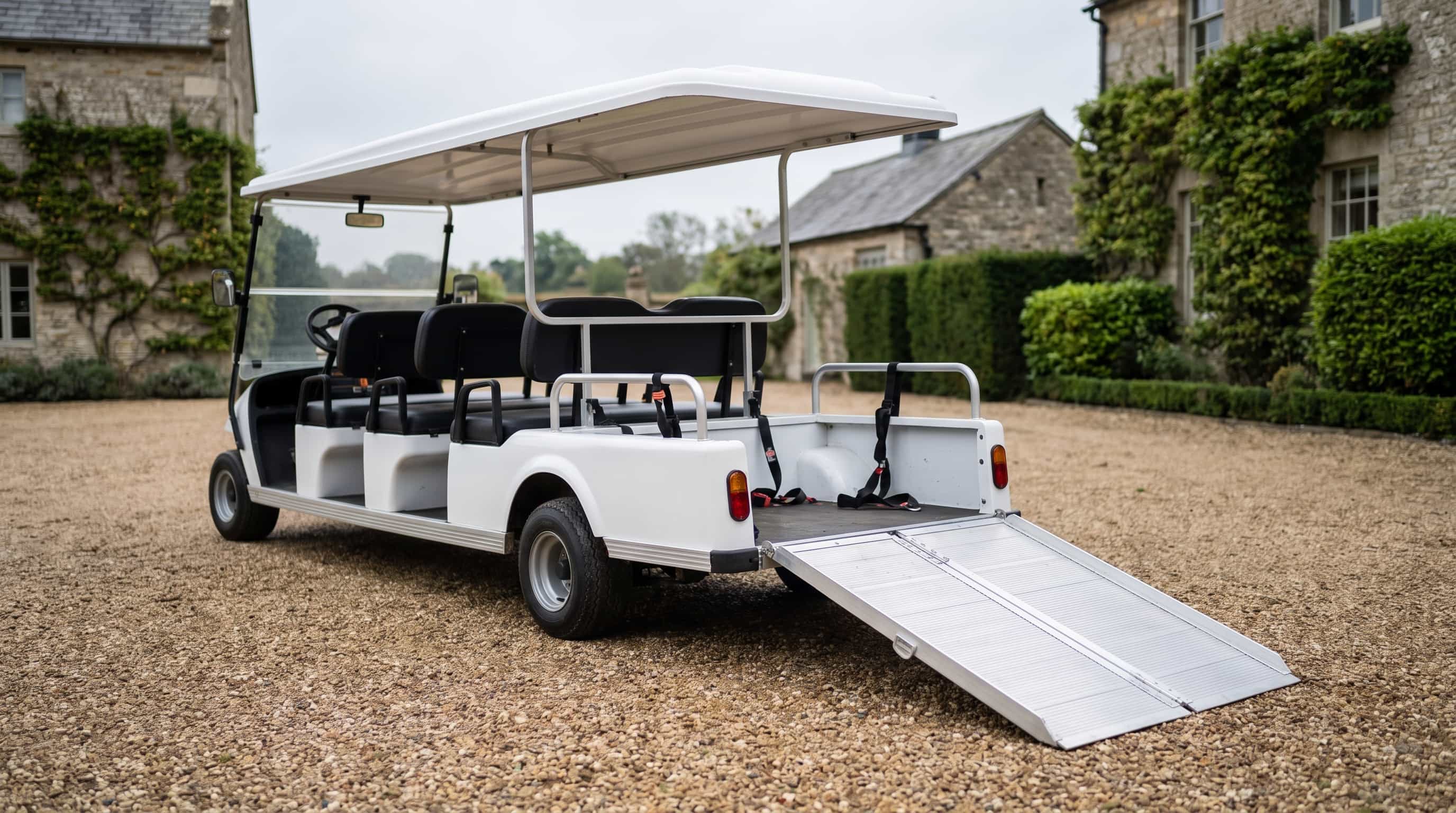
If the job is mainly moving equipment rather than people, a passenger buggy is the wrong tool however the numbers work out. Utility models are built for it: a load bed rather than rear seats, often a tipping bed, stronger suspension and a chassis designed around carrying weight.
That is the usual answer for grounds maintenance, estate work, stock movement at a showground, and getting kit across a festival site. It is a different machine and it is quoted differently, so it is worth naming the actual job when you enquire rather than asking for a buggy and hoping.
What to tell us when you enquire
The practical answer to "how much can it carry" is that we will specify a machine to the job if you describe the job. What helps most is the honest version: how many people, how heavy the equipment really is, what the ground is like, and how steep it gets.
Overloading is not a paperwork problem. It affects braking and stability, wears the drivetrain, shortens the range and voids the cover you are relying on if something goes wrong. Getting the specification right at the quote stage costs nothing, and it is much easier than discovering the limit on a slope with a full load.
Common questions
- Does the weight limit include the driver
- Yes. Manufacturer load ratings are for the whole vehicle as loaded, so the driver, every passenger and everything carried all count towards the same figure.
- Can a golf buggy tow a trailer
- Some models can, and towing is rated separately from carrying capacity. It also depends on the ground and the gradient, so tell the supplier what you intend to tow and where before assuming it.
- Will carrying more reduce the range
- Yes. A loaded buggy draws more current, particularly on gradients, so a machine worked hard all day will not cover the distance it would when empty. That matters most where charging between uses is not practical.
Ready to get a price
Tell us about your event and we will send an itemised written quote within one working hour.
Related pages
Related guides
 How to choose the right golf buggy for hire7 minute read
- Golf buggy or UTV for grounds work11 minute read
 Golf buggy or electric van for a large site11 minute read
 2, 4, 6 or 8 seater, which do you need5 minute read
 Golf buggies for hilly or uneven ground5 minute read
 Electric versus petrol golf buggies for hire7 minute read