Golf buggy or electric van for a large site
By James Brown · Updated 29 August 2026 · 11 minute read

A buggy moves people and modest loads inside your own ground. An electric van moves volume, keeps a driver dry all day, and can legally travel on a public road. If the runs are short, the loads are light and the route never leaves your land, the buggy is cheaper to run and kinder to your surfaces. Once a regular job needs an enclosed load space, a road journey or a crew working outdoors in winter, the van is doing something a buggy cannot. Large sites commonly need both.
Key takeaways
- The public road is the hard boundary, because a van is registered and insured for it and a typical buggy is not.
- Load volume and load weight are separate problems, and a van answers the first far more convincingly than the second.
- Charging a van and charging a buggy are different orders of electrical work, and the supply into the building decides what is possible.
- Distances that look trivial on a site plan become substantial once a route is repeated many times in a shift.
- A van's weight decides which grass, which courtyards and which older surfaces stay available to it.
- Your insurer decides which of your staff may drive the van, and that quietly shapes the rota.
- Two weeks of journey logging settles this argument better than any comparison of specifications.
Where a buggy stops being enough
The mismatch announces itself in small, repeated frustrations rather than in a single failure. Two trips are made for one job. A load is strapped on in a way nobody would sign off. Staff arrive at the far end wet, and stay wet. The machine is parked at a gate because the shortest route crosses a public road, so somebody walks the last stretch carrying the awkward half of the load. None of that is the buggy failing. It is a vehicle being asked to solve a problem it was not built for.
It helps to name the constraint that is actually binding, because sites often buy against the wrong one. There are four candidates and they have different answers: distance, load volume, weather exposure, and access to a public road. A bigger buggy fixes some of those and none of the others. An electric van fixes the road and the volume, and brings its own limits to the grass, the gates and the electrical supply.
Work out which constraint bites most often and you have most of the decision. If the answer is that all four bite, in different parts of the week, you are looking at a split fleet rather than a single vehicle, and that is a perfectly respectable outcome to reach on purpose rather than by accident three years later. Deciding it deliberately also lets you size each vehicle for the work it will actually be given.
Distance, and the difference between a plan and a round
A site plan flatters distance. What matters is not the length of the site but the length of a round, and a round includes the detours, the one-way loops, the locked gate that adds a lap, and the return leg that nobody counts. Walk it or drive it with somebody noting the time and the stops. Sites are regularly surprised by how much of a shift is spent in transit, and that figure, which is yours rather than ours, is the one to design around.
Energy use rises with hills, load, stop-start driving and cold weather, and that is true of both machines. An electric van and an electric buggy both do less in January than in June, so plan around the winter figure rather than the summer one. The buggy is the more exposed of the two, because its pack is smaller and its working day is often longer in hours even when it is shorter in distance.
Then look at where the natural pauses fall. A vehicle that stands at a base for meal breaks and overnight has charging opportunities built into the day. A vehicle that runs continuously through an event weekend does not, and needs either a second machine, a spare pack or a genuine plan for the gap. Work that out before the weekend rather than during it.
Load volume against load weight
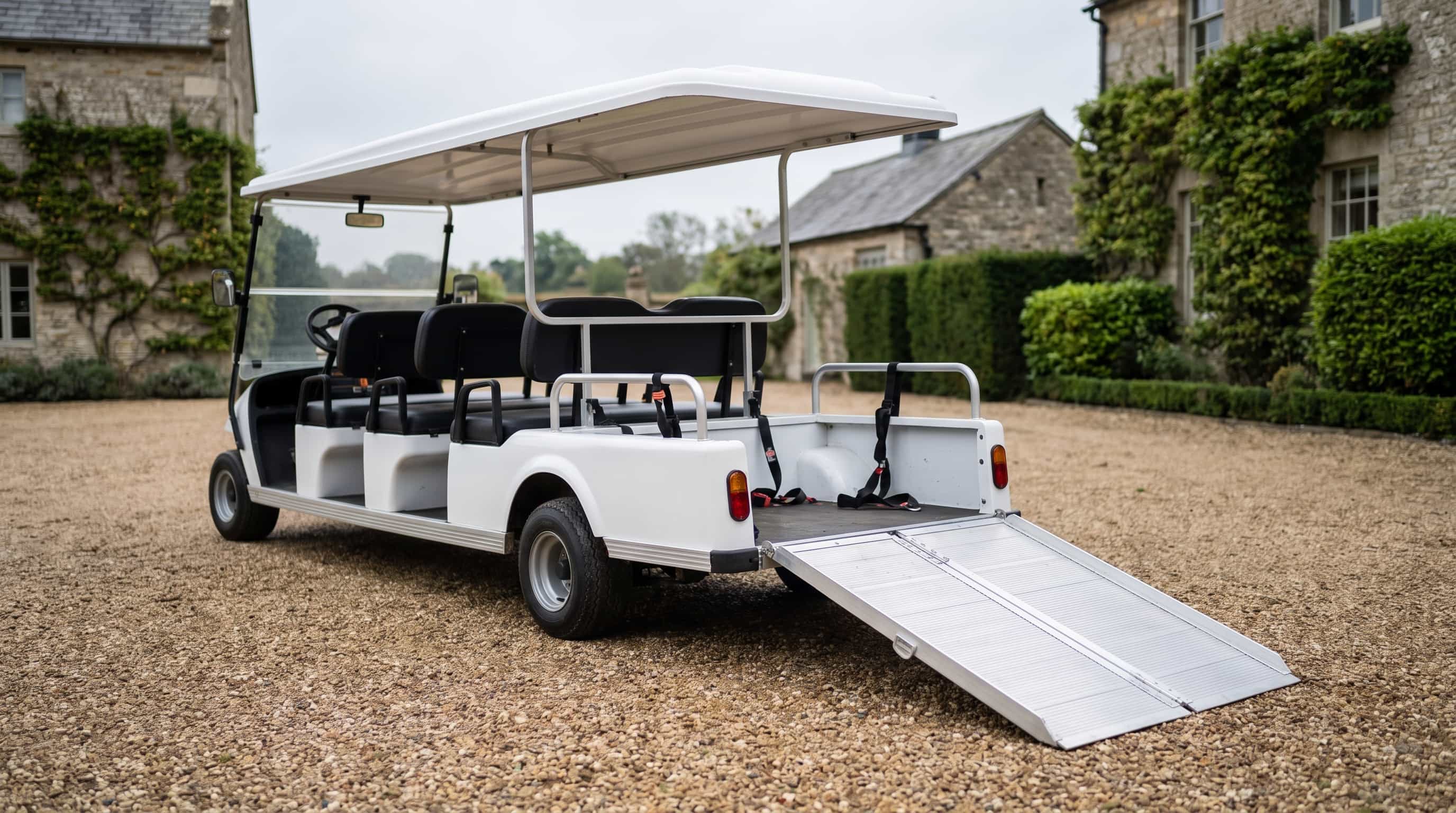
A van gives you an enclosed, lockable, dry cube. A buggy gives you an open bed and a set of tie-down points. That difference decides more jobs than payload ever does, because a great deal of what large sites move is bulky and light rather than dense and heavy: bedding, bagged waste, packaging, planting, signage, event kit. Those loads fill a bed quickly and then need a second trip, and second trips are where the buggy's running-cost advantage quietly disappears.
Dense loads are a different discussion, and neither vehicle is a tipper truck. Both carry a plated payload set by the maker, and on an electric van that payload is not the same as on a comparable diesel, so read the plate on the actual vehicle rather than assuming. Loads that need protecting from weather, from theft or from public view push towards the van regardless of their weight, because a locked cube solves a problem an open bed cannot.
- Bulky and light: bedding, bagged waste, packaging, planting, signage, event and marquee kit.
- Dense and heavy: aggregate, paving, water, salt, tools in quantity, anything delivered on a pallet.
- Needs to stay dry or locked: linen, catering, electronics and tools left unattended at the far end.
- Awkward shapes: ladders, trestles, long timber and rolled goods, which often decide the vehicle on their own.
The public road question
This is the boundary that no amount of specification crosses. A van is registered, taxed, insured and inspected for road use as a matter of course. A buggy generally is not, and turning one into a road vehicle is an approval and registration project handled through DVLA rather than an accessory you order with the machine. Anybody who tells you a set of lights and a mirror makes a buggy road legal has skipped the part that matters.
Be careful with the word road as well. The requirements bite on roads and in other public places, and a service road, an estate lane or a car park that the public can reach may count as a public place even though you own the land. Crossing a road at a single point is still road use. The authoritative answers here come from DVLA on registration and approval, and from your own insurer on what your policy actually covers.
Where the road is the only obstacle, look at the alternatives before buying a van to solve it. A new gate, a permissive route agreed with a neighbouring landowner, a signalled crossing point, or a small trailer to move the buggy between parcels of land are all cheaper than a vehicle. Sometimes none of them work and the van is simply the answer, which is a fine conclusion to reach once the cheaper options have been tested.
Drivers, licensing and what it does to the rota
A van needs a driver who holds the right licence and who your insurer is prepared to cover, and those are two separate hurdles. The licence categories and their conditions are DVLA's to state, and the cover is your broker's to confirm in writing. Age, endorsements, time held and residency all come into it, and seasonal or agency staff are frequently excluded by a policy that looks generous at first reading.
The practical effect lands on the rota. If only two people on site can lawfully and insurably drive the van, the van becomes a bottleneck and the job queues behind those two names. A buggy fleet used on private ground has fewer external gates, though the employer's own duties remain: competence, induction, supervision and a written site policy on who drives what and where. The Health and Safety Executive publishes guidance on workplace transport that is a sensible basis for that policy.
It is worth writing the driver list down for both vehicles and looking at it honestly. A vehicle only half your team can use is a vehicle doing half the work you bought it for, and that constraint tends to be invisible until the week somebody is on leave. Write that list as names against vehicles rather than as job titles, because job titles hide the gaps.
Working out what this costs for your own event? Tell us the venue and dates and you will have an itemised written quote within one working hour.
Charging, parking and the electrical supply
Buggy charging is usually a modest business: the charger supplied with the machine, a suitable socket in a store or bay, ventilation appropriate to the pack chemistry, and a qualified electrician confirming the circuit is fit for the load and the duty. Lead-acid packs need ventilation and produce gas as they charge, which is a real design requirement for the room rather than a formality. Think about where each vehicle sleeps as well, since cable routes across pedestrian ground and out-of-hours access to the charge point shape what actually happens.
Van charging is a different order of work. It involves a dedicated installation, an assessment of the incoming supply, and usually the building owner and the network operator as well as the electrical contractor. That takes time and money that belongs in the comparison from the start, and on a leased site it may need a landlord's consent that is far from automatic. Get a survey before you commit to the vehicle, not after it arrives.
Surfaces, access and the damage a van does
Weight goes somewhere. A van crossing wet grass leaves ruts that need reinstating, and on block paving, drainage covers, service ducts and older bridges or culverts its weight is a question worth asking rather than assuming. Estates and campuses with historic surfaces often have route restrictions already written down, and those restrictions were usually written after somebody learned this lesson expensively. Map the routes that only one of the two vehicles can use, because an exclusion covering a large slice of the site answers the question on its own.
Physical access matters just as much. Gate widths, turning space, low arches, bollards and courtyards decide where a van can go, and a buggy simply goes where a van needs a three-point turn and a banksman. On shared surfaces with pedestrians, a smaller and slower vehicle is easier to manage, easier to see past and less intimidating to the people it passes, which is not a trivial consideration on a hospital or campus site.
The answer most large sites reach
Most sites that go through this properly end up with both, allocated by task. The van takes the road-touching journeys, the bulky deliveries, the loads that must stay dry or locked, and the runs that carry a crew and their kit across the site in bad weather. The buggies take the internal rounds: inspections, housekeeping, maintenance call-outs, moving people, moving hand tools, and the constant small jobs that make up most of a working day.
The way to get there without guessing is to log journeys for a fortnight. Record what was carried, how far, over what ground, whether the route touched a road, and whether the load needed cover. Sort the log by constraint at the end and the shape of the fleet appears from the data rather than from a debate in a meeting.
Sequence it sensibly as well. Hiring before buying puts a real machine on your real ground with your real crew, which is worth more than any comparison exercise. Sites that do this usually find the buggy count grows over time while the van count stays flat, because once the internal work is properly covered, the van is only ever asked to do the things only a van can do.
Common questions
- Can we drive a golf buggy on a public road between parts of our site?
- Not unless that particular vehicle has been through approval and registration and is insured for road use. Fitting lights and mirrors does not achieve it. Take the answer from DVLA on approval and registration and from your insurer on cover, and remember that estate roads and car parks the public can reach may count as public places even where you own the land.
- Is an electric van cheaper to run than a buggy?
- Per journey, no. A heavier vehicle uses more energy to move the same load the same distance, and it costs more to tax, insure, service and tyre. The van earns its place by doing work the buggy cannot do at all. Compare them on the jobs each will actually be given, and use your own energy and servicing records rather than published averages.
- How many buggies replace one van?
- That question usually points at the wrong constraint. If the binding limit is road access or the need for a locked, dry load space, no number of buggies replaces the van. If the limit is simply trips per hour on internal ground, then extra buggies genuinely do help, and they help most when they remove queueing rather than adding capacity nobody uses.
- What charging do we need for a buggy?
- Normally the charger that came with the machine, a suitable socket in a bay or store, and ventilation appropriate to the pack. Have a qualified electrician confirm the circuit suits the load and the hours involved, and follow the maker's instructions on charging and on the room. Lead-acid packs need ventilation because they give off gas while charging.
- Can seasonal or agency staff drive the van?
- Your insurer decides that, not you, and the answer is often narrower than people expect. Ask your broker for confirmation in writing of who is covered, including age and licence conditions. Then check the same question for the buggies under your public liability and any specific vehicle cover, because assumptions about private ground are where claims come unstuck.
- Will a van damage our grounds?
- On wet grass and soft ground, very likely, and reinstating ruts costs labour and closed ground rather than parts. Older paving, drainage covers, service ducts and small bridges deserve a check as well. Many sites solve it by keeping the van on hardstanding and letting a lighter machine take the last leg across grass, which is a sensible split rather than a compromise.
Ready to get a price
Tell us about your event and we will send an itemised written quote within one working hour.
Related pages
Related guides
 How to choose the right golf buggy for hire7 minute read
 Golf buggy or tow tractor for moving loads11 minute read
 Golf buggy or e-bike for staff transport11 minute read
 Golf buggy or UTV for grounds work11 minute read
 Writing a transport plan for a large site7 minute read
 Golf buggy versus minibus for guest transport5 minute read