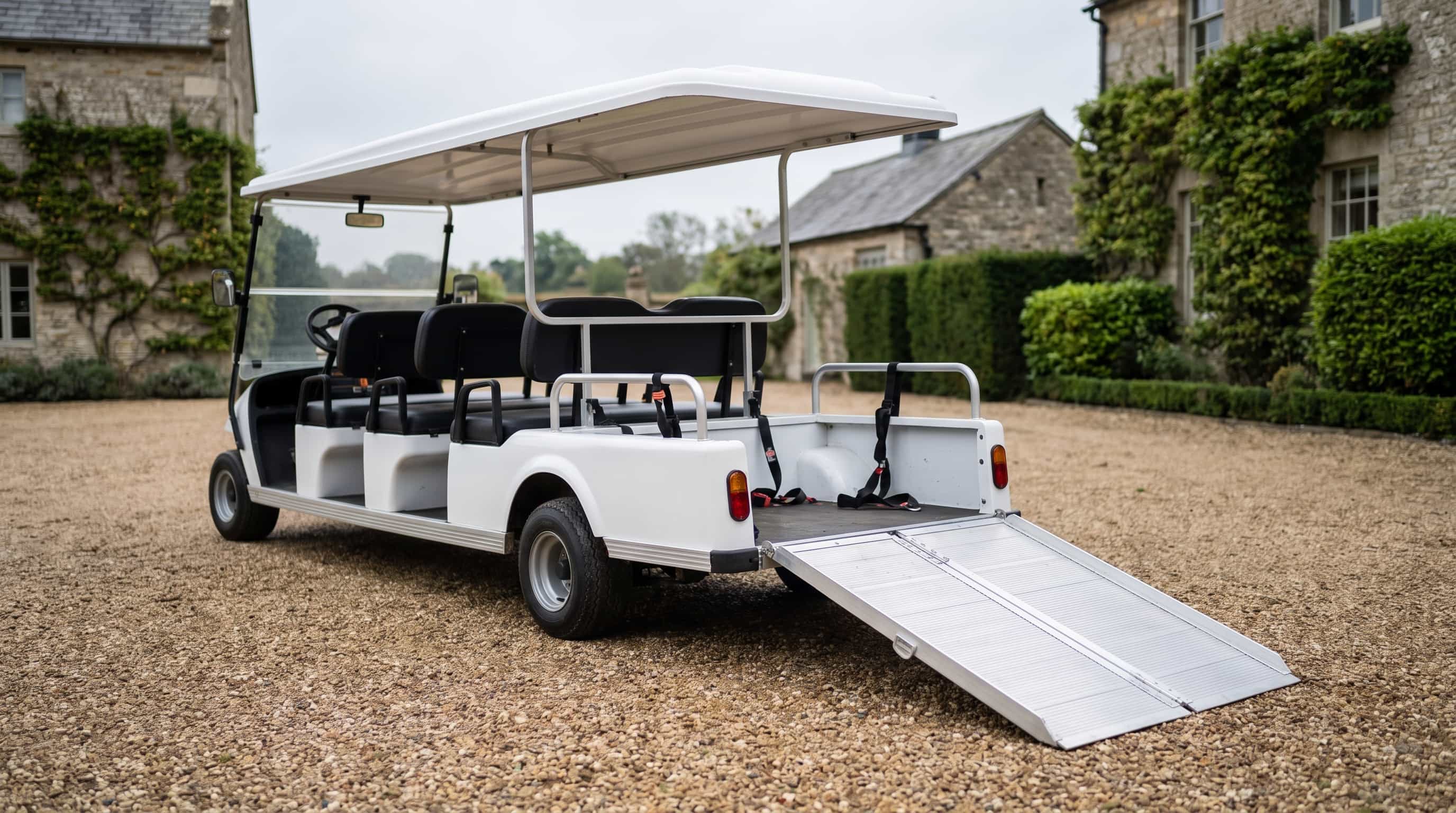
Golf buggies for elderly and disabled wedding guests
By James Brown · Updated 21 July 2026 · 7 minute read

A golf buggy looks after the elderly and less mobile guests a spread-out wedding would otherwise tire or exclude. The skill is offering it thoughtfully, to the guests who need it without embarrassing them, and having it ready for the guests whose difficulty you did not know about in advance.
Key takeaways
- Every wedding has guests the distance tires, not only wheelchair users.
- Offer the buggy warmly and generally so no one feels singled out.
- Some guests hide their difficulty, so have the buggy visible and available to all who want it.
- A calm, unhurried driver matters as much as the vehicle.
- Think about hearing, sight and confidence, not just walking.
It is more than wheelchairs
Start by widening who you are thinking about. Wheelchair users need specific provision, but they are a small part of the group the distance affects. Far more numerous are the guests who walk but struggle: the elderly, anyone with a heart or lung condition, a guest with arthritis or a bad back, someone heavily pregnant, a friend on crutches. None of them would describe themselves as disabled, and many would be mortified to be treated as such, but all of them would be glad of a lift and grateful not to have to ask for one.
So plan the buggy for the whole range, not just the obvious cases, and think of it as looking after your older and less mobile guests generally rather than as a disability measure. That framing changes how you offer it.
Offer it so no one feels singled out
The delicate part is that the guests who most need help are often the least willing to admit it. An older relative who does not want to be a nuisance will walk a distance that hurts rather than ask for a buggy, and singling them out, sending a driver to fetch "the guests who can't manage", can embarrass the very people you are trying to help.
The way round this is to make the buggy visible, general and normal. Have it running an obvious loop that anyone can hop on, mention in the order of the day or on a sign that a buggy is available for anyone who would like a ride, and let guests use it without having to declare a reason. When the buggy is just there, cheerfully carrying whoever wants a lift, the guest who needs it can take it as easily as the guest who fancies it, and no one is marked out. Discretion is the whole art of it.
Have it ready for the guests you did not know about
However well you plan, there will be guests whose difficulty you did not know about: the relative who did not mention their knee, the plus-one on crutches, the guest who felt fine that morning and is flagging by the evening. A buggy that is visible and available to all covers these people automatically, which is another reason to run it openly rather than as a booked service for named guests. Good accessible provision quietly catches the needs you did not anticipate.
Working out what this costs for your own event? Tell us the venue and dates and you will have an itemised written quote within one working hour.
The driver matters as much as the buggy
A guest being helped onto a buggy remembers how it was done more than the ride itself. A driver who is calm, patient, waits while an older guest settles, offers a hand without insisting, and does not rush, turns a lift into a kindness. One who is hurried or awkward makes the guest feel like a task. If you take a trained driver from us, this is part of what you are paying for; if a friend or the venue drives, brief them to take the older guests gently and at their pace.
Think beyond walking
Finally, remember that looking after less mobile guests is not only about legs. An older guest may struggle to hear where to go, to see a dark path at the end of the night, or to feel confident crossing unfamiliar ground. A driver who speaks clearly, a lit buggy for the evening, and a bit of reassurance all count. Caring for these guests is a rounded thing, and the buggy is the most visible part of it, but the attitude around it is what they will remember.
Common questions
- How do we offer a buggy without embarrassing older guests
- Make it visible, general and normal, running an obvious loop anyone can use, and mention in the order of the day that a buggy is available for anyone who would like a ride. When it is just there for whoever wants it, the guest who needs it can take it as easily as the guest who fancies it, and no one is singled out.
- Is a buggy only for guests in wheelchairs
- No, and most of the guests it helps are not. Far more numerous are those who walk but struggle: the elderly, anyone with a heart or lung condition, arthritis, a bad back, a pregnancy or an injury. Plan the buggy for that whole range, not just the obvious cases.
- What about guests whose difficulty we did not know about
- A buggy run openly and available to all covers them automatically, which is a good reason not to make it a booked service for named guests. There are always people whose difficulty surfaces on the day, a bad knee, crutches, someone flagging by the evening, and a visible buggy quietly catches those needs.
- Does it matter who drives
- A great deal. A guest remembers how they were helped onto the buggy more than the ride. A calm, patient driver who waits and offers a hand without insisting turns a lift into a kindness. Brief whoever drives to take older guests gently and at their pace, or take a trained driver from us who does this by habit.
Ready to get a price
Tell us about your event and we will send an itemised written quote within one working hour.